

They threw the garbage bag on a Tuesday morning in 2009. I was fifteen. It burst against my chest like a rotten heart: fish heads, used diapers, sour milk. The laughter that followed was louder than the school bell. Phones rose like a firing squad. That was the day I made a vow: On graduation day, every single one of them would lower their eyes.
My name is Trần Minh Khang. My mother collects trash for the city.
For fifteen years they had the same nicknames ready: “Thằng con bà ve chai.” “Đồ hôi rác.” “Mẹ mày bới rác kiếm ăn như chó.”
Middle school: half-eaten lunches dumped into my desk drawer. High school: the soccer team filmed the garbage-bag “prank” in slow motion, added circus music, got 40,000 views before the principal forced them to delete it. University: the cruelty got expensive haircuts and better vocabulary. “Scholarship kid, right? Must be nice having tuition handed to you.” “How does it feel knowing you only got in because of poverty points?”
I never answered back. I swallowed every word, every laugh, every video. I cried only when the nights my mother was already asleep, her breathing rough from dust and exhaustion, her hands cracked open like old leather.
She never knew. I made sure of it.
Then came graduation day.
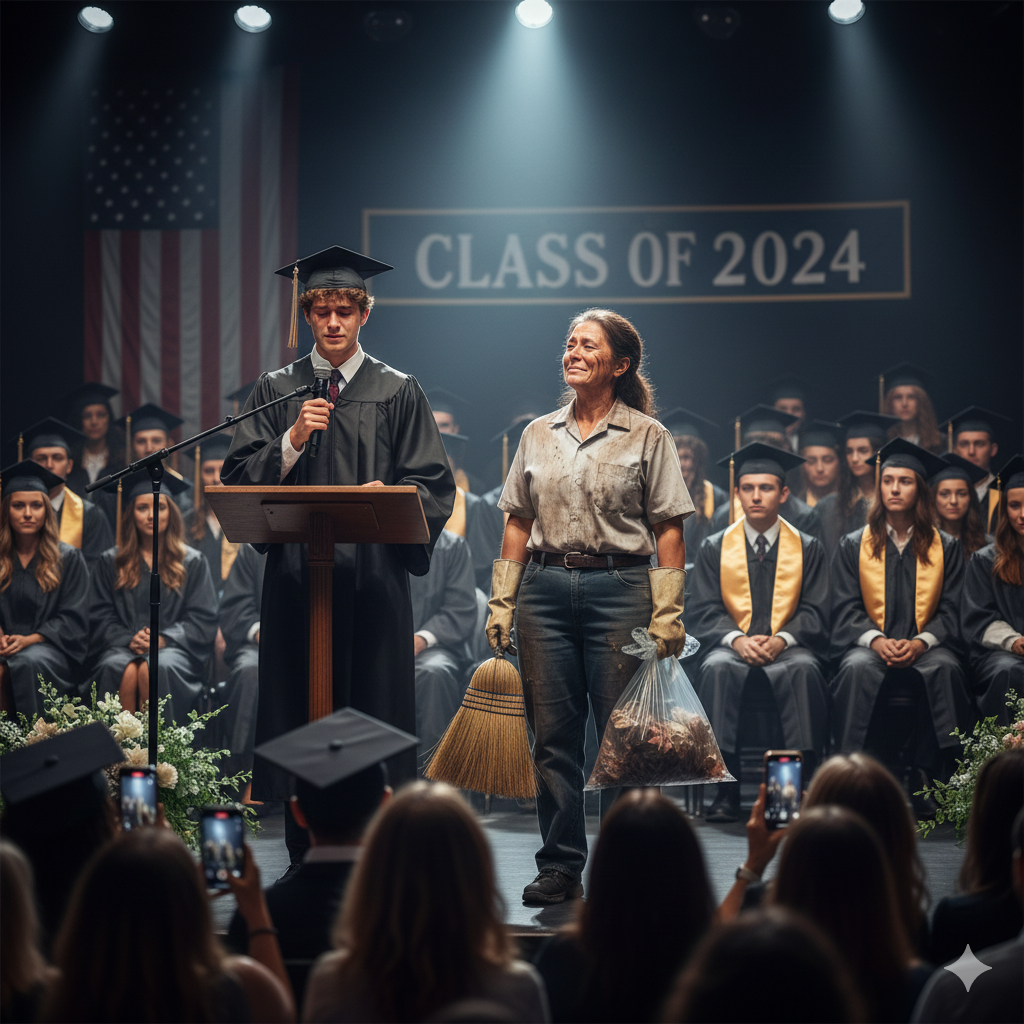
The auditorium smelled of money: perfume, new leather shoes, camera flashes. I walked across the stage in the black valedictorian gown they said I didn’t deserve, and I saw her standing at the very back, pressed against the exit door as if trying to take up no space at all.
Orange municipal uniform, three sizes too big. Plastic sandals repaired with wire. Hands hidden behind her back so no one would see the sores.
Someone behind me whispered, “Jesus, she actually came dressed like that.”
I felt the old rage rise, hot and familiar. The speech in my pocket shook in my hand.
The MC called my name. Applause thundered (polite, shocked, maybe a little unwilling).
I stepped to the microphone. Looked straight at the rows of faces that had mocked me for fifteen years. And I said the sentence I had practiced in my head since the day the garbage bag exploded across my chest:
“Today I stand here not because I am better than any of you, but because the woman you called trash for fifteen years just paid for this entire auditorium with the bottles and cans you threw away.”
Dead silence.
You could have heard a diploma drop.
Some mouths actually opened. A few people in the front row looked at their shoes like they wished the floor would swallow them.
My mother made a small sound (half sob, half laugh) and slid down the wall into a plastic chair, hands over her face.
I stepped off the stage.
The crowd parted like I was contagious.
She met me halfway down the aisle, moving faster than I had ever seen her move. She didn’t hug me (too many people, too much shame). Instead she grabbed my wrist with her rough, bleeding fingers and pressed something cold and heavy into my palm.
A rusted biscuit tin, wrapped in layers of old tape, the kind that once held butter cookies at Tết.
“I kept this for you,” she whispered, voice cracking, “since the very first day they laugh at you. I want give you when you taller than all of them.”
My legs almost gave out.
I knelt right there on the polished auditorium floor, gown pooling around me, and opened the tin with shaking hands.
Inside was not money. Not gold. Not jewelry.
It was hundreds (thousands) of plastic bottle caps, aluminum pull-tabs, scraps of copper wire, broken pieces of motherboard, anything with deposit value or scrap value that people throw away.
Every single piece had been washed clean. Sorted by hand. And on the inside of the lid, in my mother’s careful, childish handwriting:
For Khang’s future So he never has to smell garbage again – Mẹ
Under the metal mountain lay a folded paper, yellow with age.
A bank book.
Balance: 3,847,000,000 VND. Almost 160,000 USD. Saved five thousand đồng, ten đồng at a time. From bottles collected after midnight shifts. From copper stripped from broken appliances rich people tossed on the curb. From aluminum cans flattened and carried home in rice sacks so heavy she had to rest every ten meters.
Fifteen years of silent war.
I couldn’t breathe.
I looked up at her (my tiny, bent mother in her dirty uniform) and for the first time in my life I cried in public.
She tried to wipe my face with her sleeve, then remembered it was filthy and pulled back, ashamed.
I caught her hand and held it against my cheek anyway.
Then I stood.
I stood, turned to the microphone that was still live, and held the tin high so the entire hall could see.
“This,” I said, voice raw, “is what love looks like when the world teaches you you’re worthless. This is sixty billion đồng worth of garbage that bought your children’s tuition, your children’s children’s tuition. My mother collected it one piece at a time while you laughed.”
I looked straight at the soccer-team table (grown men now in suits, faces pale).
“Remember the video you made in tenth grade? My mother sold the aluminum from the energy-drink cans in that video to pay for my textbooks that year.”
A woman in the third row began sobbing openly.
I turned to the professors who had once suggested I “consider a trade school.”
“Every time you told me I didn’t belong here, she was up at 3 a.m. sorting plastic so I could.”
Then I did the thing that broke the room completely.
I walked back to my mother, took off my valedictorian medal (heavy gold, university crest), and hung it around her neck.
The medal fell almost to her waist.
I knelt again, this time in front of everyone, and pressed my forehead to her cracked, bleeding hands.
The auditorium erupted (not in applause, but in something deeper). People stood without knowing why. Some cried. Some hid their faces.
When I finally stood, I raised her hand (the hand that had bled for me every night) high above our heads like a champion.
And every single person who had ever laughed, filmed, whispered, looked down did exactly what I had promised myself fifteen years earlier.
They lowered their eyes.
Later, when the photographers asked for pictures, I refused to pose without her. So the official graduation photo shows me in the black gown, my mother in her orange uniform, both of us wearing the same medal.
That photograph went viral. Newspapers called it “The Proudest Mother in Vietnam.”
We never went back to the tiny rented room.
With the money in the tin and the scholarship I earned, we bought a small apartment in District 1. Sunlight in the morning. A balcony with flowers. A washing machine so she never has to scrub uniforms by hand again.
I started a company that turns waste into building materials. We employ only single mothers and street collectors. Profit margins are thin, but every worker gets health insurance and school fees for their children.
My mother is the chairwoman. She still wears the medal when she visits the factories.
Sometimes, when the night shift ends and the machines are quiet, she walks the floor in her old orange uniform (now clean, now pressed) and touches the bricks made from the same trash that once paid for my future.
She calls them “Khang’s bricks.”
And every year on graduation day, I go back to the old school gate.
I stand exactly where the garbage bag hit me.
I wait until a new group of rich kids walks past, laughing, phones out.
Then I open my hand and let a single clean bottle cap fall to the ground.
It rings like a bell.
Some of them look down.
Some of them understand.
Most never will.
But my mother and I we already won.
Because fifteen years of garbage turned into a future neither of us dared to dream.
And the smell of victory?
It smells like soap, sunlight, and my mother’s hands finally, finally healed.