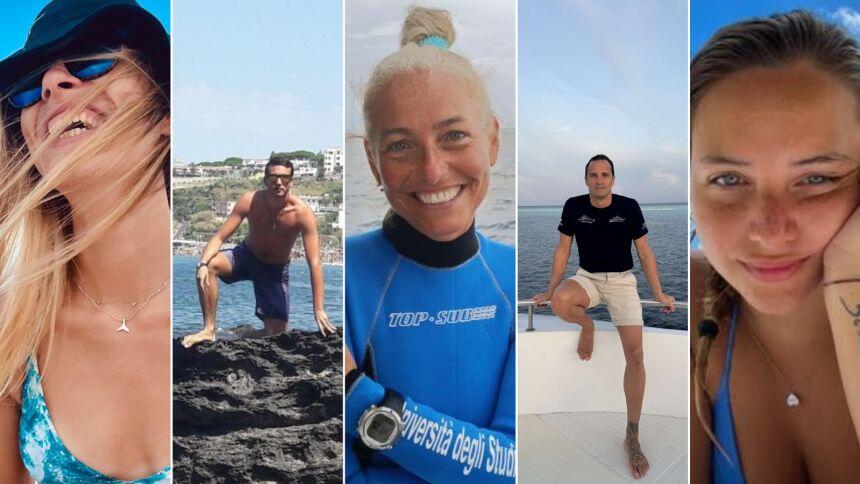
The pristine, turquoise waters of the Maldives are globally renowned as a paradise for luxury travelers and marine enthusiasts, but a unfolding tragedy has cast a dark shadow over the tropical archipelago. Specialized deep-sea recovery teams have reportedly retrieved the remaining bodies of four Italian nationals from the deepest recesses of an infamous underwater cave system in the Vaavu Atoll. The grim discovery brings a devastating conclusion to an international search and recovery operation that has gripped the diving community and claimed the life of a local military rescuer. Yet, as investigators in both Male and Rome begin the arduous task of reconstructing the final moments of the five victims, a chilling detail regarding recovered camera equipment has ignited intense speculation and horror across the internet.
The disaster began when a group of highly respected researchers and a diving instructor vanished during what was supposed to be a standard marine research expedition near Alimathaa Island. The victims included Monica Montefalcone, an associate professor of ecology at the University of Genoa, her daughter Giorgia Sommacal, marine biologist Federico Gualtieri, researcher Muriel Oddenino, and their diving instructor, Gianluca Benedetti. While Professor Montefalcone was celebrated for her meticulous approach to studying coral ecosystems, the team encountered an environment that proved unforgiving even for seasoned academics. The body of Gianluca Benedetti was recovered near the mouth of the cave system on the initial day of the disappearance, but the remaining four individuals were lost deep within the subterranean labyrinth known locally as the Thinwana Kandu or Dhekunu Kandu system, often referred to by divers as the shark cave due to the high concentration of marine predators frequenting its entrance.
Penetrating the cave system required elite specialized skills, leading to a temporary suspension of local efforts after Sergeant Major Mohamed Mahudhee of the Maldives National Defence Force tragically died of decompression sickness during an early rescue attempt. To navigate the treacherous conditions, the Maldivian government coordinated with international experts, bringing in an elite team of Finnish technical cave divers equipped with closed-circuit rebreathers and advanced underwater propulsion vehicles. These specialists managed to push through the pitch-black, confined chambers to a depth of approximately sixty meters, eventually locating the four missing researchers clustered together in the third and deepest chamber of the cave network.
While the physical recovery of the remains provides somber closure for the families, the focus of the investigation has rapidly shifted to the data recovered from the scene, particularly a submersible camera belonging to one of the researchers. Legal regulations in the Maldives strictly limit recreational diving to a depth of thirty meters, meaning the team had descended nearly twice the permissible limit into a highly complex, overhead environment without technical cave-diving gear. International media outlets and diving forums have exploded with reports that the final moments of footage captured on the camera reveal a deeply unsettling sequence of events before abruptly cutting to black, leaving internet audiences horrified by the implications of the recording.
According to sources close to the initial forensic review of the equipment, the disturbing nature of the video does not stem from a sensationalized marine animal attack, as the moniker of the shark cave might initially suggest to the public. Instead, investigators describe a psychological horror that underscores the absolute peril of deep, untrained cave penetration. The footage allegedly documents the insidious onset of nitrogen narcosis, an alteration in consciousness that occurs when breathing nitrogen at high pressure, which experts often compare to severe alcohol intoxication. In the confined, silt-heavy space of the third chamber, the video reportedly shows the divers becoming profoundly disoriented, losing their sense of direction, and mismanaging their remaining air supply as panic swept through the group.
The most agonizing aspect of the footage reported by investigators involves the complete loss of visibility caused by a phenomenon known as a silt-out. As the disoriented divers accidentally kicked up the fine sediment resting on the cave floor with their swim fins, the crystal-clear water instantaneously transformed into a dense, blinding cloud of mud. In an overhead environment where there is no direct ascent to the surface, a silt-out obliterates all visual cues, rendering high-powered dive lights entirely useless. The recording allegedly captures the frantic, blinding confusion as the researchers attempted to find the narrow exit passage connecting the third chamber back to the safety of the outer reef, only to exhaust their breathing gas while trapped in total darkness.
The circulating reports regarding the camera contents have sparked a massive wave of commentary online, with millions of viewers expressing a mixture of grief and terror at the sheer claustrophobia of the scenario. For many, the realization that highly educated marine scientists could succumb so rapidly to a chain of environmental hazards serves as a stark reminder of human vulnerability in the deep ocean. Technical diving experts online have utilized the tragedy to emphasize the critical importance of specialized training, noting that entering a cave without a continuous guideline connected to the open ocean is almost universally fatal once visibility is lost.
Official agencies have urged the public to exercise restraint and avoid spreading unverified rumors as the formal investigation continues. The Maldives Ministry of Tourism and Civil Aviation has already suspended the operating license of the liveaboard vessel involved in the excursion pending a comprehensive review of how a recreational research trip devolved into an unauthorized deep cave exploration. Italian prosecutors have likewise opened an inquiry to determine if organizational negligence contributed to the deaths of their citizens, looking into whether the divers were properly briefed on the structural dangers of the Vaavu Atoll caves.
As the bodies are prepared for repatriation to Italy, the shockwaves of the Maldives diving tragedy continue to reverberate through both the scientific and global diving communities. The final report by international aviation and maritime investigators will take months to officially compile, utilizing data from recovered dive computers to map out the exact depth profiles and breathing gas consumption rates of the victims. For now, the digital world remains captivated and sobered by the haunting legacy of the final footage, a tragic testament to the fine line between scientific exploration and catastrophic miscalculation in the shadows of the deep sea.
Để lại một bình luận