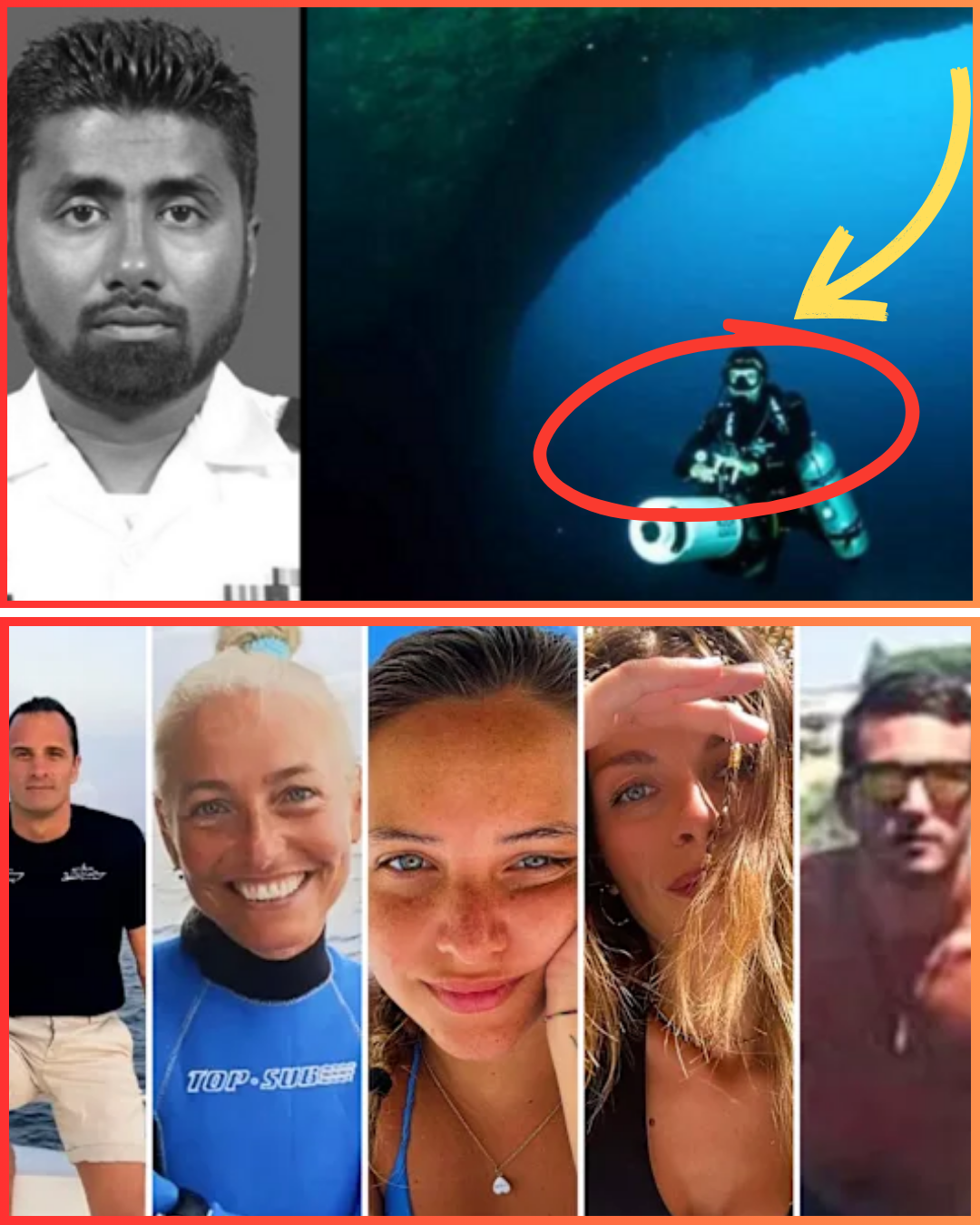
A deep-sea excursion in the Maldives has shifted from a heartbreaking tragedy into a major maritime controversy. Emergency teams confirmed that the divers dropped nearly 200 feet underwater — a depth that pushes the absolute limits of recreational diving safety — and never returned to the surface. However, the investigation took a baffling turn when recovery teams inspected the equipment. Reports reveal that all tanks still contained measurable pressure, completely shattering initial assumptions about equipment failure or a sudden lack of air. “They had breathing gas left,” a marine safety expert noted, “which means the reason they failed to ascend is far more unsettling than anyone anticipated.”
The specific computer log data recovered from the lead diver’s wrist gauge, which shows a sudden, synchronized descent during the final three minutes of the dive, is actually raising even more alarming questions about what really happened inside the Shark Cave at Vaavu Atoll on May 14, 2026. Professor Monica Montefalcone, her 20-year-old daughter Giorgia Sommacal, researcher Muriel Oddenino, marine biologist Federico Gualtieri, and diving instructor Gianluca Benedetti had set out on what was supposed to be a scientific exploration of the underwater cave system known as Devana Kandu. According to sources close to the joint Italian-Maldivian investigation, the dive computers indicate the group was initially at safer depths before a rapid and coordinated drop deeper into the labyrinth occurred in the closing stages, taking them close to or beyond 200 feet in an environment filled with powerful down-currents, silt, and narrow passages.
This discovery has intensified scrutiny on the entire operation. With oxygen still available in the tanks, experts are now focusing on other potential causes such as severe nitrogen narcosis at extreme depth, which can impair judgment and create a dangerous sense of euphoria or confusion, leading divers to venture deeper instead of ascending. Another theory involves a sudden environmental factor, such as a strong current that pulled the group uncontrollably deeper, combined with possible silt-outs that caused total disorientation and panic. The synchronized descent logged on the computers suggests the team may have stayed together as conditions worsened, possibly following one another in the low-visibility tunnel rather than executing a safe ascent protocol.
The presence of remaining gas has also shifted attention toward the divers’ decision-making, training levels, and the suitability of their equipment for such an overhead cave environment. The group, primarily using recreational setups rather than full technical cave diving configurations with multiple redundant tanks, guidelines, and specialized reels, reportedly exceeded the limits approved by the liveaboard operator. Initial assumptions about carbon monoxide poisoning or empty tanks have been largely ruled out by the forensic examination of the recovered equipment, leaving investigators to examine everything from thermal protection failures in the cold deep water to possible entanglement or task overload in the confined space. One body, that of instructor Gianluca Benedetti, was found closer to the entrance, potentially while attempting to guide the others out, while the remaining four were located deeper inside a chamber.
This new evidence has sparked fury among the diving community and the victims’ families, who are demanding full transparency about how an experienced team including a renowned University of Genoa professor ended up in such a perilous situation. Monica Montefalcone was known for her extensive diving experience and passionate advocacy for ocean conservation, yet the computer data paints a picture of a dive that spiraled rapidly out of control in the final moments. The tragedy also claimed the life of Maldivian rescue diver Staff Sgt. Mohamed Mahudhee, who died from decompression sickness during the challenging recovery operation that required specialist Finnish cave divers to navigate the hazardous conditions.
As frame-by-frame analysis of any available footage and detailed examination of the dive logs continue, the case is highlighting critical failures in risk assessment for deep cave penetrations in remote locations. The ocean that these scientists sought to study and protect became an unforgiving trap, where having oxygen in the tanks was not enough to guarantee survival against the combined forces of depth, darkness, current, and human error. The investigation is now expected to examine the liveaboard’s gas blending procedures, the divers’ certification levels for technical diving, and whether group dynamics or scientific curiosity pushed them beyond safe boundaries.
The synchronized descent recorded in those final three minutes remains the most haunting clue — a digital footprint of five passionate explorers facing a nightmare from which they could not escape. What began as laughter and excitement aboard the boat ended in silence deep within the cave, leaving the world to wonder how so much breathing gas could remain while lives were lost. This developing scandal is forcing the entire scuba industry to confront uncomfortable questions about oversight in luxury liveaboard operations and the dangers of blending recreational diving with high-risk scientific exploration in one of the planet’s most beautiful yet deadly underwater environments.
The full findings of the official inquiry are awaited with intense anticipation, as the presence of oxygen in the tanks has transformed this from a simple accident into a complex puzzle that may reshape safety standards for cave diving worldwide. The five Italians ventured deep in pursuit of knowledge, only to encounter forces far greater than anticipated in those narrow, silt-filled passages. Their story continues to serve as a somber and evolving reminder of the ocean’s immense power and the razor-thin line between discovery and disaster.
Để lại một bình luận