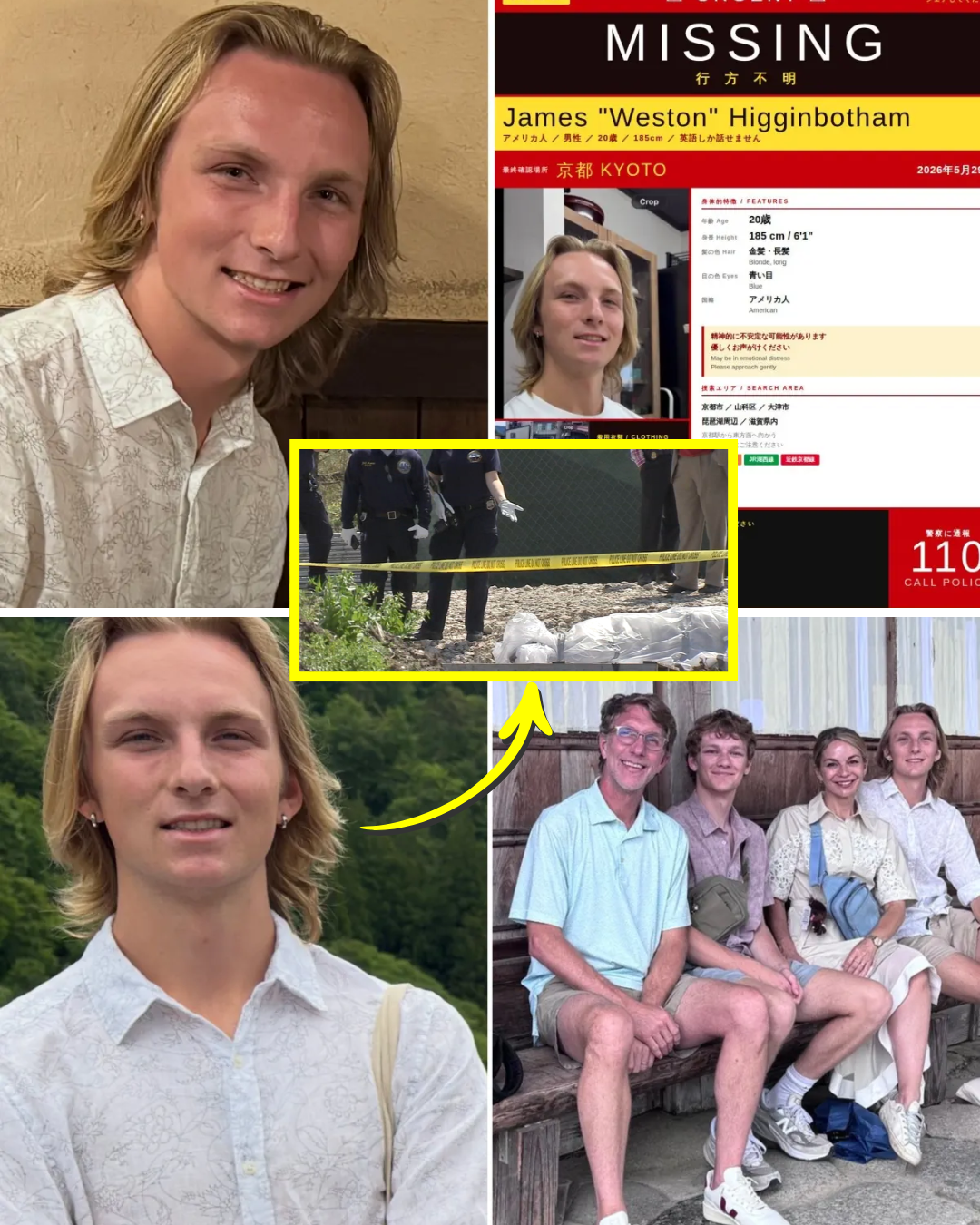
The tragic and heartbreaking search for James “Weston” Higginbotham, a 20-year-old junior from Auburn University, came to a devastating end when his body was discovered by a volunteer search-and-rescue team in a rugged, mountainous area just outside Kyoto, Japan. What makes this loss profoundly haunting for his grieving family and the local rescue teams is not just the suddenness of his passing, but the painful sequence of events and the severe environmental challenges that ultimately defined his final days. The young engineering student, who had traveled to Japan with his family to celebrate his younger brother’s high school graduation, vanished into a dense and unforgiving forest following a deeply emotional, idealistic disagreement that has left his loved ones grappling with unimaginable sorrow and a complex, haunting grief.
To fully understand the weight of this tragedy, one must look at the unique values and passion that guided Weston’s life. As a biosystems engineering student, Weston was a deeply committed naturalist and an ardent environmentalist whose personal ethics influenced every aspect of his daily routine. He lived as a strict vegan and practiced an intense form of pacifism, with his mother noting that he refused to harm even small insects, choosing instead to gently carry them outside. His academic and personal world revolved around the sustainability of natural systems, which fueled a growing and passionate opposition to the rapid expansion of artificial intelligence. Weston was profoundly troubled by the massive ecological footprint of large language models, specifically the vast amounts of electricity and water resources consumed by AI data centers, viewing the technology as a direct threat to the natural world he so deeply cherished.
This deep-rooted conviction became the unexpected catalyst for his disappearance during what was supposed to be a joyous family vacation. While exploring the historic city of Kyoto, an argument broke out between Weston and his mother regarding her frequent use of ChatGPT to assist with trip navigation, restaurant recommendations, and daily itineraries. For Weston, the reliance on the AI tool felt like an ideological betrayal of his sustainability principles, transforming a routine travel tool into a point of intense emotional friction. His mother later characterized the dispute as a tragic, minor misunderstanding born out of the stress of navigating a foreign country, but for Weston, the frustration prompted a need for personal space. Following the argument, he chose to step away from his family to clear his head, a retreat that was entirely consistent with his peaceful nature whenever he felt overwhelmed or upset.
In the hours following the disagreement, digital tracking offered a fleeting and deceptive sense of security before the situation turned dire. The Higginbotham family relied on a location-sharing application to keep tabs on one another while traveling, and the software initially showed Weston moving near a local river and subsequently boarding a train alone. Surveillance footage later captured him arriving at Yamashina Station on the eastern outskirts of Kyoto, a known gateway to popular but incredibly dense mountain hiking trails. Shortly after his arrival in the area, Weston’s phone went dark and his location services stopped updating, preventing any further digital tracking. His family initially believed he had simply turned off his device to immerse himself in nature and truly unplug, an assumption that unfortunately masked the escalating danger as night fell over the unfamiliar terrain.
The subsequent search operation quickly became an exhausting race against time, severely hindered by hazardous, extreme weather conditions. As soon as the family realized Weston was truly missing, Japanese authorities launched a massive, coordinated rescue effort that deployed over one hundred police officers, specialized canine tracking units, and helicopters to scour the Yamashina district. However, the search coincided with the arrival of a severe regional storm system linked to an active typhoon, which unleashed torrential downpours across the region. The dense forest trails rapidly deteriorated into treacherous paths, with search-and-rescue teams forced to wade through waist-high mud and navigate slick, steep inclines in near-zero visibility. Despite a thorough three-day sweep of the primary designated areas, the official police search concluded without finding any trace of the missing student, leaving the family in a state of absolute desperation.
Refusing to abandon hope, Weston’s parents initiated a private, community-led search effort, financing professional rescue crews and rallying local Japanese volunteers to explore the uncharted sections of the Yamashina wilderness. It was this dedicated volunteer group that eventually discovered Weston’s body in a remote, deeply forested sector of the mountains, bringing a sudden and devastating end to the week-long ordeal. While official authorities have not publicly released a specific cause of death or detailed the exact physical state in which he was found, the context of his discovery points to a deeply heartbreaking reality. The combination of dense, confusing terrain, a total lack of food resources, and days of exposure to relentless typhoon rains created an environment that was nearly impossible to survive, suggesting that the young naturalist succumbed to the very elements of Mother Nature he spent his life trying to protect.
The emotional aftermath of the discovery has left a profound mark on the rescue workers and volunteers who labored tirelessly through the storm. For many of the local searchers, the knowledge that a young man had traveled halfway around the world only to lose his life in the isolated woods of Kyoto was a heavy burden to bear, made even more poignant by the peaceful, nature-loving character described by his family. The tragic irony that a passionate defender of the environment was ultimately overcome by the wilderness has added a layer of profound existential sadness to the case, haunting the minds of those who pulled him from the mountain. The shared trauma has forged an emotional bond between the grieving American family and the local Japanese community that united in the frantic effort to bring Weston home.
In a moving statement shared on social media, Weston’s mother expressed the paralyzing grief that has consumed their family, while extending deep gratitude to the global community that supported their search. She noted that the outpouring of kindness, prayers, and encouragement from people across both the United States and Japan had been the only force carrying them through the darkest period of their lives. Reclaiming the narrative of her son’s life, she emphasized that Weston should be remembered for his sweet, precious soul, his unwavering kindness, and his dedication to creating a more sustainable world, rather than the tragic final argument that preceded his walk into the woods. The family has since requested strict privacy as they begin the agonizing process of navigating a future without him and preparing to transport his remains back to Alabama.
The legacy of Weston Higginbotham stands as a sobering reminder of the fragile boundary between human conviction and the harsh realities of the natural world. His tragic passing underscores the deep emotional intensity with which the younger generation experiences concerns over technology, environment, and the future of the planet, sometimes leading to profound personal isolation. As the Auburn University community and his loved ones mourn an incredibly bright, compassionate life cut short at just twenty years old, the story remains a haunting tale of a minor dispute that spiraled into an irreversible tragedy amid the dense forests of Kyoto. The daily reality for his family is now a long journey of grief, forever marked by the memory of a young man who loved nature so deeply that he sought its solace, only to be claimed by its unforgiving power.
Để lại một bình luận