
The first-degree murder trial of Karmelo Anthony in McKinney, Texas, has reached a critical juncture, bringing intense national scrutiny and raw emotional confrontation to the Collin County Courthouse. Anthony stands accused in the fatal April 2, 2025, stabbing of seventeen-year-old Austin Metcalf during a rain-drenched district track meet at Kuykendall Stadium in Frisco. As the prosecution rested its case after calling twenty-one witnesses, the introduction of graphic evidence and highly emotional footage transformed the secure, camera-free courtroom into an arena of profound grief. Among the most harrowing pieces of evidence presented to the jury was a thirty-minute police bodycam recording, a piece of digital documentation that has sparked widespread, intense discussion due to the sheer weight of what transpired in its final five minutes.
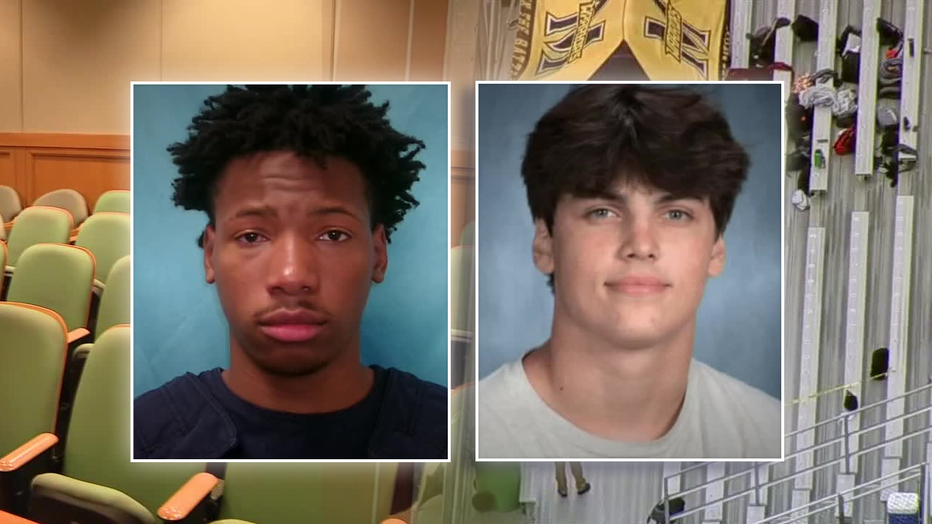 To understand the immense gravity of the footage, one must examine the starkly contrasting realities captured within the timeline of the recording. The bodycam video, recorded by Frisco school resource officer Eduardo Cortez, initially documents the chaotic immediate aftermath of the confrontation under a team tent. Eyewitnesses testified that Anthony, a student from a different high school, had sought shelter from a severe downpour under a tent reserved exclusively for Metcalf’s team. When repeatedly asked to leave by the students present, Anthony allegedly refused, issuing verbal defiances and declaring that anyone who touched him would face immediate consequences. The encounter escalated rapidly when Metcalf stepped forward to enforce the boundaries of his team’s space, initiating physical contact by shoving Anthony, who instantly responded by drawing a five-inch folding pocketknife and delivering a single, fatal blow to Metcalf’s chest.
The opening segments of the officer’s bodycam video display the frantic, structured response of law enforcement and medical personnel trying to manage a rapidly deteriorating situation. Jurors watched as Officer Cortez located and detained Anthony near the stadium boundaries, placing him in handcuffs while navigating a scene flooded with panicked students and screaming witnesses. During this initial phase of detention, the recording captures an intensely distressed Anthony sobbing heavily as he is led away from the field, repeatedly crying out that Metcalf had put hands on him. This raw, auditory display of panic from the accused formed a cornerstone of the defense’s opening arguments, which center heavily on a claim of self-defense, asserting that Anthony made a split-second decision out of absolute terror when confronted by a significantly larger student-athlete.
However, it is the final five minutes of the recording that have captured the undivided attention of legal analysts and the public alike, as the emotional and behavioral dynamics of the footage shift dramatically. As Anthony is escorted to the police cruiser and placed inside the vehicle, his visible distress completely subsides. The final moments of the footage show a starkly calm, fully cooperative individual whose demeanor bears no resemblance to the weeping teenager captured just minutes prior. While seated in the back of the patrol car, Anthony looks directly at Officer Cortez and makes a series of unprompted, clear assertions that have heavily fortified the state’s prosecution. When the officer initially radioed dispatch to announce that he had the alleged suspect detained, Anthony immediately interrupted, stating firmly, “I am not alleged. I did it.”
This abrupt transition from hysterical sobbing to calculated clarity in the closing minutes of the recording has fueled intense debate over the defendant’s state of mind. Prosecutors presented this shift as evidence of a lack of genuine remorse, arguing that the immediate confession, paired with an earlier statement to a witness that Metcalf was not going to die, indicates a cold awareness of his actions rather than a state of unmanageable panic. Conversely, the defense maintains that the sudden shift into a flat, compliant demeanor is a textbook psychological response to acute shock and trauma, rather than a sign of calculation. For the jurors tasked with deciding Anthony’s fate, these closing minutes provide a raw, unedited window into the immediate aftermath of a tragedy, forcing them to weigh a claim of existential fear against an explicit, coolly delivered admission of guilt.
For the family of Austin Metcalf, the playing of the bodycam footage inflicted a level of secondary heartbreak that proved almost impossible to endure inside the public courtroom. Sitting in the packed gallery, Austin’s parents and family members were forced to listen to the recorded, anguished cries of Austin’s twin brother, Hunter, who was present at the stadium and witnessed his brother’s final moments. The auditory trauma of the bodycam footage, followed closely by the graphic testimony of Collin County Chief Medical Examiner Dr. Elizabeth Ventura, who detailed how the knife pierced Metcalf’s sternum and penetrated the right ventricle of his heart, caused the victim’s parents to break down in tears before ultimately fleeing the courtroom. The heavy emotional toll of the evidence underscores the permanent, devastating reality of a family forced to relive the violent theft of their son’s life through the cold lens of judicial procedure.
As the trial transitions to the defense’s presentation of their case, the final five minutes of that bodycam video remain a pivotal focal point that could ultimately determine the outcome of the trial. Facing a potential sentence ranging from five years to life in prison, Anthony’s future hinges entirely on how the jury interprets the behavioral nuances captured in those closing moments of police contact. The trial, which has already drawn national attention and exposed deep community fractures along racial and cultural lines, continues to serve as a sobering demonstration of how a minor dispute over stadium seating can spiral into an irreversible catastrophe. With the courtroom operating under strict security measures and a judicial gag order, the public is left to dissect the revealed details of the trial, forever haunted by the thirty-minute countdown that ended a young life and changed another forever.
Để lại một bình luận