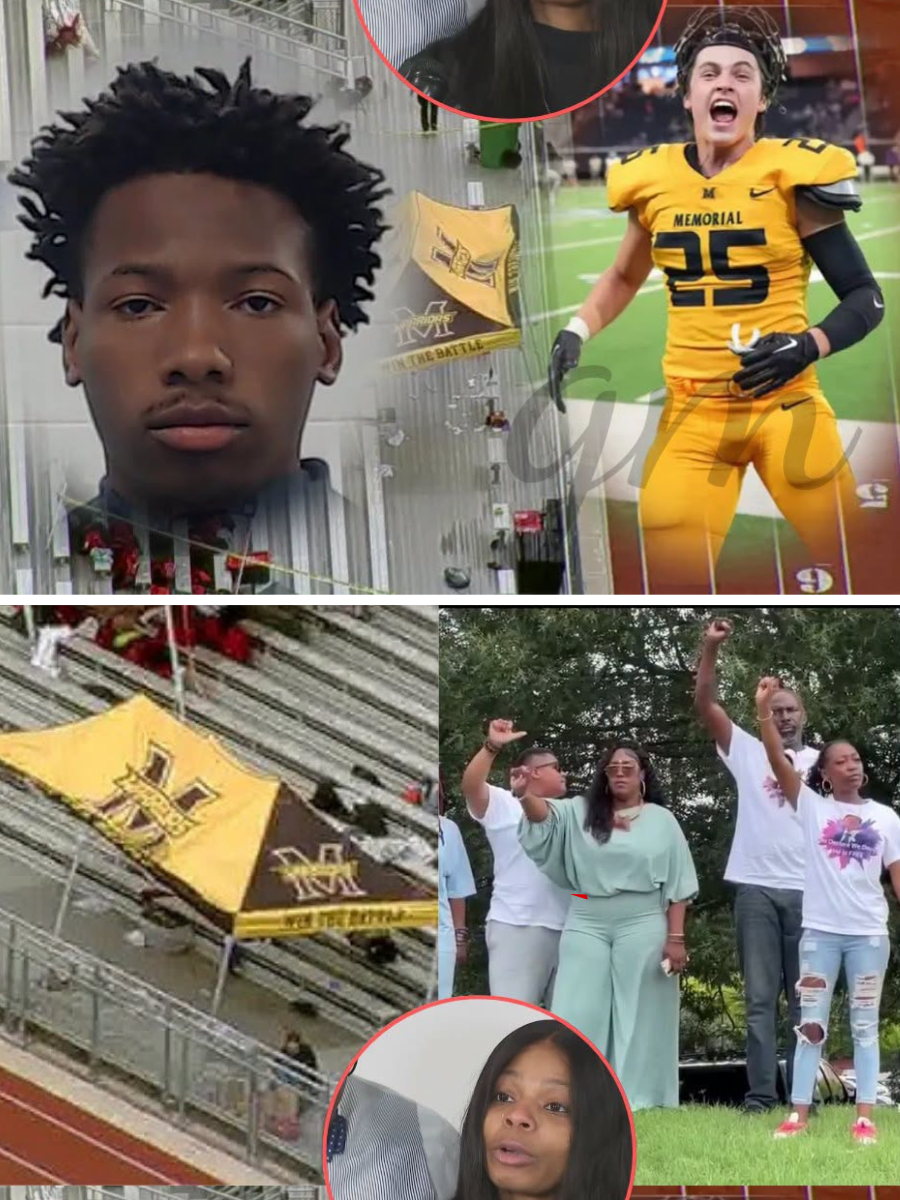
The first-degree murder trial of Karmelo Anthony in Collin County, Texas, has centered heavily on conflicting accounts of the final seconds leading up to the death of seventeen-year-old Austin Metcalf. The confrontation, which occurred during a rain-delayed track meet at Kuykendall Stadium in Frisco, escalated in a matter of moments from a territorial dispute over shelter from a downpour into a fatal altercation. While the prosecution has relied on eyewitness testimony from student-athletes to establish a narrative of aggressive defiance on the part of the defendant, Anthony’s own testimony from the witness stand has introduced a completely different perspective, forcing the jury to weigh contrasting interpretations of fear, intent, and self-defense.
According to a key witness who was present under the team tent where the stabbing took place, Anthony allegedly issued an explicit warning to the students who were trying to remove him from their team’s designated space. The witness testified that as Metcalf and several teammates pressed Anthony to leave, the defendant stood his ground and stated, “Touch me and see what happens,” a phrase prosecutors have highlighted to argue that Anthony was actively provoking a physical altercation and prepared to use the five-inch folding knife in his possession. In this version of events, Metcalf’s subsequent action of stepping forward to shove Anthony was a response to an ongoing verbal threat, framing the defendant as an armed aggressor who deliberately escalated a minor infraction into a deadly assault.
When Anthony took the stand in his own defense, he offered a narrative that directly challenged the prosecution’s portrayal of his demeanor and words. Anthony testified that he never intended to cause trouble and had only sought refuge under the tent to escape the sudden, blinding storm. According to his account, he felt instantly surrounded and intimidated by a group of larger athletes who were yelling at him aggressively. Anthony claimed that his words were not a calculated threat but a desperate plea for space born out of panic, asserting that he felt physically trapped and believed he was about to be jumped by multiple individuals. He maintained that when Metcalf initiated physical contact, his reaction was a split-second impulse driven by an absolute terror for his own safety rather than a premeditated desire to inflict harm.
This division between a calculated provocation and a panic-induced reaction forms the legal battleground upon which the jury must render its verdict. Under Texas law, a claim of self-defense requires the jury to evaluate whether a reasonable person in the defendant’s position would have believed that deadly force was immediately necessary to protect against an unlawful use of force. By presenting the “Touch me and see what happens” statement, the state aims to prove that Anthony was the initial provocateur, which would legally negate his right to claim self-defense. Conversely, the defense team has utilized Anthony’s emotional testimony to argue that the atmosphere under the tent was inherently hostile, making his fear entirely justifiable given the sudden physical escalation by a prominent athlete.
The emotional weight of these opposing narratives was visible throughout the courtroom as both families listened to the detailed re-examination of the final moments of Austin Metcalf’s life. For the victim’s family, hearing the defendant reframe the altercation as an act of self-preservation has added a layer of profound frustration to their grief, especially following previous medical testimony regarding the lethal nature of the single stab wound to the chest. As closing arguments approach, the case stands as a sobering illustration of how a brief sequence of words and actions, interpreted in two entirely different ways by those involved, can result in an irreversible tragedy that shatters multiple families and leaves a community searching for answers.
Để lại một bình luận