THE INTERNET THOUGHT THE GRIEVING HUSBAND DID IT. THEY WERE WRONG.
Before police publicly identified the alleged gunman, social media had already started building its own theory around the man who lost his wife and children.
Then the real name came out: Alan Smith — a family member who had reportedly been asked to leave his parents’ home weeks earlier.
So how did an innocent grieving father become the center of online suspicion — and what does that reveal about what really happened during the chaotic first hours of Montana’s family massacre?
The timeline is disturbing. The Internet’s rush to judgment may be even more disturbing. 👇
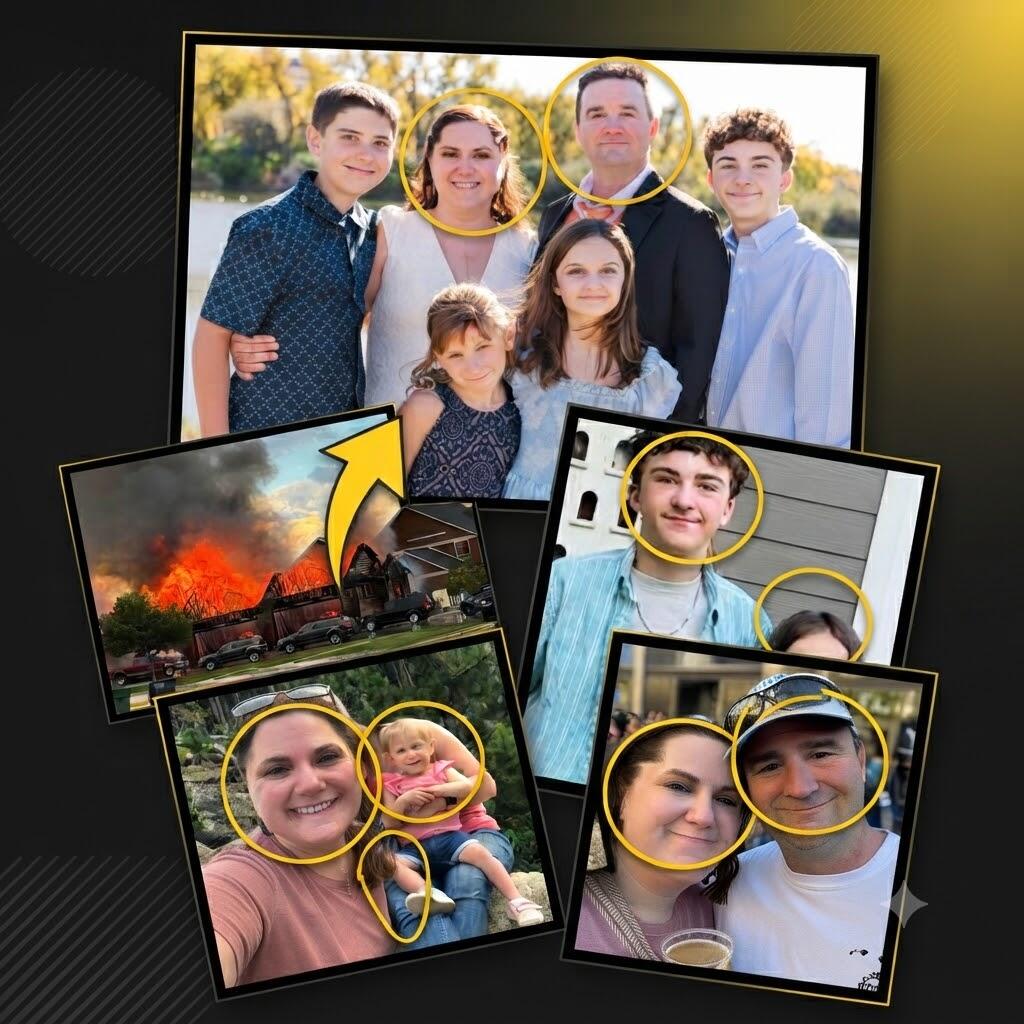
Before investigators publicly identified the man accused of killing eight members of a Montana family, the Internet had already begun looking for someone to blame.
In the confusion following Sunday’s deadly shooting and house fire outside Billings, information was scarce. Police had confirmed a horrific scene, but the identities of the victims and the suspect had not yet been fully released.
Then social media began doing what it increasingly does after a major crime: filling the information vacuum.
Online speculation focused, at least in some corners, on Adam Ghekiere, a grieving husband and father whose wife and four children were among those killed.
There was just one problem.
He was not the gunman.
As more information emerged, the suspect was identified as Alan Smith, 44, a relative of the victims who had reportedly been living with his parents before they asked him to move out weeks before the massacre.
The episode has now created a second story surrounding the Montana tragedy — one about what happens when social media attempts to solve a crime before investigators have finished establishing the basic facts.
The information vacuum
The shooting happened Sunday evening at a home on White Star Circle outside Billings.
Authorities initially responded to reports of a family disturbance and gunfire. A 911 call came in at approximately 6:01 p.m., and officers arrived around 11 minutes later.
The scene was extraordinarily chaotic.
Police reported hearing additional gunfire after arriving. The home then became engulfed in flames.
Eight people ultimately died, including four children.
The suspected shooter also died after an apparent self-inflicted gunshot wound.
But during the earliest stage of the investigation, officials had not publicly provided the complete picture.
The suspect’s name was not immediately released.
The identities and relationships of all the victims were also still being established.
That created the perfect conditions for online speculation.
On Reddit, users following the developing story began discussing possible suspects and trying to reconstruct what had happened inside the home.
The r/Billings community later specifically criticized the delay in identifying the suspect, with one commenter arguing that the lack of information had allowed speculation about the victim’s husband to spread.
The man who came home to unimaginable loss
Adam Ghekiere had been working when the emergency unfolded.
According to reporting, Ghekiere was working at an event in Billings when he heard information about an active shooting over emergency communications.
He rushed toward the family home.
What he found was a burning residence.
His wife, Megan Ghekiere, was among the dead.
So were four children connected to the family: 15-year-old Landon, 12-year-old Charlotte, 13-year-old Owen and 7-year-old Chloe. A 92-year-old relative was also among the victims.
Yet before the full family relationships and suspect identity were publicly clarified, social media users were attempting to make sense of Ghekiere’s presence, his relationship to the victims and the circumstances surrounding his arrival.
That is where a tragic phenomenon common in high-profile crimes began to emerge:
The absence of information became information.
Instead of waiting for investigators to establish what happened, some users interpreted gaps in the story as clues.
Reddit’s second investigation
Reddit quickly became one of the places where people attempted to reconstruct the case.
In the r/Billings discussion about the killings, one commenter criticized law enforcement for not naming the suspect sooner, arguing that the delay had contributed to “wild speculations” about the husband who had been working when the attack occurred.
Another commenter responded that the family itself appeared to want attention focused on the victims rather than the perpetrator.
That tension is important.
On one side was a public hungry for answers.
On the other was a family dealing with an almost incomprehensible loss.
And between them was a police investigation that could not immediately provide every answer.
The result was predictable: people started connecting dots that had not yet been confirmed to belong together.
Then the name Alan Smith emerged
The picture changed dramatically when The Associated Press published information from family members identifying the suspected gunman as Alan Smith, 44.
According to Brad Ireland, whose former wife and two children were among the victims, Smith was a relative who had been living with his parents.
His parents had reportedly asked him to move out several weeks before the killings.
On Sunday, Smith returned to the house while relatives were gathered for dinner, Ireland told AP.
Smith’s parents were among those killed.
So was his sister.
His grandmother was also among the victims.
Four children were killed as well.
Smith subsequently died from an apparent self-inflicted gunshot wound.
The revelation fundamentally changed the narrative.
The man some people online had been questioning was not the perpetrator.
The alleged killer was someone much closer to the center of the family conflict.
Why the wrong-suspect theory spread
The circumstances provide a textbook example of why social-media speculation can become dangerous during an unfolding investigation.
At first, the public knew several things:
There had been a shooting.
There were multiple fatalities.
A house had burned.
A man had been found outside and later died.
A family member had rushed to the scene.
But the public did not yet have the complete family tree.
It did not know the suspect’s identity.
It did not know precisely why the victims were targeted.
It did not know exactly how the shooting and fire unfolded.
Those missing pieces created an information gap.
And online communities tend to hate information gaps.
People naturally try to fill them.
A photograph becomes a clue.
A relationship becomes a motive.
A person’s behavior becomes “suspicious.”
A coincidence becomes a theory.
And a theory can become accepted as fact simply because hundreds of people repeat it.
The problem with “crowdsourced” criminal investigations
There is nothing inherently wrong with people discussing an unfolding crime.
Online communities can sometimes uncover useful information.
They can locate old news reports, identify locations, compare timelines and direct attention toward overlooked public records.
But there is a crucial difference between finding information and determining guilt.
The Montana case demonstrates that difference particularly well.
The early online discussion was operating with incomplete information.
Investigators were operating with evidence that the public could not see.
Those are fundamentally different positions.
A Reddit user can look at a timeline and ask why someone arrived at a scene.
A detective can potentially have access to phone records, surveillance footage, witness statements, forensic evidence and emergency-dispatch information.
The public may see the same event.
The investigators see a much larger evidentiary picture.
A false theory can become its own form of harm
For Ghekiere, the consequences of online speculation are particularly painful.
He was not simply a random bystander.
He was the husband and father who lost his immediate family.
According to local reporting, he had been working when he learned about the emergency and rushed toward the scene.
He arrived to a disaster involving his own family.
At the same time, some online users were asking whether he could somehow be responsible.
The Reddit discussion later acknowledged that this speculation had been harmful, with commenters expressing sympathy for Ghekiere and describing the situation as especially cruel because he had lost his family while people online were apparently accusing him of causing that loss.
That is perhaps the darkest irony in the story.
A man had just lost almost everything.
And before the public knew who the killer was, parts of the Internet were asking whether he was the killer.
The danger of a compelling narrative
There is another reason these theories spread so quickly.
A good conspiracy theory often feels more satisfying than an incomplete truth.
“Police haven’t released the suspect.”
becomes:
“They must be hiding something.”
“A grieving husband was at the scene.”
becomes:
“Why isn’t he being investigated?”
“The house burned.”
becomes:
“Someone must have tried to destroy evidence.”
Each step feels logical in isolation.
But the overall narrative can be completely wrong.
That appears to be what happened here.
The actual information that later emerged was dramatically different.
According to AP, Smith was not an outsider who happened to attack a random family.
He was a member of the family.
And according to relatives, the conflict had existed before the killings.
The new mystery is no longer “Who did it?”
With Smith identified, the central question has changed.
It is no longer primarily:
Who killed the eight people?
The emerging answer to that question is Alan Smith.
Now investigators and the public want to know:
Why?
Why did Smith return to the home?
Why did the conflict escalate into mass violence?
What happened in the weeks after his parents reportedly asked him to leave?
Were there specific threats or incidents before the shooting?
And what exactly happened inside the house before it caught fire?
Those questions remain open.
Authorities have described the incident as a family disturbance and said there is no broader threat to the public. But a definitive motive has not been publicly established.
The fire adds another layer of uncertainty
The house itself may hold some of the answers.
Investigators are dealing with a crime scene that was severely damaged by fire.
That makes reconstructing the sequence of events more difficult.
Police have said investigators are carefully processing the scene because of the damage and structural conditions.
The fire has also generated its own wave of online theories.
Some users have speculated about whether it was deliberately started to destroy evidence.
Others have questioned the timing of the blaze.
But again, speculation is not evidence.
Until investigators establish how the fire began and why, those theories remain theories.
What this case says about true crime in the social-media era
The Montana massacre illustrates the strange relationship between modern criminal investigations and online communities.
The public wants immediate answers.
News organizations compete to report new developments.
Reddit users dissect timelines.
X accounts race to post names.
TikTok creators turn fragments into videos.
And sometimes, information spreads faster than verification.
That speed can be useful.
It can also be devastating.
In this case, the Internet’s first narrative was incomplete.
The eventual picture was very different.
The suspect was not the grieving husband.
He was a relative who had reportedly been living in the same family environment and had recently been asked to leave.
That distinction matters.
Because once an accusation appears online, correcting it is rarely as powerful as the original accusation.
What happens next
Investigators are now left with a different set of questions.
They must reconstruct the shooting, determine the precise circumstances of the fire, examine the suspect’s history and establish what led to the attack.
The public will likely learn more as authorities release additional information.
For online communities, the case offers a cautionary lesson.
There is nothing wrong with asking questions.
There is something dangerous about answering them before the evidence exists.
In the first hours after the Montana massacre, the Internet wanted a suspect.
It found one.
It was wrong.
Then investigators identified Alan Smith.
And suddenly, the story looked completely different.
The tragedy now has a second lesson buried beneath the first:
Sometimes the most dangerous thing in an unfolding crime isn’t the information we don’t have — it’s the certainty with which we fill in the blanks.
Để lại một bình luận