THE DINNER THAT WASN’T SUPPOSED TO HAPPEN THAT NIGHT.
The family’s Sunday gathering was unusual — their dinners were normally held on Fridays. Even more chilling, the father of two of the children killed says his kids weren’t even supposed to be there that night.
Then Alan Smith reportedly returned to the house, eight family members were killed, and the home went up in flames.
Was it simply a tragic change of plans? Or is there more to the timeline investigators still haven’t revealed?
One small change may have put eight people under the same roof — at exactly the wrong moment. 👇
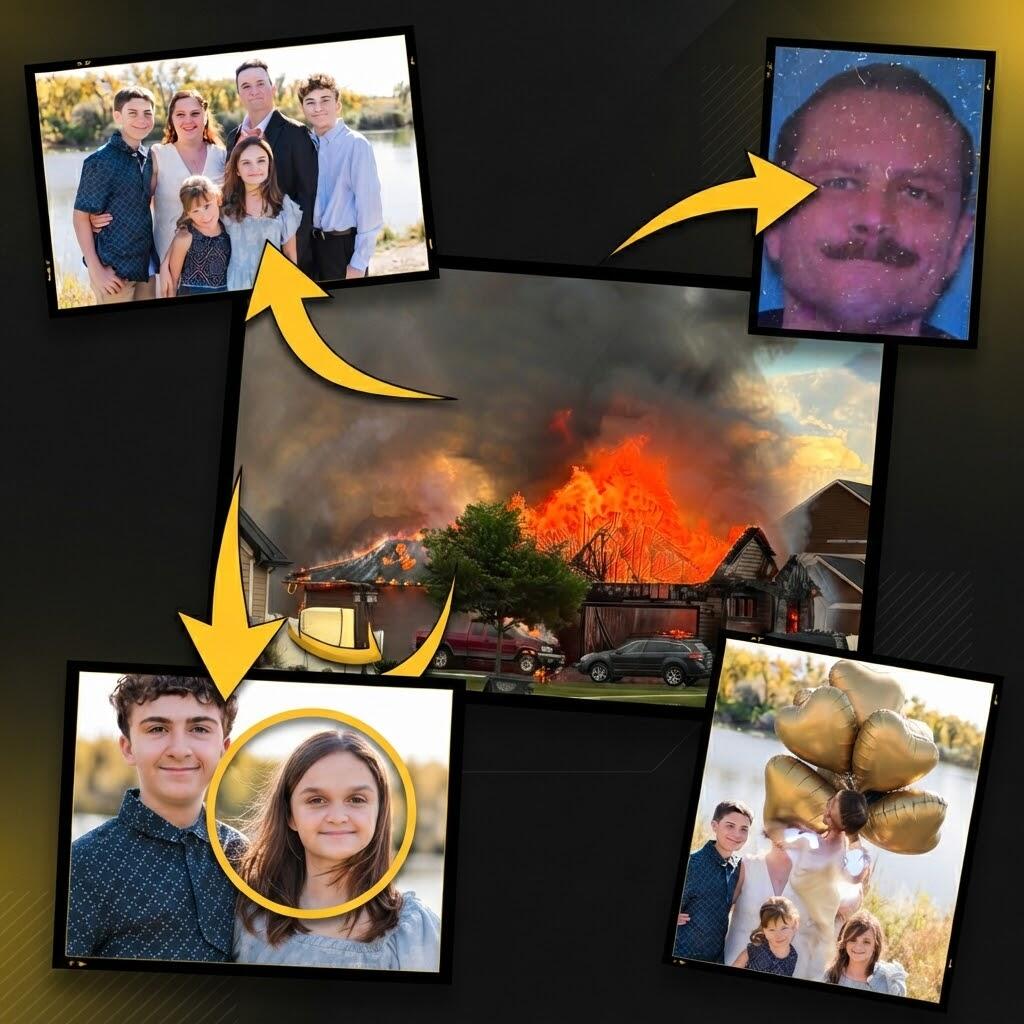
The most haunting detail emerging from Montana’s deadly family massacre may not be a gunshot, a warning sign or even the fire that destroyed the home.
It may be something much more ordinary.
Dinner.
According to Adam Ghekiere, whose wife and two children were among the eight people killed Sunday night, the extended family normally gathered for dinner on Fridays.
But Aug. 23 was a Sunday.
And his children, 15-year-old Landon and 12-year-old Charlotte, were not even supposed to be there that evening, Ghekiere told The Associated Press.
Then plans changed.
The family gathered at the home outside Billings.
And 44-year-old Alan Smith — a relative who had reportedly been asked to move out of his parents’ home weeks earlier — unexpectedly returned.
What followed was a massacre that killed eight members of the family, including four children, before the house was engulfed in flames.
The detail about the dinner does not establish that the change in schedule was connected to the attack. Investigators have not publicly said that Smith knew in advance who would be present, nor have authorities established that the Sunday gathering was part of a deliberate plan.
But it raises a question that is difficult to ignore:
Why was everyone there that night?
A family tradition — on the wrong night
According to Ghekiere’s account to AP, family dinner was normally held on Fridays.
That meant Sunday was different.
It was not necessarily unusual for a family to change dinner plans. Families reschedule meals constantly. Children have activities, parents have work, relatives travel and plans change.
But in this case, the change in plans occurred on the same night that eight family members were killed.
That coincidence is what makes the detail so striking.
Ghekiere told AP that his children were not supposed to be at the house that evening.
He was working at Billings airport when he heard over a dispatch radio that there was an active shooting.
He immediately began calling members of his family before racing toward the house.
By the time he arrived, the residence was burning.
Two hours later, he learned that his wife and children had been killed.
The tragedy therefore contains two separate timelines.
There is the timeline of the attack.
And there is the timeline of the family gathering that put eight people in the same place.
The second timeline may be just as important for understanding the first.
The children who weren’t supposed to be there
Perhaps the most painful part of Ghekiere’s account concerns his children.
Landon, 15, and Charlotte, 12, were among the victims.
Charlotte has since been remembered by family and friends as a hero after relatives said she called 911 during the attack in an attempt to get help for her family.
But according to their father, the two children weren’t even expected to be at the family dinner that evening.
That raises a particularly painful hypothetical:
Had the dinner taken place on the family’s normal Friday schedule, would the children have been somewhere else?
There is no way to answer that.
And it would be inappropriate to suggest that changing the dinner schedule caused the massacre.
The available evidence does not support such a conclusion.
But the question illustrates how a completely ordinary change in family plans can look extraordinarily significant after a tragedy.
The man who returned
What is known is that Alan Smith had a connection to the house.
According to Brad Ireland, whose former wife and two children were killed, Smith had been living with his parents for years.
His parents had recently asked him to move out.
Then, on Sunday evening, Smith returned to the property while family members were gathered for dinner.
Ireland told AP that Smith opened fire, killing his grandmother, his parents, his sister and four children before setting the home on fire.
Smith later died from an apparent self-inflicted gunshot wound.
Police have described the incident as a family disturbance rather than a random attack.
That distinction is important.
The available evidence points toward a family-centered tragedy rather than an unknown gunman randomly selecting victims.
But investigators have not publicly established every detail of Smith’s motive.
The dinner schedule therefore becomes an interesting piece of context — not proof of a larger plot.
Was Sunday significant to Smith?
This is one of the questions that investigators may eventually be able to answer.
Did Smith know there would be a family dinner that Sunday?
Did he know which relatives would attend?
Did he expect the children to be there?
Did he arrive because he knew they were gathering?
Or did he simply return to the house and encounter relatives who happened to be there?
At present, the public does not have definitive answers to those questions.
Ghekiere himself offered one interpretation to AP, saying, “I don’t think he expected my kids to be there.”
That is the family’s understanding of the situation, but it is not the same thing as an investigative finding.
That distinction should remain clear as the story develops.
The danger of turning coincidence into conspiracy
This is exactly the kind of detail that social media tends to seize upon.
A family normally eats dinner on Friday.
This time, dinner happens Sunday.
Two children who were not expected to attend end up there.
A relative who had recently been asked to leave returns.
Eight people are killed.
The house burns.
Taken together, those facts naturally invite speculation.
But a compelling sequence does not automatically mean there was a hidden plan behind it.
That is where responsible coverage becomes especially important.
There is currently no public evidence establishing that the dinner was deliberately moved to Sunday as part of a plan, or that Smith manipulated the schedule.
There is also no public evidence establishing that the children’s presence was known to him beforehand.
Those possibilities may be investigated.
They should not be presented as facts.
Yet the coincidence remains extraordinary
Even without a conspiracy, the timing is difficult to overlook.
The family had a regular rhythm.
Friday dinners.
Relatives living nearby.
Children moving between households.
Parents and grandparents maintaining close family connections.
Then one Sunday, the normal routine changed.
And eight people ended up together.
The massacre subsequently wiped out members of four generations of the blended family, ranging from a 92-year-old great-grandmother to a 7-year-old girl.
That four-generation span makes the dinner detail even more significant from a human-interest perspective.
This was not simply a group of unrelated people gathered at a public location.
It was a family gathering.
People who knew each other.
Children who were spending time with relatives.
Parents and grandparents.
A grandmother.
A great-grandmother.
Aunts, uncles and step-siblings.
The ordinary nature of the gathering is precisely what makes the outcome so disturbing.
Charlotte’s final attempt to get help
The Sunday dinner also became the setting for Charlotte’s final known act of courage.
Family friend Jennifer Mercer told AP that Charlotte called 911 during the attack and tried to save her family.
Her father later said police confirmed that Charlotte was the person who made the emergency call.
The 12-year-old is now being remembered by relatives not simply as one of the victims, but as someone who attempted to summon help while the attack was still unfolding.
That call provides another link in the timeline.
The family gathered.
The shooting began.
Charlotte called 911.
Police responded.
Additional gunfire was heard.
And shortly afterward, the house became engulfed in flames.
The exact sequence inside the residence remains under investigation.
6:01 p.m. — the call that changed everything
Billings police said officers were dispatched at approximately 6:01 p.m. Sunday after a 911 call reporting an active shooting.
When officers arrived, they heard gunfire from the rear of the house.
Within minutes, the residence was fully engulfed in flames.
Firefighters battled the blaze until approximately 1 a.m. Monday. The property is in a subdivision outside city limits where fire hydrants are not required, adding another challenge to the response.
The fire ultimately destroyed much of the structure, creating significant challenges for investigators trying to reconstruct the crime scene.
And that makes the question of who knew what — and when — even harder to answer.
The house may not reveal all its secrets quickly
Investigators are now working with a severely damaged crime scene.
The residence was burned down to its foundation, according to police reporting, and concerns about structural integrity have complicated evidence collection.
That means investigators cannot simply walk through the house and reconstruct the evening.
They may need to rely on surviving physical evidence, emergency communications, witness accounts, forensic analysis and digital records.
The Sunday dinner itself could become part of that reconstruction.
Who was expected to attend?
Who actually arrived?
When did each person arrive?
When did Smith return?
Who spoke with him?
What happened immediately before the shooting?
And crucially:
Did Smith know the children would be there?
Those are questions that could potentially be answered through interviews and evidence.
The motive remains the bigger mystery
The dinner schedule is intriguing.
But it does not, by itself, explain why Smith allegedly attacked his family.
That question remains much larger.
Relatives have described Smith as isolated and unemployed and said there had been warning signs before the killings. He had reportedly been living with his parents and was asked to leave weeks earlier.
Yet AP reported that relatives did not know him to have a history of arrests or criminal charges, and Ireland said he had not previously been violent to his knowledge, although he could be verbally abusive.
That makes the case more complicated than a simple narrative of an obviously violent man suddenly carrying out a massacre.
The family may have recognized problems.
They may have experienced conflict.
But that does not necessarily mean anyone anticipated eight killings.
A tragedy built around ordinary decisions
Perhaps that is ultimately why the Sunday dinner detail resonates so strongly.
There was nothing inherently dramatic about changing a family dinner from Friday to Sunday.
There was nothing unusual about children visiting relatives.
There was nothing suspicious about family members gathering for a meal.
There was nothing remarkable about a man returning to a family property where he had lived.
Individually, each event could have been completely ordinary.
But together, on that particular night, they became part of the chain of events surrounding one of Montana’s most devastating recent killings.
That is the cruel nature of hindsight.
After something terrible happens, every small decision suddenly seems significant.
What investigators still need to establish
The investigation will ultimately have to separate coincidence from causation.
The fact that the dinner was on Sunday is established by family accounts.
The fact that the children were not expected to be there comes from their father’s account.
The fact that Smith returned to the house and allegedly opened fire comes from relatives’ account of the events.
But whether those facts were connected by a deliberate plan remains unknown.
That distinction could become increasingly important as investigators release more information.
If evidence shows that Smith knew the family’s plans in advance, that would change the significance of the Sunday gathering.
If investigators determine that he did not know the children would be there, the timing may ultimately prove to have been a tragic coincidence.
For now, neither conclusion can responsibly be made.
The question that will keep people talking
The Montana massacre is already being discussed online as investigators work to establish the full story.
But among all the questions surrounding the case, one is particularly haunting because it involves something so mundane:
Why Sunday?
Why was dinner moved from its normal Friday schedule?
Why were Landon and Charlotte there when their father says they weren’t supposed to be?
Why did Smith return that particular evening?
And did any of those things have anything to do with one another?
There may eventually be straightforward answers.
There may not.
But one thing is already clear.
A family changed its dinner plans.
Eight people ended up under the same roof.
And by the end of the night, four generations of that family were gone.
Sometimes the most disturbing part of a tragedy isn’t the extraordinary decision that caused it — but the ordinary decision that happened just before everything changed.
Để lại một bình luận