HE RAN TOWARD THE HOUSE — NOT KNOWING HIS WIFE AND TWO CHILDREN WERE INSIDE.
Adam Ghekiere was working when emergency communications alerted him to a shooting at the family home. He rushed toward the scene, desperately trying to reach the people he loved.
But when he got there, the house was already burning.
His wife was gone. His 15-year-old son was gone. His 12-year-old daughter — the girl who reportedly called 911 trying to save her family — was gone.
Now, the father who arrived too late is speaking about the family he can never get back… and one detail about that terrible night is haunting everyone. 👇
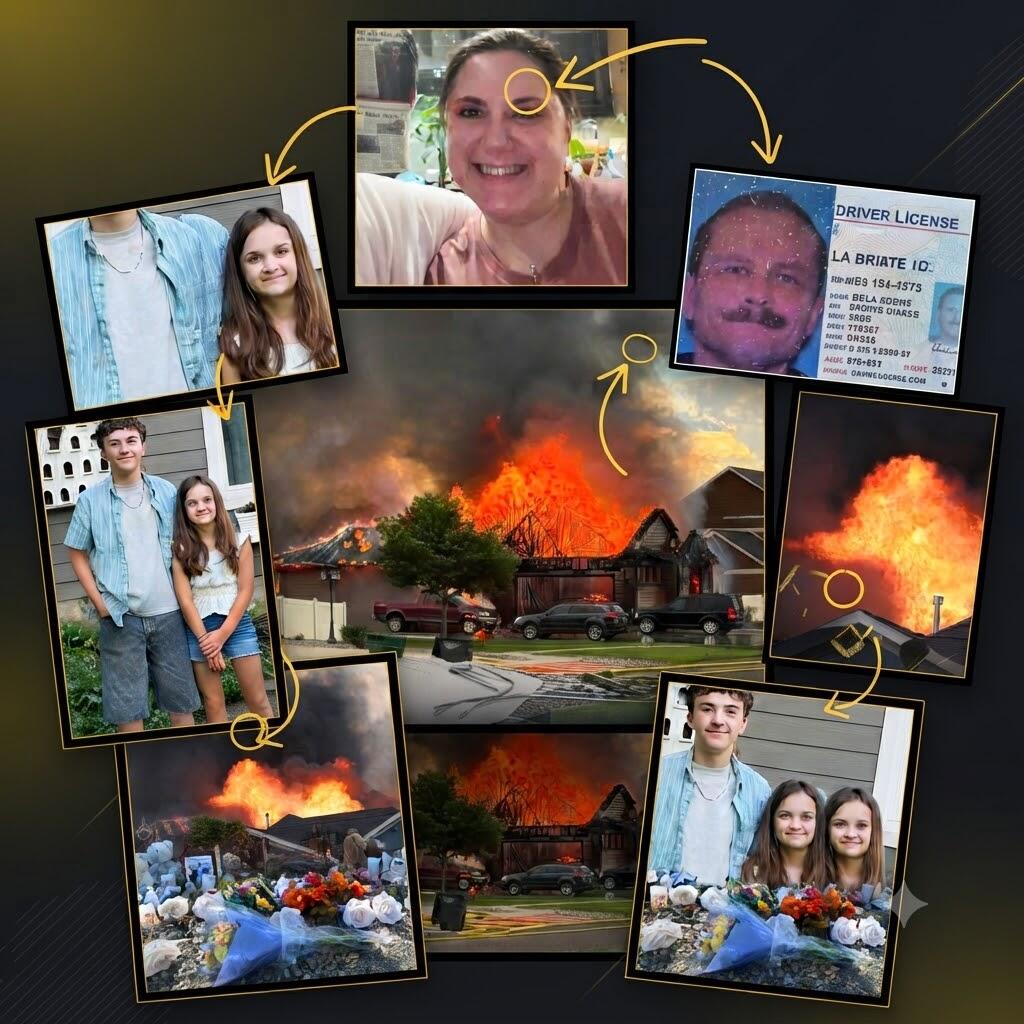
He was not supposed to be the one arriving at a disaster scene involving his own family.
Adam Ghekiere was working when he learned that something was terribly wrong at the home where his wife, children and other relatives had gathered for dinner.
Then the emergency communications began.
There had been a shooting.
The address was familiar.
It was home.
Ghekiere rushed toward the scene.
But by the time he arrived, the family residence was burning.
Inside were eight members of his extended family.
His wife, Megan.
His 15-year-old son, Landon.
His 12-year-old daughter, Charlotte.
And five other relatives.
All eight would be killed.
Now, as Billings continues to mourn, Ghekiere is left trying to do something that seems almost impossible:
remember his children for the lives they lived rather than the way they died.
The father who was at work
The tragedy unfolded Sunday evening at a home on White Star Circle outside Billings.
According to authorities, 44-year-old Alan Smith arrived in the neighborhood shortly before the shooting.
Smith was the son of homeowners Dana and Barbara Smith and had previously lived at the property.
Relatives have said his parents had asked him to move out weeks earlier.
That family conflict is now a major part of the investigation into what happened next.
But Adam Ghekiere was not at the house.
He was working.
Ghekiere works as a firefighter at Billings Logan International Airport, according to reporting about the tragedy.
When information about the emergency began circulating through the communications system, he realized the location was connected to his family.
He began trying to reach his loved ones.
Then he headed toward the house.
According to the New York Post, Ghekiere described the frantic effort to get back to his family as he learned about the shooting.
But the scene he eventually reached was not the family home he knew.
It was a burning crime scene.
His wife was inside
Ghekiere’s wife, Megan Ghekiere, was among those killed.
Megan was at her parents’ home for the family dinner along with her children and other relatives.
Her death left Adam facing not one loss, but several.
Their two children, Landon and Charlotte, were also killed.
That makes Adam’s story fundamentally different from many of the other family accounts emerging from the tragedy.
He did not simply lose relatives.
He lost his immediate family.
His wife.
His son.
His daughter.
And he learned of it while trying to get back to them.
Landon was 15
Family members are now trying to make sure Landon is remembered as a teenager rather than simply one of eight victims.
Landon was 15.
His mother, Erica Schneider, has described him as kind, funny, sarcastic and full of love and gratitude.
In a heartbreaking detail shared after the shooting, Schneider said she saw her son on the day he died and that he told her she was the best mom before leaving.
Those ordinary words have become extraordinarily important.
Because there was no indication that this would be the last time she would see her son.
There was no final farewell.
No expectation that a normal family evening would become a permanent goodbye.
Landon was preparing for the next stage of his teenage life.
Instead, his family is now talking about the memories he left behind.
Charlotte was 12
Then there is Charlotte.
Charlotte was 12 years old and preparing to enter seventh grade.
Family members have described her as funny, precocious and caring.
She enjoyed crochet and had recently taken an interest in golf.
But one detail has come to define her place in the story.
According to relatives, Charlotte called 911 during the shooting.
The call reportedly helped bring emergency responders to the house.
Her family now calls her a hero.
The significance of that detail is difficult to overstate.
Charlotte was a child.
She was inside a house where gunfire was taking place.
And according to her family, she managed to reach emergency services and try to get help.
That means that while her father was racing toward the house from outside, his daughter was reportedly doing what she could from inside to bring help to the family.
Two people were moving toward the same crisis from opposite directions.
One was a father.
The other was a 12-year-old daughter.
Neither could stop what happened next.
The moment the house caught fire
The official timeline makes the story even more painful.
Authorities said the first 911 call came in around 6:01 p.m.
The suspect had reportedly arrived in the neighborhood at about 5:49 p.m.
The first law-enforcement officer arrived at approximately 6:11 p.m.
At roughly the same time, officers heard gunfire.
Smoke was coming from the house.
And officials later determined that multiple fires had been started inside the residence.
Smith eventually fled toward the backyard and died from an apparent self-inflicted gunshot wound.
By the time Adam reached the area, the house where his family had gathered for dinner was engulfed.
The image is almost impossible to reconcile with what had existed there only minutes earlier.
A family dinner.
Children.
Parents.
Grandparents.
A 92-year-old great-grandmother.
Then gunfire.
Then flames.
Then silence.
He wasn’t expecting this
One of the more revealing details from Adam’s comments concerns the children’s presence.
According to AP, Ghekiere said he did not believe Smith expected his children to be at the house that night.
That statement is significant because the family normally gathered for dinner on Fridays, while the fatal gathering happened on Sunday.
Adam said his two children were not originally expected to be there.
But they ended up at the house anyway.
It creates an unsettling question:
Did Smith know they would be there?
Right now, there is no publicly established evidence proving that he did.
That distinction is critical.
The unusual dinner schedule and the children’s unexpected presence are facts reported by family members.
Whether those details had any connection to Smith’s actions is still something investigators must establish.
The man left behind
Unlike Smith, Adam will have to live with the aftermath.
There will be no trial at which he can confront the person accused of killing his family.
Smith died shortly after the shooting.
That means Adam will never hear a complete explanation directly from the man responsible.
There may be no confession.
No cross-examination.
No courtroom moment in which every unanswered question is placed in front of the accused.
Instead, Adam and the rest of the family must rely on investigators to reconstruct what happened.
And some questions may never have answers.
The house cannot tell the whole story anymore
The destruction of the residence makes that problem even worse.
Investigators are currently sifting through the burned remains looking for evidence.
AP reported Wednesday that investigators were carefully searching the debris and had recovered objects including a family Bible and photo album that survived the fire.
The house itself, however, is largely gone.
That means investigators are trying to reconstruct an event from a crime scene that was also a fire scene.
Bullet trajectories.
Locations.
Movement.
Fire origins.
Potential evidence.
All of those things can be altered or destroyed by intense heat.
And because Smith is dead, the investigation cannot simply ask him what he did.
The evidence must speak for itself.
The Internet has its own theories
As is often the case after a tragedy of this magnitude, social media has begun trying to fill the gaps.
Questions about the unusual Sunday dinner have circulated.
So have questions about the fire.
People have wondered whether Smith knew who would be present.
Others have focused on the timing between Charlotte’s 911 call, the arrival of officers and the flames.
But authorities have already had to push back against rumors.
During a Wednesday press conference, Yellowstone County Sheriff Kent O’Donnell specifically addressed misinformation circulating online, including claims that the house was a drug residence and rumors about Smith’s relationship to people in the home. Officials clarified that the victims and suspect were members of the same extended family.
That is a reminder that the most dramatic theory is not necessarily the correct one.
And in a case involving dead children, the difference between a verified fact and a social-media rumor matters enormously.
What Adam wants people to remember
Perhaps the most revealing development has come not from investigators but from the family.
Adam and Erica Schneider have begun talking publicly about their children.
Not about crime-scene details.
Not about conspiracy theories.
Not about the killer.
About Landon and Charlotte.
Schneider remembered Landon as kind, funny, sarcastic and loving.
Adam described Charlotte as having a heart of gold.
A growing memorial has appeared near the site, while community members have organized support for the families.
That shift is important.
Because the longer the investigation continues, the easier it becomes for the victims to disappear behind the headlines.
“Eight killed.”
“Family massacre.”
“Montana shooting.”
“House fire.”
Those phrases describe the event.
They do not describe the people.
A father now has a different job
Before Sunday, Adam’s role was straightforward.
He was a father.
A husband.
A firefighter.
A man working to provide for his family.
Now his role has changed.
He is helping preserve the memory of two children who should have had decades ahead of them.
Landon should have been thinking about driving, school and growing into adulthood.
Charlotte should have been starting seventh grade.
Instead, their parents are talking about who they were.
That may be the most painful part of the aftermath.
The investigation is about the final minutes of their lives.
The family is trying to remember everything that came before them.
The question that may never leave Adam
There is one question that may haunt a parent forever after a tragedy like this:
What if I had gotten there sooner?
It is a question that has no fair answer.
Adam was not responsible for what happened.
He was working.
He responded when he learned there was an emergency.
He drove toward his family.
The scene itself was dangerous, with active gunfire and a rapidly spreading fire.
Even trained emergency responders faced an extraordinarily difficult situation.
Authorities have emphasized how complex the scene was, with law enforcement dealing with an armed suspect while firefighters confronted a burning structure.
There is no evidence that Adam could have prevented the massacre.
But grief does not always follow logic.
It asks questions that cannot be answered.
What investigators still need to know
The investigation remains active.
Officials still have to reconstruct the exact sequence of the shooting and fires.
They need to determine Smith’s precise motive.
They need to establish what happened inside the home.
They need to analyze the surviving physical evidence.
And they may eventually learn more about the 911 call made during the attack.
That evidence could help answer questions surrounding the final minutes.
But for Adam, none of those answers will change the outcome.
The house may eventually yield its forensic secrets.
The investigation may eventually explain the timeline.
A motive may eventually become clearer.
None of it will bring his family home.
He arrived at the scene.
He arrived at the place where his wife and children were supposed to be.
He arrived looking for them.
Instead, he found a burning house.
That image may become one of the defining images of the Montana tragedy.
But it should not become the defining image of Landon and Charlotte.
They were not born into a crime story.
They were children.
They had parents.
They had interests.
They had personalities.
They had plans.
And they had a father who was supposed to see them grow up.
Now, the person who raced toward them when the emergency began is left with memories — and the impossible task of carrying those memories forward.
**The house is gone.
The investigation will eventually end.
But for Adam Ghekiere, the emergency never really will.**
Để lại một bình luận