🚨 THE FIRST FEW MINUTES AFTER THE CRASH MAY BE THE MOST IMPORTANT PART OF THE ENTIRE CASE.
Around 9:09 p.m., Stephen Schneider’s boat struck Channel Marker 39.
Then everything happened at once.
Two children were thrown into the water. One was brought back aboard. Stephen went into the bay searching for the other. Laurie called 911. CPR followed. And rescuers raced to find them.
But when you put the known timeline together, some questions become impossible to ignore:
How long were the children in the water? What happened between the impact and the 911 call? And what exactly happened before rescuers arrived?
The newly released audio gives the public a glimpse — but not the whole story.
👇 Here’s what we know about those critical first minutes.
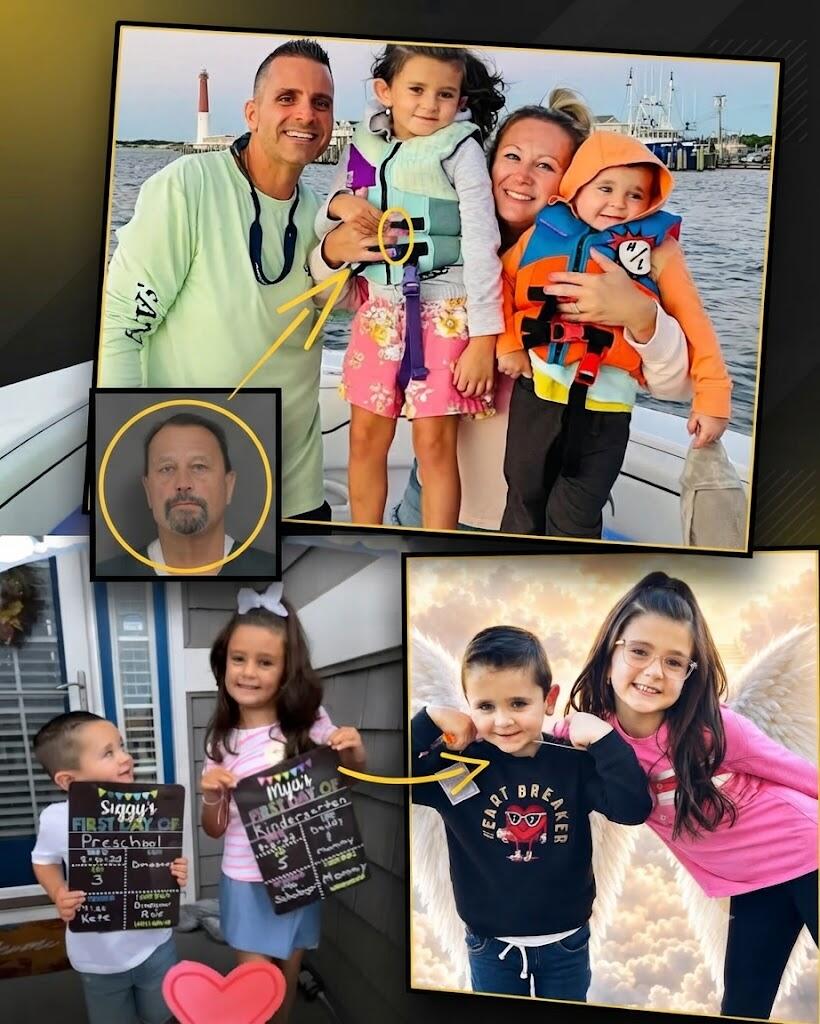
The crash itself lasted seconds. What happened afterward unfolded in a frantic race against time — as two children were thrown into the dark waters of Barnegat Bay, their grandparents searched for them and a 911 dispatcher tried to determine exactly where they were.
The newly released emergency call involving Stephen Schneider’s fatal boating crash has given the public its clearest glimpse yet into the minutes immediately following the collision.
But the recording also raises a more fundamental question:
What exactly happened between the moment the boat struck the marker and the moment rescuers arrived?
The publicly available evidence does not provide a perfect second-by-second reconstruction.
It does, however, provide several important pieces.
The crash happened shortly after 9 p.m. on July 19 in Berkeley Township, New Jersey. Schneider was operating a roughly 28-foot Tidewater Custom vessel when it struck Intracoastal Waterway Channel Marker 39. Two grandchildren aboard the boat — 9-year-old Mya Bella Golabek and 7-year-old Sigmund Paul Golabek — were thrown into the water.
What followed was a chaotic rescue attempt.
And the newly released 911 recording allows the public to hear part of it.
Around 9:09 p.m.: The collision
According to New Jersey State Police information reported at the time, the crash occurred at approximately 9:09 p.m.
The boat struck Channel Marker 39 in the Intracoastal Waterway.
The impact ejected both children from the vessel.
Court documents later indicated that the children were seated toward the front of the boat and were wearing life jackets.
That detail matters because the collision appears to have immediately transformed an ordinary evening boat ride into a water rescue.
There was no prolonged warning period described in the publicly released account.
The boat struck the marker.
The children went overboard.
And the adults aboard had to locate them.
The first problem: finding the children
News 12 reported shortly after the incident that Stephen Schneider and Laurie Schneider found the children in the water.
The newly released 911 audio provides additional context.
Laurie Schneider told the dispatcher that one child was on the boat while her husband was still in the water attempting to locate the other.
That means the rescue was not a single event.
It happened in stages.
One child had been recovered.
The other was still missing.
Stephen was searching the water.
Laurie was communicating with emergency dispatchers.
And the family was trying to determine exactly where they were.
That distinction becomes important when reconstructing the timeline.
The 911 call: “My husband’s in the water”
The most revealing part of the newly released recording may be the description of the rescue itself.
Laurie Schneider tells the dispatcher that they have one child on the boat while her husband is in the water searching for the other.
The dispatcher then asks about the children’s condition.
Laurie’s response indicates that the children were unresponsive.
The recording captures the family trying to provide information while simultaneously dealing with the emergency itself.
The call is important because it provides something the initial police reports could not fully convey:
the sequence of the emergency as it was happening.
But it also has limitations.
The recording does not provide a perfect timestamp for every action.
It does not establish precisely when each child was recovered.
And it cannot independently determine how long either child had been in the water.
Those questions require investigators to combine the 911 recording with dispatch logs, witness statements, medical records and physical evidence.
The location problem
Another revealing element of the call involves location.
Laurie Schneider reportedly asked whether they were near Channel Marker 39.
That may seem like a minor detail.
It isn’t.
Emergency responders need to know where a vessel is before they can reach it.
And a boat in distress on a large body of water at night can be difficult to locate, particularly when the people aboard are simultaneously attempting to rescue someone.
The exchange also reinforces how disorienting the situation had become.
The family knew what had happened.
They knew the children were in the water.
But communicating their precise position to emergency responders was itself part of the emergency.
The race against time
Once the children were recovered, CPR efforts began.
The New York Post reported that the family attempted to resuscitate the children before emergency responders arrived and the children were transported to a hospital.
That sequence is important because it shows why the first minutes are receiving so much attention.
In a water emergency, the difference between the moment someone enters the water and the moment they are recovered can become medically significant.
But the public should be careful about turning that general principle into a claim about this particular case.
The currently available reports do not establish an exact duration for which either child was submerged.
Nor do they establish that a particular delay caused or contributed to the outcome.
Those are questions that require medical and investigative evidence.
What the record does establish is that the family was actively searching for the children before emergency responders completed the rescue.
What happened before 911?
This is one of the most obvious gaps in the public timeline.
The collision occurred at approximately 9:09 p.m.
A 911 call followed.
But the publicly available reporting does not provide a second-by-second account of everything that happened between impact and the beginning of the emergency call.
That creates a natural area of interest for anyone trying to reconstruct the incident.
Who first realized both children had gone overboard?
Who entered the water first?
How quickly was the first child recovered?
When did Stephen enter the water?
When did Laurie begin CPR?
When exactly was 911 contacted?
How long did it take emergency responders to reach the vessel?
Some of those questions may already be answered in investigative records that have not all been publicly released.
Others may become clearer as the case progresses.
For now, they should remain questions — not assumptions.
The prosecution has another timeline
The rescue timeline is only one part of the case.
Prosecutors are also interested in what happened before the collision.
According to court documents, Schneider told police that he had consumed three beers over approximately two hours before the crash.
He reportedly said he was traveling at about 20 mph and saw the channel marker only at the last second.
Prosecutors have also said Schneider’s BAC was approximately 0.16, twice New Jersey’s legal limit.
Those facts are relevant because investigators are not simply trying to determine how the children were rescued.
They are trying to reconstruct why the boat struck the marker in the first place.
That requires a different timeline:
What happened before impact?
The marker question
Authorities have said the channel marker was functioning properly.
But the defense has raised questions about whether the marker was actually illuminated at the moment of the collision.
Schneider reportedly told investigators that he saw it only at the last second.
That creates another important gap between the known facts and the unanswered questions.
If the marker was properly illuminated and visible from a reasonable distance, prosecutors could argue that the operator should have detected it sooner.
If visibility was somehow compromised, the defense could argue that the circumstances were more complicated than the prosecution’s account suggests.
At present, the public record does not establish that the marker was dark.
The issue remains part of the defense’s investigation.
Then comes the 911 audio
This is where the two timelines intersect.
Before the crash, investigators are examining:
- Schneider’s alleged alcohol impairment
- the boat’s speed
- the marker’s visibility
- the vessel’s course
- the moments immediately preceding impact
After the crash, the evidence shifts:
- the children are in the water
- the adults begin searching
- one child is recovered
- Stephen remains in the water searching
- Laurie calls 911
- CPR is attempted
- emergency responders arrive
The newly released recording provides evidence about the second half of that timeline.
It does not independently answer the first half.
That distinction is critical.
Why social media is filling in the gaps
The lack of a complete public timeline has naturally encouraged speculation online.
People want to know exactly what happened in the minutes that separate the collision from the emergency response.
Some commenters have focused on the alcohol evidence.
Others have questioned the marker.
Some have tried to calculate how long the children may have been in the water.
Others have focused on why the parents were not aboard the same boat.
These discussions can be understandable, but there is a major difference between asking a question and answering it without evidence.
For example, the available information establishes that the children’s parents had arrived for dinner in a separate boat and that the children planned to return with their grandparents.
It does not establish that the parents could have anticipated the crash.
Likewise, the 911 call establishes that Stephen was in the water searching for one child.
It does not establish exactly how many minutes he was there.
Those distinctions become especially important in a case that has attracted intense public attention.
The first minutes may matter in more than one way
The immediate rescue could become relevant not only emotionally but also evidentially.
Investigators may use the 911 call to establish the sequence of events.
Emergency dispatch records can provide timestamps.
First-responder records can help establish when rescuers arrived.
Medical records can establish when the children were evaluated and what treatment was performed.
Witness statements can help fill in gaps.
Together, those pieces can produce a much more precise timeline than any single recording.
That timeline could also help prosecutors and defense attorneys test competing accounts of what happened.
What the 911 recording does — and does not — prove
The recording is powerful.
But its evidentiary value should not be exaggerated.
It proves that the family was in distress after the crash.
It documents the grandmother communicating with emergency dispatchers.
It provides information about the children’s condition as described during the call.
And it confirms that Stephen was in the water searching for one of the children.
But it does not, by itself, establish criminal liability.
It does not prove that alcohol caused the collision.
It does not prove that the marker was or was not illuminated.
It does not establish the boat’s precise speed.
And it does not determine how long the children were in the water.
Those questions belong to the larger investigation.
A tragedy unfolding in minutes
Perhaps the most haunting aspect of the timeline is how quickly an ordinary family evening changed.
The family had dinner.
The children chose to ride back with their grandparents.
The boat headed across Barnegat Bay.
At approximately 9:09 p.m., it struck Channel Marker 39.
Within moments, two children were in the water.
Then came the search.
The 911 call.
The recovery.
CPR.
Emergency responders.
And the hospital.
The entire sequence unfolded rapidly.
But for the family, those minutes would become the dividing line between what came before and what came after.
What remains unknown
The public now knows significantly more than it did immediately after the July 19 crash.
But the complete timeline is still not public.
The precise interval between impact and the 911 call remains an important question.
So does the exact time each child was recovered.
The precise arrival time of emergency responders.
The duration of CPR before hospital transport.
And the exact sequence of actions taken by each adult aboard the boat.
Those details could emerge through additional court filings, investigative records or testimony.
Schneider’s next court appearance is scheduled for Sept. 15, while the criminal case continues.
Until then, the newly released 911 recording offers only part of the picture.
And perhaps that is why it has generated so much attention.
The public can finally hear those terrifying minutes.
But the recording still leaves a series of unanswered questions between one moment and the next.
What happened in those first few minutes after Marker 39 was hit?
That may ultimately be one of the most important timelines in the entire case.
Để lại một bình luận