💔 PAUL McCARTNEY AND WILLIE NELSON JUST SHOWED THE WORLD WHAT DOLLY PARTON REALLY MEANT TO THEM.
Paul called it an honor to have Dolly sing one of his most beloved songs. Willie said almost nothing at all — he simply brought back a decades-old performance and let their voices tell the story.
But why did two legendary songwriters choose such completely different ways to say goodbye… and what do those tributes reveal about the woman they both admired? 👀
The answer says a lot more about Dolly than another celebrity tribute ever could.
👇 See what Paul and Willie were really saying about Dolly Parton.
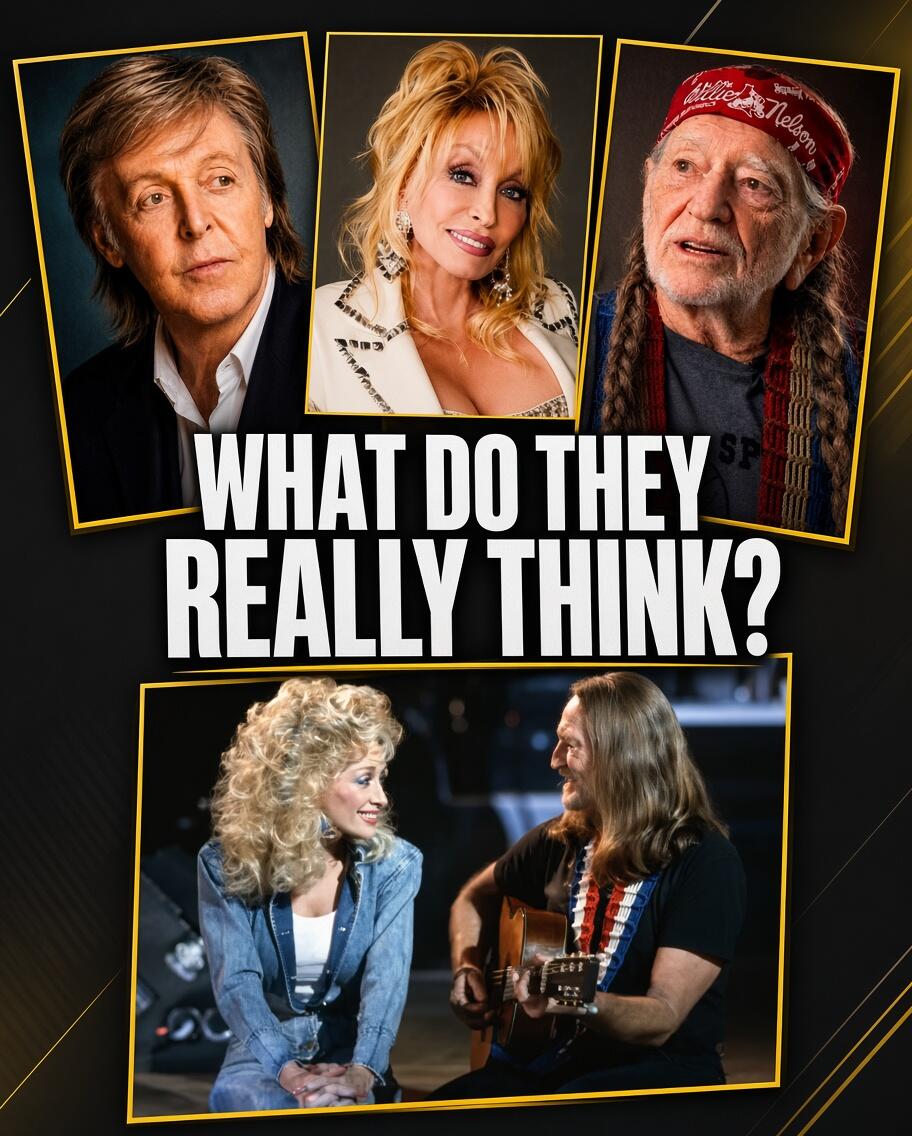
What Paul McCartney and Willie Nelson Really Thought of Dolly Parton — Two Legends, Two Very Different Goodbyes
When Dolly Parton died at 80 on August 25, 2026, tributes arrived from virtually every corner of popular culture.
Actors remembered her warmth. Country singers remembered her generosity. Fans remembered the songs.
But two tributes stood out for a different reason.
Paul McCartney and Willie Nelson were not simply admirers of Dolly Parton. They were fellow songwriters, performers and musical giants who had shared something with her that went beyond celebrity acquaintance.
McCartney chose words — and some of his strongest words were about Parton’s musicianship.
“There was no greater honour for me” than having Parton sing his song “Let It Be,” McCartney wrote after her death. He recalled meeting her in Nashville at the Grand Ole Opry, when she was still working with Porter Wagoner and preparing to establish herself as a solo artist. He remembered her as “bubbly and full of life” and praised her songwriting, singing and philanthropy.
Nelson took an entirely different approach.
Rather than issuing a long written statement, the country legend posted a video of himself and Parton performing together decades ago.
No lengthy explanation.
No grand declaration.
Just Dolly and Willie singing.
And in its own way, that may have been the most revealing tribute of all.
McCartney Saw Dolly as a Fellow Songwriter
The relationship between Parton and McCartney is particularly interesting because their musical worlds were not identical.
McCartney emerged from Liverpool and the Beatles, helping reshape popular music through some of the most influential songwriting of the 20th century.
Parton came from the Tennessee mountains and built her career in country music before becoming one of the most successful crossover artists in American entertainment.
Yet the distance between their backgrounds did not prevent mutual admiration.
McCartney recalled first meeting Parton at the Grand Ole Opry, where she was performing alongside Porter Wagoner. At the time, she was on the verge of the solo career that would eventually make her one of the most recognizable entertainers in the world.
Decades later, their paths crossed professionally in connection with Parton’s 2023 album Rockstar.
Parton recorded “Let It Be,” the Beatles classic written primarily by McCartney and released by the group in 1970.
For McCartney, hearing Parton take on the song was apparently not merely another celebrity cover.
He described it as an honor.
That wording is important.
McCartney could have simply said he was “sad” or that Parton was a “great artist.” Instead, he focused on the privilege of having her interpret one of his songs.
It was an acknowledgment from one legendary songwriter to another.
Parton was not merely famous enough to record a Beatles song.
She was an artist whose interpretation could make the songwriter himself feel honored.
The “Let It Be” Connection
Parton’s version of “Let It Be” also represented something larger about her career.
She spent decades refusing to remain confined to a single musical category.
Country was the foundation, but Parton repeatedly moved between country, pop, rock, bluegrass, gospel and musical theater.
Her songwriting became the bridge.
Songs such as “Jolene,” “9 to 5” and “I Will Always Love You” demonstrated that she could write material powerful enough to survive outside the genre in which it was created.
McCartney’s tribute therefore fits naturally into the larger story of Parton’s career.
He was not simply praising a famous singer who happened to cover his song.
He was recognizing another songwriter’s ability to take something familiar and make it personal.
That quality was central to Parton’s appeal.
Willie Nelson Let the Music Speak
Willie Nelson’s tribute was quieter.
According to reports following Parton’s death, Nelson shared a video of the two performing “Everything’s Beautiful (In Its Own Way)” from December 1984.
The choice carried its own emotional weight.
Nelson and Parton had known each other for decades. Their friendship and musical association stretched back roughly six decades, to the period when both were working as professional songwriters and musicians.
Instead of explaining the relationship to fans, Nelson essentially showed it.
The footage captured two artists who had already become legends, sharing a stage without needing to prove anything.
For fans watching the clip after Parton’s death, the emotional impact came from seeing Parton alive, singing and interacting with someone who had known her for so long.
The performance became a kind of time capsule.
It did not need a caption explaining why Dolly mattered.
The chemistry was there in the recording.
Two Tributes, One Message
At first glance, McCartney and Nelson appear to have offered completely different responses.
McCartney wrote an extended reflection.
Nelson posted a performance.
But underneath those choices was a remarkably similar message.
Both men treated Parton as an artist first.
McCartney emphasized her songwriting and singing.
Nelson returned to the music they had made together.
Neither tribute reduced her to the image of the rhinestone-covered entertainer or the larger-than-life personality that had become part of her brand.
That distinction matters.
Parton’s public persona was enormous.
She was a movie star, businesswoman, philanthropist, theme-park owner and television personality. She was famous for her humor, her appearance and her ability to turn almost any interview into an unforgettable story.
But musicians who worked with her repeatedly returned to something simpler.
She could write.
She could sing.
And she could make people feel something.
A Friendship That Outlasted Eras
Nelson’s connection with Parton was particularly significant because it survived multiple generations of country music.
When they first crossed paths, the modern country industry looked very different.
There was no streaming economy, no TikTok, no YouTube and no social media.
Artists built careers through radio, records, touring and television.
Parton eventually became one of the few entertainers capable of thriving through virtually every transformation that followed.
Nelson did much the same.
That makes the footage of them performing together more than an old celebrity clip.
It represents two musicians from an earlier era who continued to matter long after the entertainment industry around them had changed.
Parton’s ability to maintain that relevance was one of the reasons tributes following her death extended far beyond traditional country music.
Reuters noted that her influence reached into philanthropy, literacy, healthcare, disaster relief and multiple areas of popular culture. Her Imagination Library alone had distributed hundreds of millions of books to children around the world.
The Reaction From Fans
The emotional response to both tributes also reflects how differently modern fans experience celebrity grief.
A statement from McCartney immediately became a piece of news.
Nelson’s video became something else: a shared memory.
Fans could watch the footage and see Parton not as a historical figure, but as a performer.
That distinction has become especially important in the days following her death.
Social-media discussions surrounding Parton have repeatedly focused on old performances, interviews and collaborations. Instead of simply discussing her achievements, fans have been revisiting the moments that made those achievements possible.
The same phenomenon has occurred with tributes from other artists.
CBS’s retrospective on Parton’s career emphasized her unusual combination of talent, warmth, wit and philanthropy, while other musicians have shared personal stories and archival photographs.
In other words, fans are not simply mourning the loss of a celebrity.
They are revisiting a body of work that accompanied their lives.
Why Their Words Matter
There is another reason McCartney and Nelson’s tributes carry unusual weight.
Both men understand what it means to write songs that become bigger than their creators.
McCartney’s catalog includes songs that have been recorded by generations of performers.
Nelson has spent decades interpreting songs written by himself and others, often demonstrating how a great performer can change the emotional meaning of a familiar composition.
Parton belonged to that same tradition.
She could write a song herself, perform another songwriter’s material or reinterpret a classic and somehow make it sound as though it had always belonged to her.
That may explain why McCartney’s words about “Let It Be” landed so strongly.
The Beatles legend was not simply saying Dolly had a great voice.
He was acknowledging her ability to take his creation and make it her own.
Dolly’s Legacy Is Bigger Than Any One Tribute
Parton’s death has already produced an extraordinary outpouring of remembrance.
Her family held a private funeral, respecting her wishes, while public celebrations of her life are now being planned.
The estate has announced Dollyfest, a two-day celebration planned for Nashville and London in 2027, transforming what had originally been envisioned as an 80th-birthday celebration into a posthumous tribute to her life and career.
That may eventually provide the enormous public farewell many fans expected.
But McCartney’s words and Nelson’s video reveal why such a celebration will never be able to capture the whole story.
Dolly Parton meant something different to almost everyone who encountered her.
To millions, she was the voice behind “Jolene.”
To others, she was the songwriter behind “I Will Always Love You.”
To children around the world, her name became associated with books and literacy.
To fellow musicians, she was something more specific.
She was one of them.
And that may be the most important thing contained in these two tributes.
Paul McCartney remembered the honor of hearing Dolly Parton sing his song.
Willie Nelson remembered by showing the world what it looked and sounded like when the two of them sang together.
One used words.
The other used music.
But both ultimately arrived at the same conclusion: Dolly Parton was not merely a superstar who happened to become a great songwriter.
She was a songwriter and musician who became a superstar — and never stopped being either.
As the public continues to celebrate her legacy, that distinction is likely to remain at the heart of the tributes still to come.
Để lại một bình luận