NO ONE KNEW THOSE WOULD BE PAMELA CISNEROS’ FINAL WORDS.
Just days before the shocking Times Square attack, Pamela spoke with someone in her family.
At the time, the conversation seemed ordinary.
But after what happened next, those words suddenly carry a completely different meaning.
Her family had already noticed something wasn’t quite right.
They just didn’t know how serious it was.
Then Pamela entered Times Square.
Minutes later, Erin Piacenti was gone.
Now one question is haunting those closest to Pamela:
What exactly did she say before everything changed?
👇 The disturbing details of Pamela Cisneros’ final conversation are raising new questions.
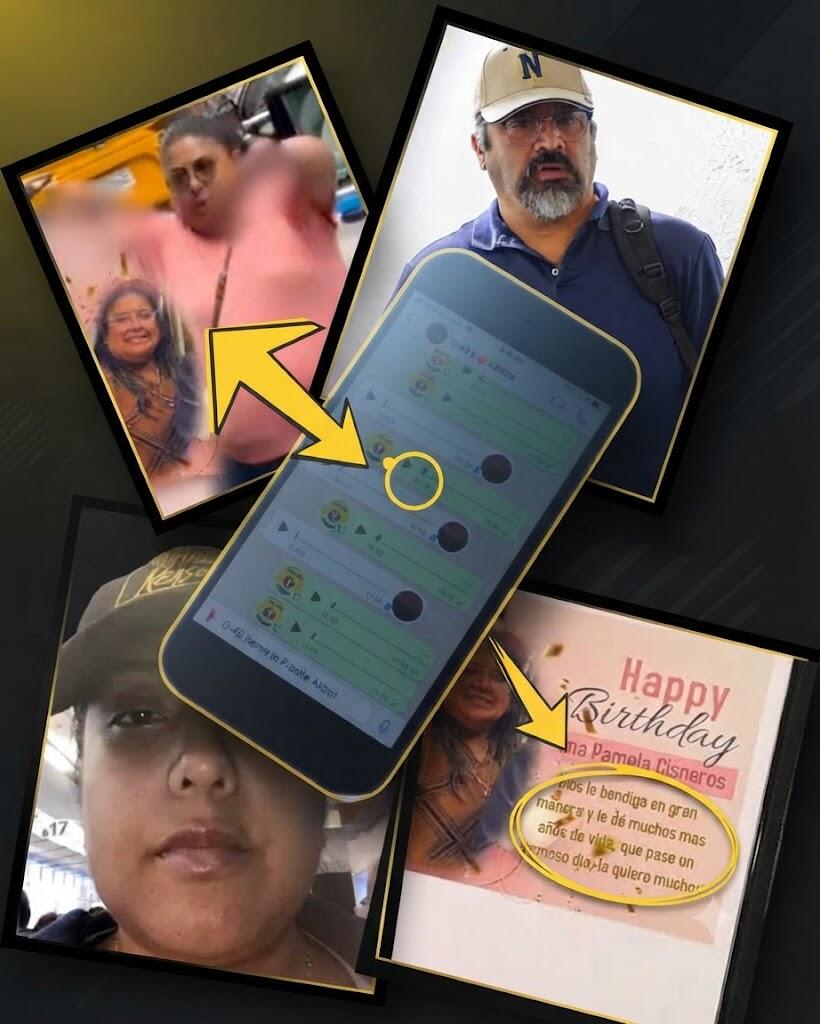
Two days before Pamela Cisneros walked into Times Square carrying two knives, she had a seemingly ordinary conversation with her mother.
Cisneros said she was fine.
There was no indication, at least from the family’s perspective, that the 49-year-old Queens woman was about to become the central figure in a violent attack that would leave Bank of America executive Erin Piacenti dead and another man injured.
That brief conversation has since taken on a haunting significance for Cisneros’ relatives.
Her brother, Patrick Peralta, has described a woman who had struggled with serious mental-health problems for years but who, in the period before the attack, appeared to have regained a measure of stability. Her father similarly believed that treatment had helped his daughter turn a corner.
Yet something had changed.
In the week before the Aug. 31 attack, Cisneros stopped showing up for her family’s usual visits. Relatives began calling to check on her. When her mother finally spoke with her on Saturday, Cisneros reportedly reassured her that she was fine.
Two days later, she was dead, shot by police after a confrontation in Midtown Manhattan.
The gap between those two moments is now one of the most troubling parts of a case that remains without a clear public explanation.
The last known conversation
According to Peralta’s account to reporters, Cisneros had normally maintained regular contact with her mother and stepfather.
She often came over for meals and remained involved with her family.
That routine changed shortly before the attack.
Peralta said the family noticed that she had not come by during the previous week and began trying to reach her.
The last reported direct conversation between Cisneros and her immediate family before the attack came on Saturday, Aug. 29, when her mother spoke with her by phone.
Cisneros said she was fine.
That was apparently reassuring enough at the time.
There was no reported warning in that conversation that she was preparing to travel into Manhattan or that violence was imminent. The family has not publicly described any specific threat or detailed plan that Cisneros disclosed during the call.
That makes the simplicity of the exchange particularly difficult to process after what happened.
Her brother later said the family had not imagined that she could commit such an act.
“She was fine. Normal,” Peralta recalled of the last time he had personally seen his sister, at a family birthday gathering earlier in August.
The family’s account does not provide a definitive explanation for what happened next.
It does, however, establish a striking contrast: someone who appeared outwardly stable to relatives shortly before an attack that police described as random and unprovoked.
A history the family thought they understood
Cisneros had a documented history of mental-health problems stretching back years.
Police Commissioner Jessica Tisch said Cisneros had previous encounters with the NYPD in 2018 and 2019 related to mental-health concerns. In March 2019, police encountered her after she attempted to jump in front of a subway train at the Union Turnpike-Kew Gardens station, according to police records cited by The New York Times.
Her father, Mario Cisneros, told The New York Times that the family had become deeply involved in her treatment following a 2019 crisis.
He said he began taking her to monthly appointments where she received injections that appeared to help stabilize her.
For a time, he believed the situation had improved.
Then, in April, he said, Cisneros refused his offer to drive her to a mental-health appointment at Jamaica Hospital Medical Center.
Her message to him, according to his recollection, was essentially that he should not worry because she was doing fine.
That memory has become particularly painful in light of what happened months later.
It is important to note that authorities have not publicly established that a lapse in treatment caused the Times Square attack. Her family has raised questions about her treatment and recent behavior, but those questions remain part of an incomplete picture rather than a confirmed explanation.
The personal history behind the headlines
Cisneros’ family history has also attracted attention as reporters have examined her life before the attack.
According to The New York Times, Cisneros had been married to a Citibank employee and the couple shared two daughters. They later filed for divorce in 2020 and had a custody dispute involving their youngest daughter.
Family members have also said Cisneros had three daughters and had experienced significant difficulties in maintaining family relationships.
Those details are important context, but they do not establish a motive for the Times Square attack.
Nor has police publicly linked the stabbing to a marital dispute, a custody issue or a conflict involving her children.
That distinction has become increasingly important as online discussions attempt to connect separate pieces of Cisneros’ personal history.
A person’s struggles, family circumstances or mental-health history cannot by themselves explain why a violent act occurred.
Investigators still have to establish what happened during the period immediately preceding the attack.
What happened in Times Square
The attack unfolded with extraordinary speed.
At approximately 4:24 p.m. on Aug. 31, police said Cisneros pulled two kitchen knives from a red Target shopping bag near West 41st Street and Seventh Avenue.
Her first reported victim was Tak Kam, a 68-year-old man who was stabbed in the abdomen.
Approximately 20 seconds later, Cisneros moved toward West 42nd Street and attacked Piacenti.
Piacenti, 32, was a vice president at Bank of America and had been heading home from work when she was attacked.
She was taken to Bellevue Hospital but died from her injuries.
Kam survived.
Police described the attacks as random and unprovoked and have not publicly identified a personal connection between Cisneros and either victim.
The randomness of the apparent attack is one reason Cisneros’ background has received such intense scrutiny.
If there was no known relationship between attacker and victims, investigators and the public are left looking elsewhere for an explanation.
But as of now, no definitive motive has been publicly established.
The final minutes
After the stabbings, officers confronted Cisneros near West 43rd Street.
According to police officials, she was still holding a knife in each hand.
Officers spent several minutes attempting to get her to drop the weapons.
Police said Tasers were deployed but failed to stop her.
Cisneros then moved toward the officers while armed.
Two officers fired their guns, striking her.
She was taken to Bellevue Hospital, where she died.
Videos recorded by witnesses and released through official channels have become a major part of the public discussion surrounding the confrontation.
The New York attorney general’s office has opened an investigation into the police shooting, as required by state law in cases involving civilian deaths caused by police. The NYPD’s Force Investigation Division is also examining the encounter.
The investigation does not, by itself, indicate that officers acted improperly. Such reviews are required under New York law.
Erin Piacenti’s life ended in an instant
While Cisneros’ family is trying to understand the events leading up to the attack, Piacenti’s family is dealing with an entirely different loss.
Piacenti was a 32-year-old Bank of America vice president who lived in Chester, New Jersey.
She had recently returned to work following maternity leave and had a five-month-old daughter.
Her death has prompted an outpouring of support for her family, including a GoFundMe campaign intended to help provide for her daughter. Recent reports said the fundraiser had surpassed $500,000 and was approaching its $750,000 goal.
The circumstances have made the tragedy especially difficult to absorb.
Piacenti had been returning to work and building a life with her husband and young daughter when she encountered a stranger in one of Manhattan’s busiest public spaces.
There is no indication that she knew Cisneros.
The attack appears to have been completely unexpected.
The online reaction
The case has also generated intense discussion online, particularly around mental health, police tactics and whether warning signs were missed.
A Reddit discussion about the attack quickly split between users praising officers for attempting to use Tasers and de-escalation before opening fire, and others questioning whether the confrontation could have been handled differently.
Those arguments mirror a broader debate now unfolding around the case.
Some commenters focus on Cisneros’ mental-health history and ask whether earlier intervention might have prevented the attack.
Others focus on the circumstances surrounding the police shooting and whether officers had any realistic alternative once she continued advancing while armed.
Neither discussion, however, answers the central question of why Cisneros attacked two strangers in the first place.
The New York attorney general’s investigation is expected to examine the police encounter itself, while investigators continue gathering information about the stabbing attack.
The question her family cannot answer
For Cisneros’ relatives, perhaps the most painful detail is not one of the dramatic videos from Times Square.
It is the ordinary phone call that came just two days earlier.
Her mother spoke with her.
Pamela said she was fine.
That was the last known conversation between Cisneros and her immediate family before the attack, according to her brother’s account.
Her father had also believed she was doing better.
The family had seen her struggle before. They had watched her receive treatment. They had experienced periods when she appeared stable enough that the worst seemed to be behind them.
Then, sometime between that final reassuring conversation and the afternoon of Aug. 31, something changed.
Exactly what changed remains unclear.
There is currently no publicly confirmed account showing that the family knew an attack was coming, nor is there a confirmed explanation connecting the attack to her marriage, children or treatment.
That uncertainty is likely to remain central as investigators reconstruct Cisneros’ final days.
For now, the known timeline is stark.
A woman with a long history of mental-health difficulties told her family she was fine.
Two days later, two strangers were attacked in Times Square.
One of them, Erin Piacenti, died.
And moments after the violence began, Pamela Cisneros herself was dead.
The investigations now continue on two fronts — the circumstances of the Times Square stabbings and the police shooting that followed.
For the families involved, however, the most important unanswered question may be much simpler:
What happened during those final two days that no one saw coming?
Để lại một bình luận