🚨 HE SENT A DEMO WITH A NOTE SAYING “IT’S UNFINISHED.” WHAT HAPPENED NEXT MADE MUSIC HISTORY.
Jimmy Webb thought it was just a rough, incomplete draft. It only had two short verses. It had no ending. It was literally missing a whole chunk of the song.
So he mailed it over with a explicit warning: “This isn’t done yet.”
Weeks went by in complete silence. Jimmy assumed they hated it and threw it in the trash.
Then he ran into Glen Campbell in the hallway.
What Glen confessed right then and there completely shocked Jimmy—and led to a daring, impromptu decision in the recording studio that changed American pop music forever.
Instead of writing that missing third verse, Glen grabbed a rare six-string bass and played something so breathtaking, even Bob Dylan later declared it “the greatest song ever written.”
Yet to this very day, the man who wrote it still insists the song is missing something.
The unbelievable story of a solo lineman on an Oklahoma highway, a borrowed instrument, and a No. 1 masterpiece created by accident is mind-blowing 👇
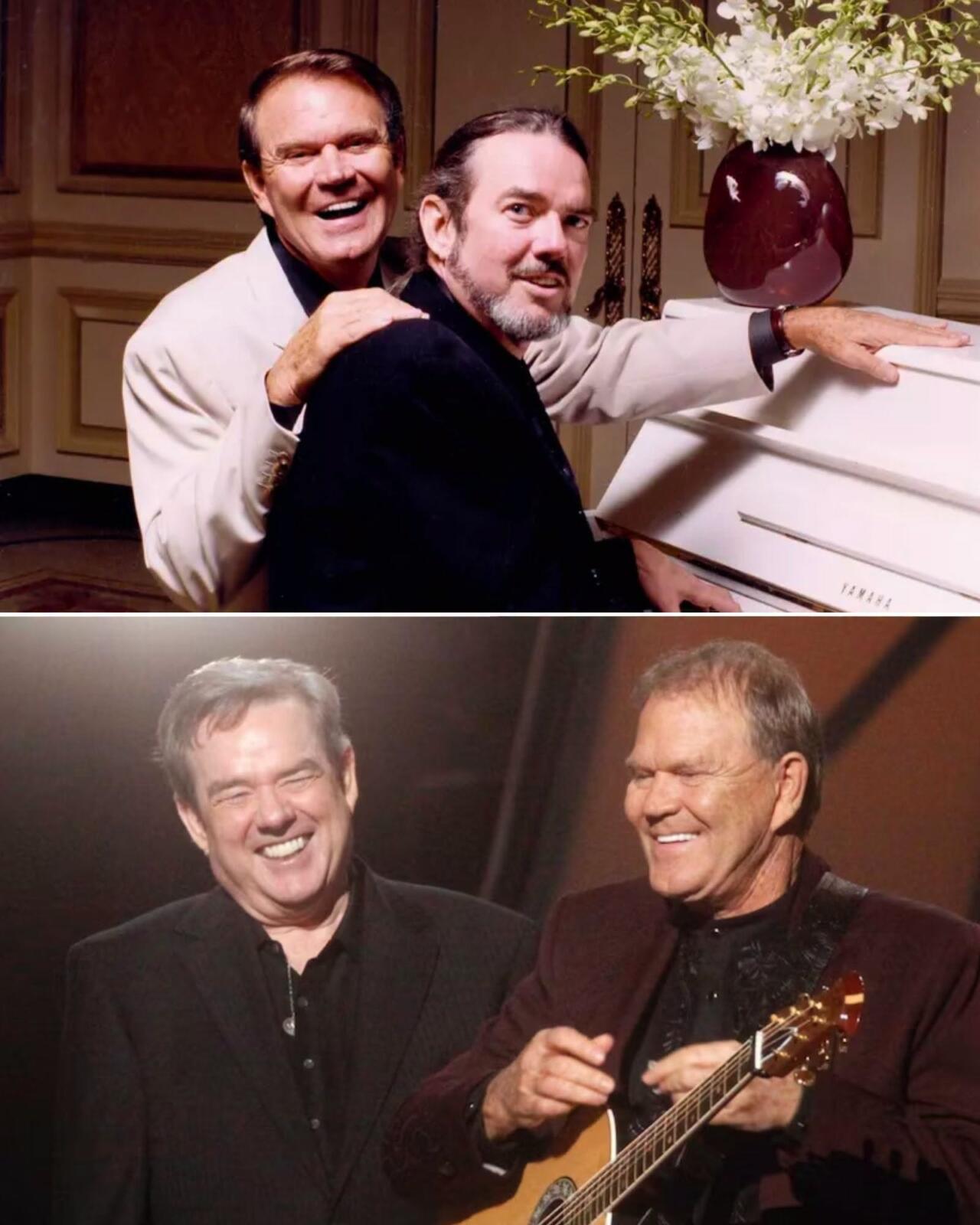
In the late autumn of 1968, a song began playing across American radio stations that sounded unlike anything else on the airwaves. It was lush, melancholic, and deeply cinematic, telling the story of a lonely utility worker stretching wires across the vast, empty expanse of the American heartland.
That song was “Wichita Lineman,” performed by country-pop sensation Glen Campbell and written by prodigal songwriter Jimmy Webb.
It went straight to No. 1 on the Billboard Country chart, peaked at No. 3 on the Billboard Hot 100, and eventually earned a permanent place in the Great American Songbook. Decades later, Bob Dylan himself would publicly declare it “the greatest song ever written.”
Yet, behind the record’s staggering critical and commercial success lies one of the most bizarre and improbable recording stories in popular music history: the songwriter never intended for the version millions fell in love with to be released. In fact, Jimmy Webb sent the track to Glen Campbell as an unfinished demo with a note warning that it was incomplete—only for Campbell to record it anyway, fill the missing gap with a legendary bass solo, and turn an accident into a timeless classic.
A Phone Call and an Oklahoma Highway: The Birth of an Icon
The story of “Wichita Lineman” began with an urgent request. In late 1967, Glen Campbell had achieved massive crossover success with “By the Time I Get to Phoenix,” a haunting ballad composed by the young, extraordinarily talented songwriter Jimmy Webb.
Eager to follow up on the track’s momentum, Campbell called Webb with a specific brief. He wanted another song along the same lines—a story tied to a geographic location, capturing a sense of distance, yearning, and everyday human experience.
Webb, sitting at his piano in his Los Angeles home, began reflecting on his childhood drives through rural Oklahoma and Texas. He remembered a vivid, isolated image from a drive through Washita County, Oklahoma: flat prairie stretching out endlessly under a vast sky, lined with endless rows of wooden telephone poles heading toward the horizon.
As Webb drove past, he looked up and saw a solitary line technician perched high atop one of the poles, holding a telephone handset and talking to someone far away.
“I thought to myself, what a lonely job that must be,” Webb later recalled in various interviews archive documented by music historians. “Here was a man working in complete solitude, surrounded by miles of empty land, yet holding the lines of communication for thousands of people.”
Webb sat down at his piano that afternoon and began composing. He adopted the perspective of the worker, giving birth to lines that would become iconic: “I am a lineman for the county, and I drive the main road / Searchin’ for another overload…”
“It Isn’t Finished”: The Missing Third Verse
Webb poured his emotions into the track, but as the afternoon wore on, he hit a creative wall. He had composed two verses and a chorus, but structurally, the song was incomplete. In traditional pop songwriting of the 1960s, a record required a third verse or a distinct bridge to bring the narrative to a satisfying resolution.
However, Campbell’s record label was pressing for new material immediately. Webb recorded a quick piano demo of what he had, attached a note explicitly stating, “This song isn’t finished yet—I’ll write the third verse later,” and sent it over to Campbell’s studio.
Weeks passed. Webb heard nothing back.
Assuming Campbell and his producers had listened to the fragment, deemed it unsatisfactory, and tossed it aside, Webb moved on to other projects.
Then, roughly a month later, Webb bumped into Campbell in person at a studio complex in Los Angeles.
“Hey Glen,” Webb recalled saying, “I guess you guys didn’t like that ‘Lineman’ song since I never heard back from you.”
Campbell looked at him with a grin and replied, “Oh, we recorded that two weeks ago! It’s already mixed.”
Webb was stunned. “How could you record it? It doesn’t have a third verse!”
The Six-String Bass Solo: Turning a Void into Magic
When Campbell and his legendary group of session musicians—the famed “Wrecking Crew”—had gathered at Capitol Studios in Hollywood to record the track, they immediately recognized the magic in Webb’s two verses. But when they reached the spot where the missing third verse was supposed to go, they faced a dilemma.
Rather than waiting for Webb to write more lyrics, Campbell decided to take a creative gamble.
Sitting in the studio was legendary session bassist Carol Kaye, who happened to have a rare Danelectro six-string bass guitar with her. Campbell, an extraordinary guitarist in his own right, picked up Kaye’s six-string bass—an instrument tuned lower than a standard guitar but higher than a traditional bass—and began improvising over the chord progression.
Instead of words, Campbell filled the empty space with a subtle, twangy, and deeply emotional instrumental melody. The solo mirrored the sweeping sadness of the orchestral arrangements added later by arranger Al De Lory, perfectly capturing the atmospheric desolate beauty of the Oklahoma plains.
That improvised solo, born out of a literal gap in the sheet music, remained right in the middle of the finished master recording.
Chart Conquest and Public Obsession
Released in October 1968, “Wichita Lineman” exploded across radio networks nationwide.
The public reaction was immediate and passionate. Listeners on both country and pop stations were captivated by the song’s atmospheric production, Campbell’s effortless, soaring vocals, and the sheer poetry of lines like “And I need you more than want you / And I want you for the time being.”
Online music communities on Reddit (such as r/ClassicRock and r/CountryMusic) and music history forums frequently discuss those specific lyrics as some of the most complex emotional statements in pop music history. The song captured a universal feeling of blue-collar loneliness, resonating deeply with a late-1960s America undergoing massive social upheaval.
The track swept through the music charts:
-
Billboard Hot Country Singles: #1 (spending two weeks at the top)
-
Billboard Hot 100: #3
-
Billboard Adult Contemporary: #1 (spending six weeks at the top)
It sold over a million copies almost instantly, solidifying the musical partnership between Glen Campbell and Jimmy Webb as one of the most successful singer-songwriter duos of the era, alongside the likes of Elton John and Bernie Taupin.
The Critics, Dylan, and the Eternal Debates
Over the decades, “Wichita Lineman” only grew in stature. Rolling Stone magazine placed it on its list of the “500 Greatest Songs of All Time,” while music critics from publications like The Guardian and The New York Times routinely analyze its minimalist narrative structure.
Perhaps the highest praise came from Nobel laureate Bob Dylan. In a well-documented media exchange, Dylan singled out “Wichita Lineman” as “the greatest song ever written,” praising its haunting imagery and emotional restraint.
On platforms like X (formerly Twitter), TikTok storytelling accounts, and YouTube music reaction channels, younger generations continue to discover the track, often amazed to learn that its iconic structure was essentially an accident.
“The fact that Glen Campbell plugged a missing verse with a six-string bass solo and turned it into Bob Dylan’s favorite song is absolute genius,” wrote one popular commentator on X.
On Reddit, musicians often break down the technical brilliance of Campbell’s solo and De Lory’s string arrangements, noting that a third verse might have actually ruined the song’s sparse, poetic mystery.
The Songwriter’s Persistent Itch
Despite the millions of copies sold, the Grammy nominations, and the universal acclaim, Jimmy Webb’s perspective on his greatest creation remains humorously conflicted.
In interviews given throughout his long and distinguished career, Webb has repeatedly maintained—with a self-deprecating smile—that in his mind, the song remains incomplete.
“Every time I hear it on the radio, I still think, ‘Man, I should have written that third verse,’” Webb once told a journalist. “Glen proved to me that a great performance can transcend the rules of classical songwriting, but as a writer, part of me will always feel like I left the job half-done.”
Glen Campbell passed away in August 2017 after a heroic battle with Alzheimer’s disease, but “Wichita Lineman” remains a central pillar of his legacy.
The Future Legacy: An Unbroken Connection
Today, “Wichita Lineman” continues to be covered by artists across virtually every genre—from rock bands like R.E.M. and The Smashing Pumpkins to modern country star Keith Urban and indie-folk artists.
Its enduring power lies in its restraint. By stopping right where it did, the song left a deliberate “information gap” that allowed millions of listeners over the last half-century to fill in the blanks with their own feelings of love, distance, and longing.
What started as an incomplete demo mailed across town with a note of apology stands today as a masterclass in musical serendipity—proving that sometimes, what you leave out of art is just as powerful as what you put in.
Để lại một bình luận