Britain’s Regular Army Just Hit a Size Last Seen in 1799—Right as London Promises Troops for Major War. 🚨🇬🇧
Nuclear deterrent? Check. Two aircraft carriers? Check. Big diplomatic pledges for NATO’s eastern flank and postwar Ukraine? Check.
Except when you look behind the curtain, Britain’s regular army has shrunk to roughly 66,000–74,000 soldiers, its heavy artillery was sent to Ukraine with replacements not due until 2028, and Parliament is debating being “ready for war within 1,000 days” while defense budgets and troop pipelines face brutal reality checks. 📉💥
Wait until you see the math on how many troops Britain can actually keep in the field without burning out, why artillery shell production hits a brick wall, and how raising the military recall age to 65 exposes a massive gamble. 👀
Can an army built to arrive actually survive a war built to stay?
Read the full breakdown before everyone else does 👇🔥
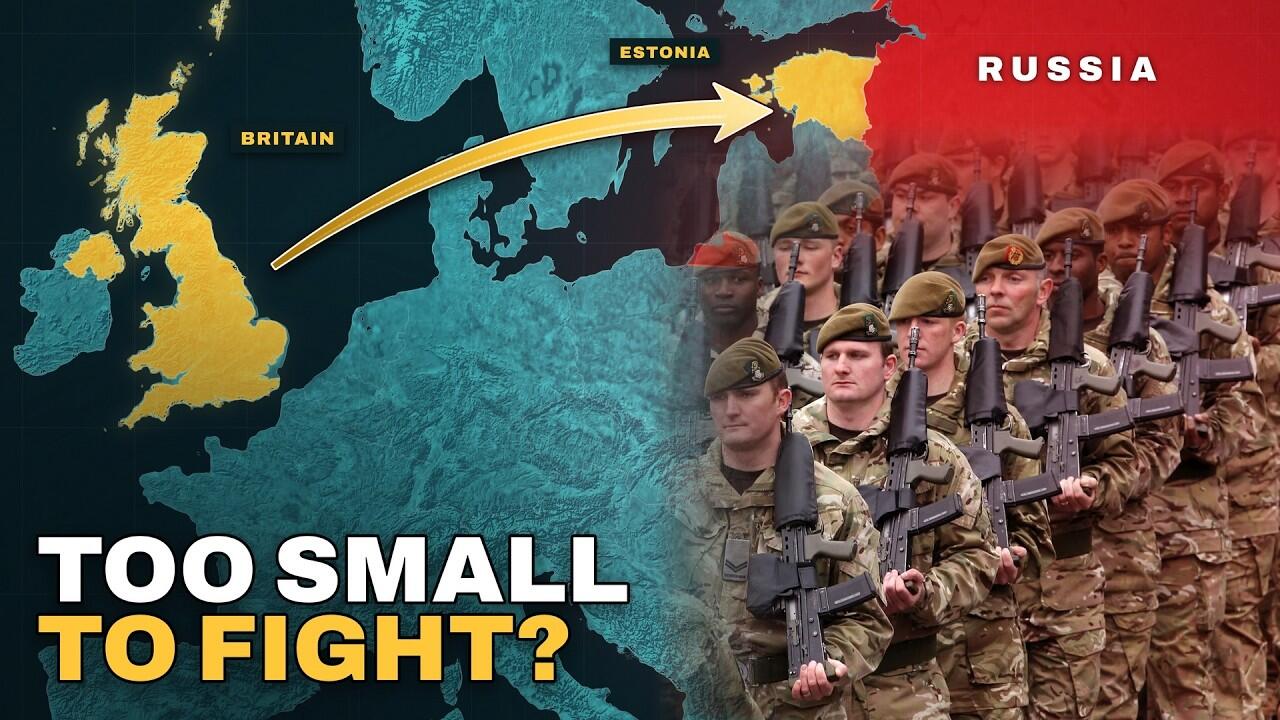
A British general commands multinational planning, a few hundred troops rehearse in Poland, a battle group rotates in Estonia, and London’s political leaders speak urgently about being ready to fight and win within roughly 1,000 days as global threats mount. Yet behind the headlines of strategic ambition sits a stark question echoing through Westminster, think tanks, and defense forums: Does Britain still have the industrial depth, manpower pipeline, and staying power to fight a prolonged, high-intensity major war?
That debate—examined in a Theatre of Power video analysis and underscored by U.K. parliamentary committee reports, Ministry of Defence (MoD) statistics, and British press coverage through late November 2026—cuts to the core of modern British military power. Britain remains a nuclear-armed state with aircraft carriers, F-35s, intelligence capabilities, and a major defense budget. Critics and defense analysts argue, however, that decades of peacetime downsizing and delayed equipment programs have left a gap between strategic promises and sustainable force depth.
A Force Built to Arrive, Not to Stay
At the center of the argument is a distinction between initial deployment and sustained endurance. A modern military can deploy a sharp spearhead for a limited mission, but a major conventional conflict consumes troops, ammunition, spare parts, and experienced leaders at a pace that peacetime forces were rarely sized to absorb.
According to the Theatre of Power breakdown and figures cited from British fact-checking organization Full Fact alongside MoD personnel reporting, the regular British Army has contracted dramatically since the end of the Cold War in 1990—falling from roughly 153,000 regulars then to around 109,000 by 2010, moving toward an 82,000 ceiling under reforms a few years later, and standing around 74,000 total regulars (with roughly 66,730 counted as fully trained regulars on narrower measures, and around 109,000 when including reservists and Gurkhas depending on the count). At that scale, observers note, regular army headcount has reached levels not seen since the turn of the 19th century.
Why does headcount matter so much for endurance? Because front-line combat units need rotation, recovery, training, and replacement. As the Theatre of Power analysis notes using Britain’s deployment in Helmand province, Afghanistan, between 2010 and 2012 as a benchmark, sustaining roughly 9,500 troops through six-month brigade rotations out of a regular army of about 109,000 already stretched the force over years—even in a counterinsurgency without peer-level enemy artillery or air power. With a smaller regular army today, analysts warn that sustaining a single brigade over a long deployment—or a larger formation for a few months—draws repeatedly on the same finite pool of personnel when multiple commitments overlap on paper.
Even modest casualty rates in a high-intensity European war would test that arithmetic sharply. While no Western force plans to absorb losses on the scale of recent Russian attrition figures cited by British defense intelligence, analysts point out that losing even a fraction of a major conflict’s casualty rate over a year would quickly eat into a small regular force—and crucially, into the non-commissioned officers and junior leaders who train replacements. Historical parallels to August 1914 are frequently invoked by historians and commentators: when a small professional force suffers heavy early losses, the loss of experienced sergeants and officers slows the training of expanded forces later on.
Artillery, Munitions, and Flagship Delays
Manpower is only half the equation; stockpiles and industrial capacity determine whether a force can keep firing once a conflict begins.
To support Ukraine’s defense, Britain transferred its entire fleet of AS90 self-propelled artillery guns—widely reported as around 70 to 80 systems—a move widely praised for putting hardware into immediate combat use rather than mothballs, but one that left the British Army reliant on a small stopgap fleet of Swedish Archer guns while awaiting new RCH155 howitzers ordered under a roughly £1 billion deal with deliveries beginning around 2028 and extending over subsequent years.
Ammunition production tells a similar story of tight margins. High-intensity warfare burns through artillery shells at rates that dwarf peacetime manufacturing lines. While defense contractors and the U.K. government have worked to expand domestic energetics and shell-filling capacity—such as upgrades at BAE Systems’ Glascoed facility in Wales—analysts note that scaling up output from peacetime baselines to match modern battlefield consumption takes years, capital investment, and supply-chain resilience.
Meanwhile, flagship land modernization has faced years of turbulence. The Army’s Ajax armored vehicle program, originally ordered in 2014 with an early in-service target around 2020, suffered protracted delays tied to crew noise and vibration issues, with initial operating capability declarations and trials stopping and restarting across 2025 and 2026. When a major program stalls, the cost isn’t just on the parade ground: tied-up funds, stretched timelines, and delayed deliveries complicate budget bargaining when defense money is divided among nuclear deterrence, naval shipbuilding, air power, and cyber or space capabilities.
Westminster Politics, the “1,000 Days” Push, and Recall Proposals
Defense readiness has moved front and center in British politics throughout 2026 amid economic pressures, leadership transitions, and heightened warnings over global instability.
In June 2026, then-Defense Secretary John Healey resigned, pointing to tensions over how quickly defense spending would reach higher shares of national income—with debates swirling around trajectories toward roughly 2.7 percent of GDP by 2030 versus calls for 3 percent—just as the government’s Defence Investment Plan stretched certain programs, canceled two warship classes, and backed investments such as air and missile defense, munitions replenishment, and digital targeting. Subsequent autumn budget debates and parliamentary scrutiny—including a November 2026 report from the House of Lords Industry and Regulators Committee urging government and industry to move at pace to meet a ~1,000-day readiness ambition ahead of a December defense investment summit—highlighted both urgency and execution hurdles.
Opposition figures, including Conservative leadership, have pressed the government over whether readiness targets are backed by concrete plans and sufficient funding, while debates over fiscal trade-offs—between defense, public services, and welfare—continue to divide politicians and commentators.
On the personnel front, legislative efforts to raise the maximum recall age for former armed forces personnel from 55 to 65 (estimated to cover around 95,000 former personnel over time as rules take effect) reflect a pragmatic acknowledgment that the regular army alone is small. Yet defense analysts caution that a recall pool only works if equipment, instructors, units, and refresher training are ready to absorb returning personnel—noting that recalling former soldiers and relying on reserves fills gaps in existing formations rather than conjuring a second full-scale army overnight.
The Counterargument: Alliances, Sea Power, and Nuclear Deterrence
Not everyone accepts a bleak verdict on Britain’s ability to contribute to a major war. Defenders of current U.K. strategy—and military analysts who push back against alarmism—stress several vital caveats:
-
Collective defense, not fighting solo: Britain’s core warfighting doctrine centers on NATO and allied coalitions, not fighting a major war against a peer power alone. In a European contingency, frontline mass and large standing armies from regional allies such as Poland—which has expanded its armed forces substantially—would play a major role alongside U.S. and European partners.
-
High-end enablers and deterrence: Britain’s strategic weight rests heavily on its continuous at-sea nuclear deterrent, Royal Navy submarines and carrier strike capabilities, Typhoon and F-35 aircraft, intelligence sharing, special operations, and commanding multinational headquarters—areas where an island nation can punch above a small ground-force headcount.
-
Technological shift: Modern warfare increasingly blends mass with unmanned systems, sensors, air defense, and precision fires rather than relying solely on Cold War-era divisions.
Even so, critics counter that alliance commitments cut both ways: when NATO plans rely on rapid reinforcement and sustained presence on the eastern flank, thin depth in artillery, air defense, logistics, and trained reserves can still constrain what London can sustain without strain.
Community Reaction: Defense Buffs, Reddit, and X Clash Over Britain’s Military
Online, the question of whether Britain can still fight a major war draws passionate debate from veterans, defense enthusiasts, and casual observers:
-
Reddit (
r/CredibleDefense,r/LessCredibleDefence,r/ukpolitics,r/UnitedKingdom): Defense-focused subreddits frequently dissect exact MoD statistics, procurement timelines for Ajax and RCH155, shell-stockpile math, and the difference between deployable combat power and sustainable rotation depth. Many users argue that Britain’s real value in a NATO crisis lies in naval, air, nuclear, and intelligence contributions rather than mass infantry, while others warn that hollowing out munitions and training pipelines leaves dangerously little margin for error. On U.K. political forums, arguments often split between those blaming past austerity and procurement mismanagement across governments and those arguing that tight domestic budgets limit how fast spending can rise. -
X and YouTube Comment Sections: Clips from Theatre of Power and British defense debates spark lively exchanges over whether the U.K. has become a “hollow force” or whether critics understate naval power, AUKUS submarine cooperation, and allied burden-sharing. Some commenters scoff at raising recall ages to 65 as a sign of desperation, while others view it as standard legal housekeeping alongside broader reserve and industrial reforms.
What Comes Next? Scenarios for Britain’s Defense Rebuild
As Britain moves from strategic reviews toward implementation in late 2026 and into 2027, several milestones will test whether rhetoric and capability converge:
-
Procurement Delivery vs. Delays: Whether newer artillery, air defense, drone, and armored programs hit realistic delivery schedules without repeating past cost overruns and technical setbacks.
-
Industrial Scaling: How quickly domestic munitions and energetics lines expand output—and how defense investment summits translate into multi-year orders and skilled manufacturing jobs.
-
Recruiting and Retention Trends: Whether modest upticks in applications and reduced early exits translate into sustained growth in trained soldiers and experienced NCOs, rather than revolving-door turnover.
-
Budget Realities and Allied Burden-Sharing: How future spending reviews balance defense targets against domestic fiscal constraints, and how European allies coordinate stockpiles, air defenses, and deterrence along NATO’s eastern flank.
For Britain, the test ahead is not simply whether its flag can be shown or a rapid deployment mounted—it is whether the industrial and human foundation beneath that force is strong enough to endure if crisis turns into prolonged conflict.
Để lại một bình luận