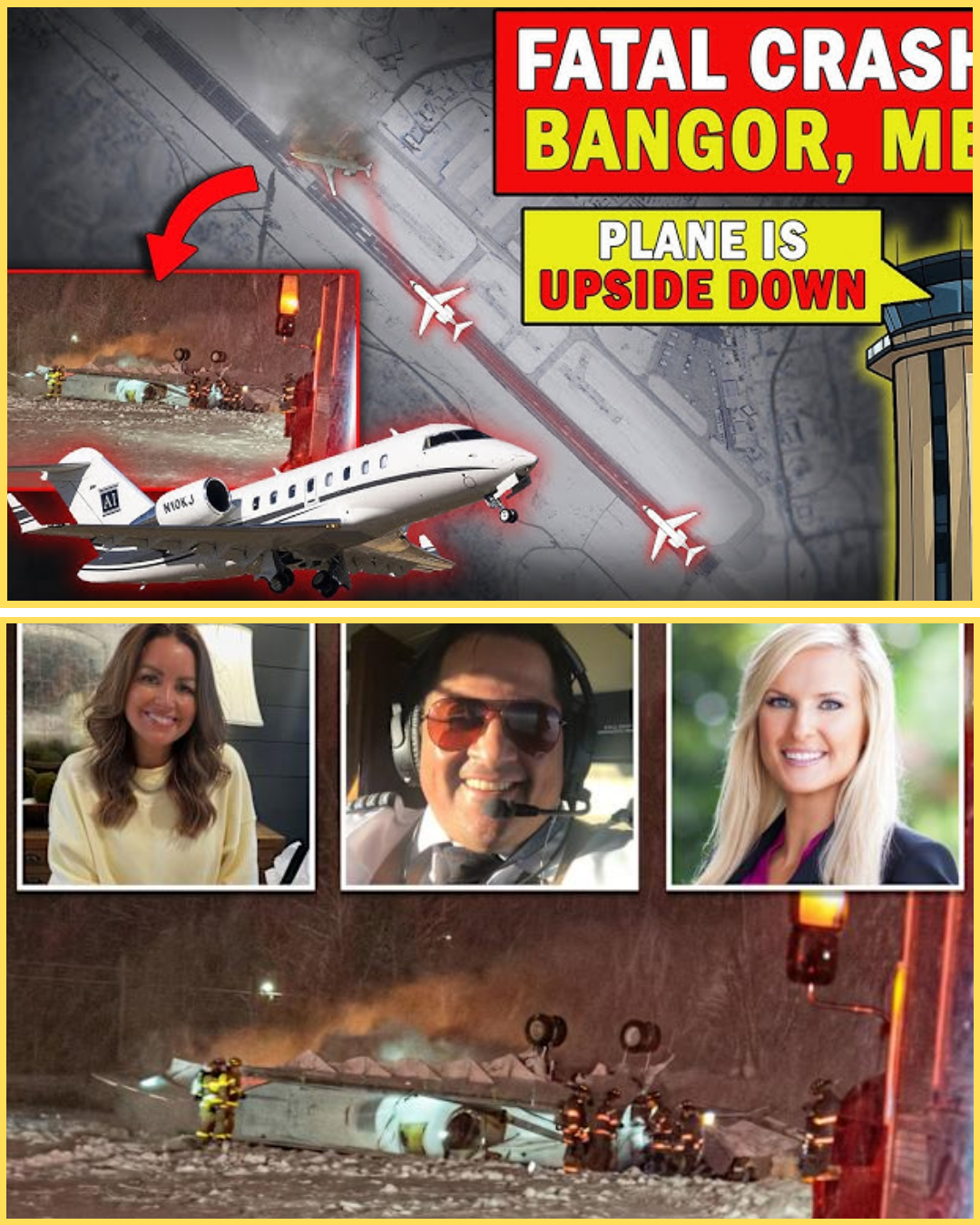
The chilling words “No one warned either of them” have echoed through grieving families and aviation circles in the wake of the fatal Bombardier Challenger 600 crash at Bangor International Airport on January 25, 2026. Relatives of the victims have voiced shock and mounting questions upon learning that the aircraft model carries a documented history of vulnerabilities to icing during takeoff — a risk that some say should have prompted heightened caution or explicit warnings in the high-stakes world of private jet travel.
The tragedy claimed all six people aboard the Paris-bound jet (registration N10KJ): two crew members and four passengers. The plane, which had flown in from Houston’s Hobby Airport earlier that evening, sat exposed on the ground for over an hour amid accumulating snow and sub-zero temperatures before attempting departure around 7:45 p.m. It flipped inverted during the takeoff roll, came to rest upside down on or near the runway, and erupted in flames. No mayday call was reported, and the crash unfolded rapidly despite de-icing operations being underway at the airport.
The Model’s Troubled Legacy with Icing
Aviation safety experts have repeatedly highlighted the Bombardier Challenger 600 series’ notorious sensitivity to wing contamination in cold weather. Former NTSB investigator and consultant Jeff Guzzetti described the type as “very susceptible” to even minor ice, frost, or slush buildup on the upper wing surface — sometimes as thin as rough sandpaper — which can disrupt airflow, reduce lift asymmetrically, and cause the aircraft to roll uncontrollably during rotation.
This vulnerability isn’t new. Historical incidents include:
- Deadly crashes in Birmingham, England (early 2000s) and Montrose, Colorado (2004), where icing contributed to loss of control on takeoff. The Colorado crash killed the son of NBC executive Dick Ebersol, prompting extensive NTSB scrutiny.
- Three prior incidents in Canada involving unexpected rolls during cold-weather takeoffs, leading to an FAA Airworthiness Directive in 2008. It mandated specific warnings in the flight manual: even small amounts of ice, frost, or slush could cause pilots to lose control.
Post-incident recommendations from Bombardier and regulators emphasized rigorous pre-flight inspections, timely de-icing, and strict holdover times (typically 20 minutes in active precipitation). While no major icing-related crashes on the type had occurred in recent years, experts stress that the supercritical wing design remains inherently unforgiving compared to other business jets.
In Bangor’s case, the plane taxied to the de-icing pad for about 20 minutes before proceeding to the runway. Airport officials confirmed de-icing operations were active, but it’s unclear if this specific aircraft received full treatment or if conditions — including possible cold-soaked fuel in the wings accelerating ice formation — exceeded safe limits. Other flights operated without issue that evening, but snow was falling and visibility had dropped significantly.
Family Anguish and Growing Questions
For the victims’ prominent families — many with ties to Houston, including connections to a law firm associated with the jet’s registration — the revelation of the model’s history has intensified grief into outrage. Relatives described the moment of discovery as devastating: learning not just of the loss but that the Challenger 600 had a known predisposition to icing mishaps felt like an avoidable layer of preventable risk.
“No one warned either of them,” one family member reportedly said, encapsulating the sentiment that pilots, passengers, or charter operators might not have been adequately briefed on the type-specific dangers in marginal winter conditions. Questions now swirl around:
- Whether the crew received explicit risk communications about the model’s icing sensitivity.
- If charter protocols adequately addressed the plane’s history versus generic de-icing standards.
- Broader accountability: Should operators of older Challenger variants face stricter scrutiny or mandatory training in icing-prone routes?
The victims included Houston-area pilot Jacob Hosmer (confirmed by his father) and others linked to professional and legal circles. Identities of all six remain under official confirmation by Bangor police and the coroner, with the NTSB controlling wreckage access. Early discrepancies — FAA initially reporting eight aboard with one survivor, later corrected to six presumed deceased — added to the confusion.
Investigation and Lingering Uncertainty
The NTSB team arrived promptly, focusing on the pilots, aircraft systems, weather data, and de-icing records. The cockpit voice recorder (if recoverable) and flight data could clarify if icing asymmetry caused the rollover — a signature failure mode in prior Challenger incidents. Airport director Jose Saavedra defended operations, noting Bangor’s resilience in snow (“A Little Snow Doesn’t Scare Us”) and quick response times.
Bombardier expressed condolences and pledged cooperation, reiterating the type’s overall safety record after delivering over 1,000 units. Yet for grieving families, the technical history has transformed a weather-related accident into something more haunting: a reminder that private aviation’s luxury can mask persistent risks when history isn’t heeded.
As the probe unfolds over months, the phrase “No one warned either of them” stands as a poignant indictment of communication gaps in an industry where knowledge of an aircraft’s quirks can mean the difference between safe flight and catastrophe.
The pain for those left behind grows larger with every unanswered question.
Để lại một bình luận