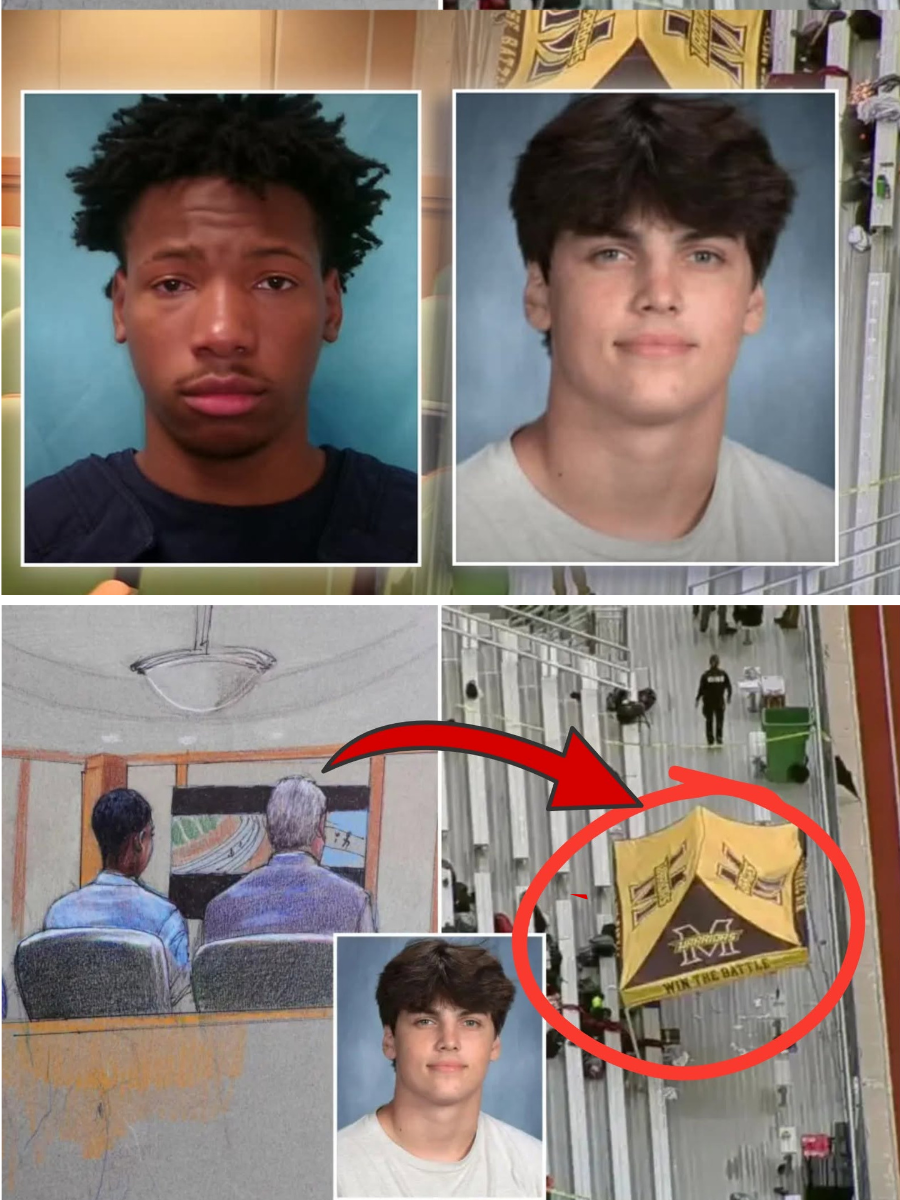
The architectural grandeur of the Collin County courthouse in McKinney, Texas, has served as a grim stage for some of the most emotionally charged legal battles in recent state history. Yet, few cases have captured the public imagination or fractured a community quite like the first-degree murder trial of nineteen-year-old Karmelo Anthony. Anthony stood accused, and was subsequently convicted, of the fatal 2025 stabbing of seventeen-year-old track athlete Austin Metcalf during a rainy, chaotic high school sports meet at David Kuykendall Stadium in Frisco. The legal proceedings concluded with a definitive thirty-five-year prison sentence, a judgment that many heralded as a victory for accountability. However, the trial itself will long be remembered not just for the clinical arguments of the prosecution, but for the profound, uncomfortable human drama that unfolded at the defense table.
Throughout the grueling weeks of testimony, cross-examinations, and the presentation of graphic forensic data, one question continually echoed through the crowded public gallery and across the volatile landscape of social media: “Do you support your son?” This direct, provocative inquiry was leveled implicitly and explicitly at Anthony’s parents, most notably his mother, Kala Hayes. In the court of public opinion, where the narrative of an innocent victim taken too soon held absolute sway, any public display of maternal devotion was viewed by many as an affront to justice. Yet, as the state systematically built its case, the Anthony family maintained a steadfast, highly visible presence in the front row of the defense gallery. Their unyielding allegiance to their child, even in the face of mounting public hostility and devastating physical evidence, became one of the most polarizing aspects of the entire judicial saga.
To understand the immense societal pressure bearing down on the Anthony family, one must first recognize the sheer scale of the tragedy that claimed the life of Austin Metcalf. Austin was a universally beloved young man, an exceptional athlete, a twin brother, and a central figure within his school community. When he was killed beneath a rainy team tent following a dispute over seating, the immediate reaction was an outpouring of collective grief and righteous fury. The public demanded swift, uncompromising retribution. In this environment, the parents of the accused were thrust into an impossible position. They were the guardians of a young man who had undeniably caused the death of another human being, a reality that forced them to navigate a delicate path between public contrition and private, unconditional maternal protectiveness.
As the formal trial progressed, the prosecution introduced key elements of evidence that fundamentally altered the public’s understanding of the final five minutes leading up to the tragedy. Foremost among these disclosures was the stadium closed-circuit television footage, which captured the rapid escalation of the dispute. The digital recordings showed Anthony entering a tent designated for Memorial High School to seek shelter from a severe thunderstorm—a decision that sparked immediate territorial tension with the students inside. The silent video frames documented a verbal confrontation that quickly spilled over into physical aggression, culminating in a brief but violent struggle during which Anthony deployed a semi-serrated folding knife from his backpack.
For the spectators in the courtroom and the thousands following the case online, these video frames were seen as the definitive proof of a calculated, unprovoked assault. The prosecution argued with blistering intensity that Anthony had intentionally brought a lethal weapon to a school sporting event, deliberately provoked an argument, and executed a fatal attack on an unarmed teenager. In the wake of these revelations, public animosity toward the defendant reached a fever pitch. Media commentators and community activists questioned how any responsible parent could sit in a courtroom and continue to offer comfort to a individual associated with such a catastrophic act of violence. The phrase “Do you support your son?” became a rhetorical weapon used to condemn the family for their perceived lack of empathy toward the grieving Metcalfs.
Despite the crushing weight of public condemnation, Kala Hayes and her husband refused to retreat into the shadows. Their daily arrival at the courthouse became a study in quiet resilience. They sat directly behind the defense table, leaning forward to offer encouraging nods, whispered words of comfort, and brief touches of reassurance during recess periods. This public stance was not born out of a desire to minimize the horrific loss of Austin Metcalf, nor did it represent a denial of the physical reality of the crime. Rather, it was the manifestation of a fundamental, unconditional parental instinct—the refusal to abandon a child at their absolute lowest point, regardless of the gravity of the actions that brought them there.
Behind the scenes, the legal team representing Anthony was utilizing the very same surveillance footage and forensic data to construct a complex defense rooted in the principles of self-defense and apparent danger. The defense attorneys argued that the CCTV footage, when analyzed frame by frame, revealed a more nuanced and chaotic interaction than the prosecution claimed. They pointed to the visual evidence showing Anthony surrounded and outnumbered by members of the rival track team, including Austin and his twin brother Hunter. The defense asserted that the teenage boy had reacted out of a sudden, overwhelming flash of panic and fear for his own physical safety when the verbal argument degenerated into a physical altercation inside the cramped, dark tent.
For the Anthony family, this legal narrative provided the conceptual framework that allowed them to reconcile their love for their son with the horrific outcome of his actions. They did not view Karmelo as a hardened, malicious predator, but as a terrified seventeen-year-old minor who had made a disastrous, split-second error in judgment while under intense physical duress. This perspective was vital to their survival throughout the trial, enabling them to endure the graphic autopsy reports, the bloodstain pattern analyses, and the emotional testimonies of the state’s witnesses without collapsing under the weight of collective guilt. Their support was a declaration that while the law evaluates an individual strictly by their worst mistake, a parent sees the entire trajectory of a life.
The polarization of the courtroom reached its absolute zenith during the high-stakes sentencing phase of the trial, after the jury had returned a swift verdict of guilty for first-degree murder. With the question of legal guilt settled, the defense called Kala Hayes to the witness stand as their primary character witness. The transformation of the mother from a silent observer in the gallery to an active participant on the record was a moment of extraordinary dramatic tension. As she walked toward the microphone, she was forced to look directly at the twelve jurors who held her son’s future in their hands, as well as the Metcalf family, who sat mere feet away clothed in the collective armor of their immense loss.
Taking the stand, Hayes delivered an emotional testimony that would become the defining, most talked-about moment of the entire proceeding. She did not use her time to argue legal technicalities, nor did she attempt to deflect blame onto the victim or the school administration. Instead, she wept openly as she expressed her profound, heartfelt sorrow to the Metcalf family, acknowledging that no words she could offer would ever fill the permanent void left by Austin’s absence. She spoke as one mother to another, attempting to bridge the immense chasm of pain that separated the two sides of the courtroom.
Then, turning her focus back to the jury, she made a desperate, maternal plea for mercy. She begged the jurors not to issue a life sentence that would completely erase any possibility of a future for her son. She reminded the courtroom of Karmelo’s youth at the time of the stabbing, noting that his adolescent brain was not fully capable of processing the catastrophic long-term consequences of his actions during that chaotic five-minute window in the rain. She asked for a sentence that would provide a glimmer of hope—a finite term that would allow for rehabilitation, education, and eventual redemption, arguing that her son was a salvageable human being who could still offer something positive to the world if given a second chance.
The reaction to her testimony demonstrated the profound division that characterized the entire case. For those aligned with the prosecution and the Metcalf family, the plea for mercy was seen as an unacceptable attempt to shield a killer from the full consequences of his actions. They argued that Anthony had shown absolutely no mercy to Austin when he plunged a folding knife into his chest over a petty dispute, and that asking for leniency was an insult to a family that had been handed a permanent life sentence of grief. From this viewpoint, parental support at this stage was interpreted as a form of enabling, a refusal to fully accept the terrifying reality of what their son had done.
Conversely, a substantial segment of legal observers and advocates for criminal justice reform viewed Hayes’s testimony as a powerful, necessary act of courage. They recognized that a mother’s duty to protect her offspring does not cease when that offspring commits a crime. They argued that the state’s desire for retribution should not require the total destruction of an entire family unit, and that advocating for a young person’s potential for rehabilitation is a fundamental right that should be protected. For these observers, the image of a mother begging for her child’s life was a universally human and deeply moving spectacle that transcended the specific, horrific details of the indictment sheet.
The jury ultimately struck a balance between these two irreconcilable positions, sentencing Anthony to thirty-five years in prison. It was a severe penalty that guaranteed he would spend his entire youth and much of his middle age behind maximum-security walls, yet it technically granted his mother’s desperate wish by keeping the door to eventual freedom cracked open. When the sentence was read, the Anthony family did not celebrate, nor did they protest; they simply held hands, absorbing the reality of a decades-long separation with the same quiet endurance they had maintained since the day of the initial arrest.

The formal legal proceedings have since concluded, and the courtroom has been cleared for other cases, but the fallout from the trial continues to reverberate through the local community and across digital spaces. The Anthony family has found that the conclusion of the criminal case has not brought an end to their public isolation. They continue to face intense scrutiny, social ostracization, and ongoing security concerns, including multiple dangerous swatting incidents targeting their residence. The question “Do you support your son?” has followed them out of the courthouse doors, serving as a permanent shadow over their daily lives as they adjust to the reality of having a child in a state penitentiary.
The legacy of the Karmelo Anthony trial lies in its refusal to offer easy answers or clean emotional resolutions. It exposed the raw, bleeding fractures of a society grappling with youth violence, the accessibility of weapons, and the true purpose of the penal system. Yet, beneath the complex layers of statutory law and public policy, the case remains a deeply intimate tragedy involving two households that have been permanently broken by a single five-minute encounter in the rain. One mother is left to mourn a son who will forever remain seventeen, while another mother must navigate the next thirty-five years knowing her son is alive only behind concrete walls.
Ultimately, the steadfast stand of the Anthony family throughout the trial serves as a powerful testament to the absolute, unconditional nature of parental love. It demonstrates that in the architecture of the human heart, the bond between a parent and a child is designed to withstand even the most catastrophic failures, the heaviest public condemnation, and the most devastating realities. Kala Hayes and her family did not support the crime, nor did they support the violence that stole the life of Austin Metcalf; they simply supported their son, proving that even when the legal system has spoken and the cell door has locked, a mother’s presence remains an unyielding, unbreakable anchor in a hostile world.
Để lại một bình luận