🚨 THE TWO CHILDREN WERE AT THE BOW — JUST MOMENTS BEFORE EVERYTHING WENT WRONG.
Mya, 9, and Sigmund, 7, were reportedly sitting at the front of their grandfather’s boat when it slammed into a Barnegat Bay channel marker, throwing both children into the water — and now that positioning is becoming a major focus in reconstructing the final seconds. 👀
Why were the children there? How fast was the boat moving? What could they see — and what could the person at the helm see?
The final moments before the collision may be more complicated than they first appeared. 👇
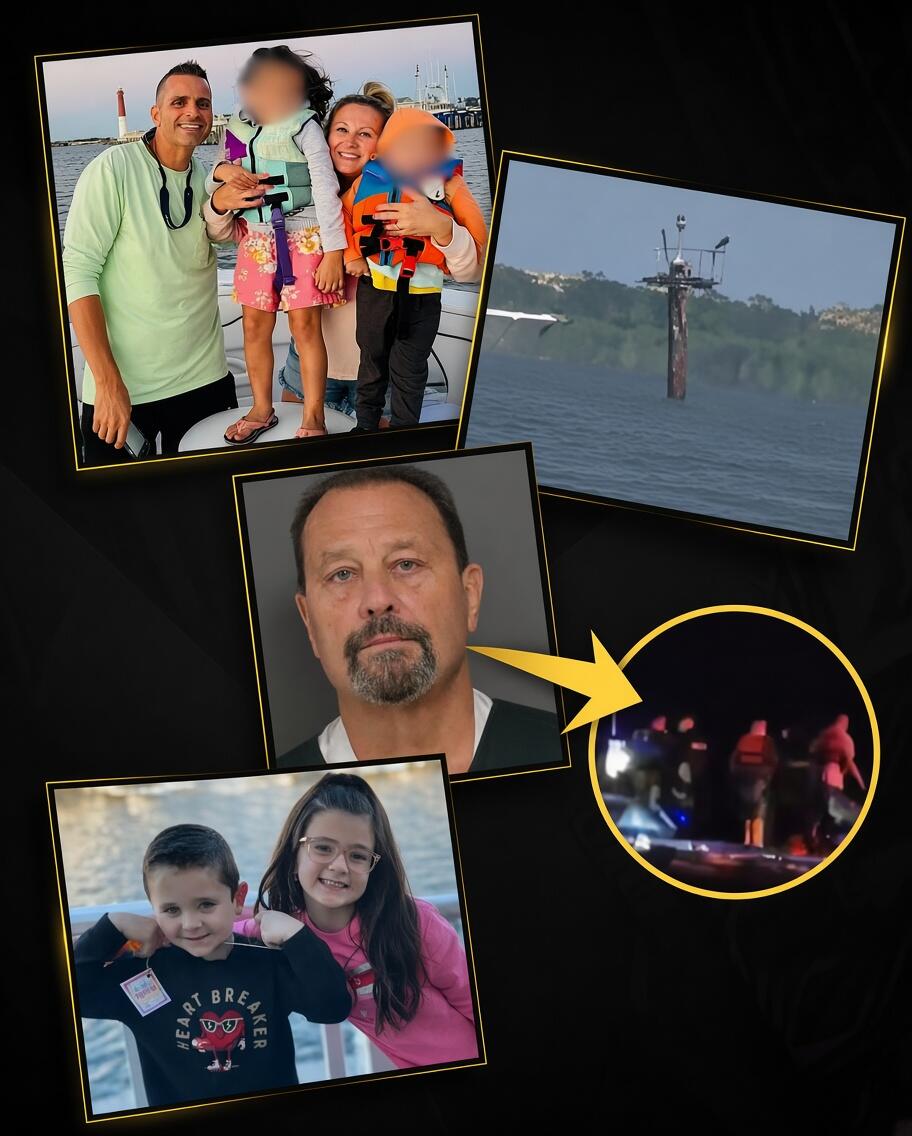
The fatal Barnegat Bay boating crash that killed two young siblings is now being examined down to the positioning of the passengers in the moments before impact.
Mya Golabek, 9, and her brother, Sigmund “Siggy” Golabek, 7, were reportedly seated toward the front of their grandfather Stephen Schneider’s boat as the family traveled across Barnegat Bay on the night of July 19.
Moments later, the boat struck an Intracoastal Waterway channel marker.
The collision sent both children into the water.
Despite rescue efforts, neither survived.
Schneider, 64, is now facing criminal charges in connection with the deaths, including two counts of second-degree reckless vessel homicide and charges related to boating under the influence and reckless operation. Prosecutors say his blood-alcohol concentration was approximately 0.16 following the crash, twice New Jersey’s legal limit for operating a vessel. (nbcphiladelphia.com)
But as investigators and attorneys reconstruct what happened, another seemingly basic detail has taken on greater significance:
Where exactly was everyone sitting?
The children were at the front
According to reporting based on investigative and court records, Mya and Sigmund were positioned toward the bow of Schneider’s Tidewater Custom 280 center-console boat.
The children were reportedly wearing life jackets.
That detail is important because the collision threw them from the forward portion of the vessel into the water. Their location meant they were closer to the point of impact than passengers sitting farther back might have been.
The boat struck a channel marker while traveling through Barnegat Bay.
Schneider reportedly told investigators that he was traveling at approximately 20 mph and did not see the marker until the last second. (6abc.com)
That account has become one of several pieces of evidence being examined as prosecutors and defense attorneys attempt to reconstruct the crash.
But the children’s position alone does not establish why the collision occurred.
It does, however, help explain why the two youngest passengers were particularly vulnerable when the vessel struck the marker.
A family trip that suddenly became deadly
The outing began as a Fourth of July weekend family gathering.
Schneider, his wife, their daughter and son-in-law, and their two grandchildren had been together at MJ’s Restaurant & Bar before the children decided to return by boat with their grandparents.
The parents reportedly traveled separately.
Schneider then piloted the boat across the bay with his wife and the two children aboard.
According to accounts reported after the crash, the children were seated toward the front.
At some point during the trip, the boat collided with a channel marker.
The impact was violent enough to throw both children into the water.
Schneider and his wife also ended up in the water while attempting to recover the children.
A 911 call followed, bringing emergency personnel to the scene.
The children were transported to Community Medical Center in Toms River, where they were pronounced dead. (6abc.com)
For the families involved, the precise seating arrangement has obvious emotional significance.
For investigators, however, it can also have a practical purpose: understanding how the boat reacted to the collision and how passengers were thrown from it.
Why the bow matters
In a boating accident reconstruction, passenger location can provide clues about the mechanics of a crash.
A person sitting near the bow can experience a very different trajectory from someone seated closer to the stern when a vessel suddenly stops or changes direction.
But that does not mean that simply being at the bow made the children unsafe or that their parents or grandparents necessarily made an improper decision by allowing them to sit there.
The available public reporting does not establish the precise distance between the children and the bow, whether they were seated, standing or moving immediately before impact, or whether either child was holding onto a particular part of the vessel.
Those details would matter in a forensic reconstruction.
What is known is considerably narrower:
They were toward the front, they were wearing life jackets, the vessel struck a fixed marker, and both children entered the water.
Everything beyond those established points requires evidence.
The channel marker is another major piece of the puzzle
Schneider’s account of the collision has placed the channel marker at the center of the investigation.
According to reports based on court documents, Schneider told investigators he was traveling at roughly 20 mph and saw the marker only shortly before impact. (6abc.com)
The defense has indicated that it intends to investigate whether the marker was properly illuminated.
That issue could become significant because the visibility of a navigational marker at night can affect how a collision is interpreted.
However, police have reportedly said the channel-marker lights were operating properly.
That creates a factual question for the court to resolve rather than an established explanation for the crash. (6abc.com)
The lighting question and the passenger-position question are therefore connected to the same larger issue:
What exactly could Schneider see, and when could he have seen it?
The alcohol evidence adds another layer
The investigation has also produced a significant piece of evidence concerning Schneider’s condition.
At an Aug. 19 detention hearing, prosecutors disclosed that Schneider’s BAC was approximately 0.16.
That figure is twice New Jersey’s legal limit of 0.08 for operating a vessel.
Schneider had reportedly told investigators after the crash that he had consumed three beers during dinner.
The difference between that statement and the toxicology result is expected to be an important issue in the case. (nypost.com)
The defense has indicated it intends to scrutinize the blood-alcohol evidence, including the circumstances and timing of the blood draw.
That matters when reconstructing the crash because a BAC measurement taken after the collision is not necessarily identical to the driver’s BAC at the exact moment of impact.
The timing of alcohol consumption, the crash and the blood collection can all become relevant in interpreting toxicology evidence.
Could the children’s position explain the severity of the crash?
It is tempting to look at the seating arrangement and draw a direct conclusion.
The children were at the bow.
The boat hit a marker.
They were thrown overboard.
Therefore, some might reason, their position must explain why they were the ones who suffered fatal consequences.
But that would be too simplistic.
A boat collision involves multiple variables: speed, direction, angle of impact, vessel design, passenger position, visibility, weather and water conditions, the actions of the operator and the nature of the object struck.
Without a full reconstruction, the public cannot determine which of those factors played the greatest role.
The fact that both children were wearing life jackets is also important.
Life jackets can dramatically improve survival chances in many water emergencies, but they cannot eliminate the risk of serious injury or drowning following a high-energy collision.
The available reports do not establish that the children’s life jackets failed or that they were improperly worn.
What happened immediately after impact?
The aftermath provides another important piece of the timeline.
Both children ended up in the water.
Schneider and his wife also entered the water and attempted to locate and recover them.
The family called for emergency assistance.
The children were ultimately taken to a hospital but could not be saved.
Those details are significant because they show that the immediate response involved an effort to rescue the children rather than simply abandoning them.
They also form part of the broader investigative record that prosecutors and defense attorneys will use to reconstruct the sequence.
The crucial question, however, remains what happened before the impact.
That is where the passenger positions, the vessel’s speed, the visibility of the marker and Schneider’s condition become relevant.
The case is not simply about where the children were sitting
The focus on the bow should not obscure the broader criminal case.
Schneider has been charged with two counts of second-degree reckless vessel homicide, as well as boating-under-the-influence and reckless-operation offenses. (patch.com)
The prosecution’s case will have to establish more than the fact that Schneider was operating the vessel when the children died.
It will have to prove the required elements of the charges beyond a reasonable doubt.
The defense, meanwhile, is expected to challenge the state’s interpretation of the crash.
That could include questions about the channel marker, its lighting, the boat’s speed, the visibility conditions and the interpretation of the toxicology evidence.
The seating position of the children could become part of that reconstruction, but it is unlikely to answer the entire question on its own.
A devastating detail for the family
For the children’s parents, the knowledge that Mya and Sigmund were sitting at the front of the boat before the collision adds another painful image to an already devastating night.
The children had been spending time with their grandparents.
They were wearing life jackets.
They were returning from a family outing.
Within minutes, they were in the water.
Their parents later supported Schneider’s release from jail, underscoring the extraordinary emotional complexity of the case. According to reports from the Aug. 19 detention hearing, the children’s father submitted a letter describing Schneider as a loving grandfather and asking the court to release him while the case proceeds. (nypost.com)
That position does not determine Schneider’s legal responsibility.
But it highlights just how different the emotional and legal dimensions of the case can be.
What investigators and the court still need to establish
Several questions remain open.
How fast exactly was the boat traveling?
What were the visibility conditions?
Was the channel marker illuminated?
What was the precise position of each passenger immediately before impact?
How did the vessel strike the marker?
How did the children leave the boat?
And what was Schneider’s actual level of impairment at the time of the collision?
Some of those questions may be answered through physical evidence, surveillance footage, witness accounts, boating records and expert reconstruction.
Others may remain disputed.
The court will ultimately have to separate those factual disputes from speculation.
What happens next?
Schneider was released under conditions after the Aug. 19 hearing and is scheduled to return to court Sept. 15. His ability to operate a boat or motor vehicle has been restricted while he undergoes a court-ordered assessment. (abc11.com)
The prosecution is expected to continue developing its case, while the defense investigates the toxicology evidence and circumstances surrounding the channel marker.
As that process continues, the positioning of Mya and Sigmund will remain one piece of a much larger reconstruction.
It may help explain why the collision had such devastating consequences.
But it cannot, by itself, explain why the crash occurred.
The most important unanswered question is therefore not simply where the children were sitting.
It is what happened in the seconds immediately before the boat struck the marker — and whether the evidence ultimately shows that the collision was the result of reckless conduct, impaired operation, environmental factors, or some combination of circumstances.
Until that evidence is presented and tested in court, the precise sequence of those final moments remains a matter for investigators and the judicial process to determine.
Để lại một bình luận