🚨 THE “HUSBAND THEORY” JUST EXPLODED — AND INTERNET SLEUTHS ARE RECONSTRUCTING PATRICK CLANCY’S EVERY MOVE.
A missing stretch of time. CVS surveillance. Restaurant footage. Timestamped messages. And a husband who returned home to an unimaginable scene — now every minute of his timeline is being dissected online. 👀
But there’s one massive problem with the viral theory: what does the actual evidence show?
The timeline, the unanswered questions and the conspiracy theory taking over social media — explained. 👇
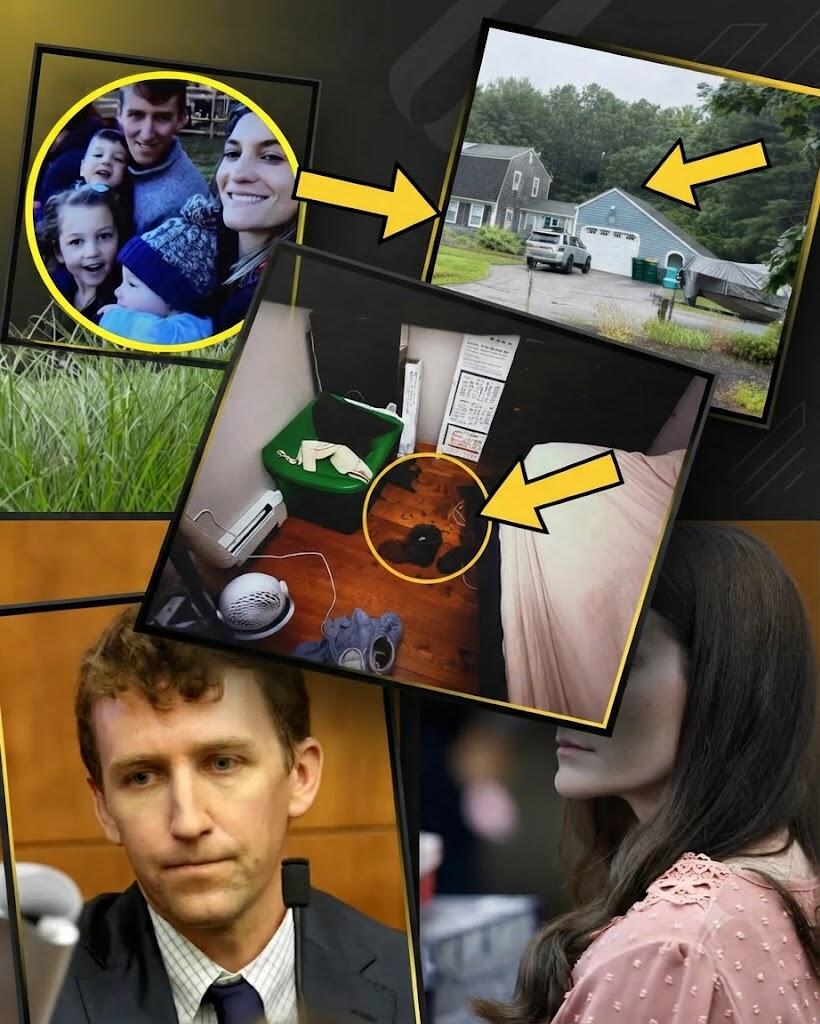
For much of the Lindsay Clancy case, the central question has been whether a mother suffering from a severe psychiatric disorder could be held criminally responsible for killing her three children.
But as Clancy’s murder trial approaches its conclusion, a very different question has taken over parts of the internet:
What was her husband Patrick Clancy doing while the killings were taking place?
On TikTok, Reddit, Threads and other online communities, amateur investigators have reconstructed Patrick’s movements on Jan. 24, 2023, scrutinizing surveillance footage, timestamps, text messages and even small differences in photographs.
Some have gone much further, suggesting Patrick was involved in the deaths of his three children and that Lindsay was framed.
There is, however, a critical problem with that theory.
There is no public evidence establishing that Patrick Clancy killed his children or participated in their deaths.
In fact, evidence presented during the trial and reported by multiple news organizations has corroborated significant portions of his account of that afternoon. Surveillance footage placed him at a CVS and later at a restaurant, while timestamped communications provided additional information about his movements.
Patrick is not a defendant in the case.
The jury is deciding whether Lindsay Clancy was criminally responsible for the deaths of Cora, Dawson and Callan — not whether Patrick committed them.
Yet the online theory has become sufficiently widespread that major publications have begun examining not just the case itself, but the phenomenon surrounding it.
How the “husband theory” began
The theory did not emerge from a single piece of evidence.
Instead, it developed through the accumulation of questions raised online about the timeline.
Patrick has testified that on the afternoon of Jan. 24, 2023, he left the family home in Duxbury to pick up dinner and medication. He stopped at a nearby CVS before going to a restaurant to collect the family’s food.
When he returned home, he found his wife critically injured outside and his children in the basement.
The prosecution and defense agree on the fundamental fact that Lindsay killed the children.
The dispute at trial concerns why she did it and whether she was legally responsible because of her mental state.
But online communities began examining the period when Patrick was away from the house and asking whether the publicly available timeline completely accounted for his movements.
That question itself is legitimate.
The leap from that question to an accusation of murder is not.
The missing time that became a conspiracy theory
One of the most frequently cited issues involves the exact amount of time between Patrick’s departure from the house and Lindsay’s fall from the second-story window.
The New Yorker recently noted that the Commonwealth has never publicly delineated the precise interval between Patrick leaving and Lindsay falling from the window. That uncertainty has become fuel for online theories about what might have happened inside the house.
But an incomplete publicly available timeline is not the same thing as an unexplained criminal act.
There are many reasons why investigators and prosecutors may not publicly disclose every minute of an active homicide investigation.
More importantly, investigators did not rely solely on Patrick’s account.
Surveillance footage and electronic records have been used to establish parts of his movements.
According to reporting on the case, footage placed Patrick at CVS and later at ThreeV restaurant, while timestamped text messages between Patrick and Lindsay have also been examined.
Those details make the internet theory considerably more complicated than a simple “he disappeared for 45 minutes” narrative.
What the surveillance footage shows
The CVS footage has become one of the most heavily discussed pieces of evidence online.
Internet sleuths have analyzed images from the store and compared them with footage from other locations, attempting to determine exactly when Patrick arrived, how long he stayed and what he was wearing.
Some online posts have even used enhanced or manipulated images to support theories about Patrick’s movements.
The New Yorker described examples of online investigators using crude AI-enhanced CVS footage and attempting cinematic-style analysis of photographs and social-media posts.
But digital enhancement can create its own problems.
When low-resolution surveillance footage is enlarged or processed by AI, the resulting image may appear to contain details that were never actually captured by the original camera.
That means a viral image appearing to show a different article of clothing, facial expression or object should not automatically be treated as forensic evidence.
The same principle applies to social-media photographs.
A screenshot can generate a compelling narrative without establishing a factual timeline.
The restaurant stop matters
Patrick’s movements did not end at CVS.
Evidence reported from the case placed him later at ThreeV restaurant, where he picked up dinner.
That restaurant stop is important because it provides another independent location in the timeline.
The more independently corroborated locations there are, the harder it becomes to construct a theory based solely on Patrick’s statement.
That does not mean every second of his movements has been publicly explained.
It means there is a difference between an incomplete public record and evidence contradicting the record.
The former exists.
The latter has not been publicly established.
What happened when Patrick returned home?
This remains one of the most emotionally devastating parts of the case.
Patrick returned to the Duxbury home and discovered Lindsay outside after she had apparently attempted suicide by jumping from a second-story window.
Inside the basement were the couple’s three children.
Cora was 5.
Dawson was 3.
Callan was 8 months old.
Patrick called 911 and told first responders that Lindsay had killed the children, despite not having personally witnessed the killings.
A police officer later testified that Patrick screamed, “She killed the fucking kids!” after returning home.
For conspiracy theorists, the fact that Patrick immediately identified Lindsay has become part of the broader narrative they are attempting to construct.
But that fact has an obvious alternative explanation: he had returned to a scene in which his children were dead or dying and his wife was critically injured, and he was attempting to understand what had happened.
His statement was not a confession.
It was his immediate interpretation of an extraordinarily chaotic scene.
Patrick’s own testimony
Patrick eventually testified publicly during the trial.
His account has been consistent with the basic timeline described by investigators: he left the home to pick up food and medication, stopped at CVS and went to retrieve the family’s dinner before returning home.
He has also described Lindsay as appearing normal during their interactions earlier that day.
That point has become important to both sides.
The prosecution argues that Lindsay’s apparently normal communications and behavior demonstrate planning and awareness.
The defense argues that postpartum psychosis can fluctuate and that a person experiencing severe psychiatric illness can appear outwardly normal for periods of time.
Patrick himself has supported aspects of the defense’s mental-health argument.
That makes the internet theory particularly striking.
The man some online users accuse of framing Lindsay has actually spent years publicly describing her as a loving mother who became severely ill.
In a 2024 profile, The New Yorker quoted Patrick saying: “I wasn’t married to a monster—I was married to someone who got sick.”
That position has remained one of the defining features of his public response to the tragedy.
Why are people blaming Patrick?
The answer may have less to do with new evidence than with the extraordinary difficulty of accepting the official narrative.
The undisputed facts are almost impossible for many people to process.
A seemingly devoted mother killed her three young children.
She then attempted suicide.
And the entire sequence occurred while her husband was away running an errand.
For some observers, that story is psychologically difficult to accept.
As The New Yorker recently noted, conspiracy theories often grow when an investigation appears to have reached a conclusion that some members of the public find emotionally impossible to accept.
That appears to be happening here.
Instead of accepting that Lindsay could have committed the killings during a psychiatric crisis, some online communities have searched for an alternative perpetrator.
Patrick became the obvious target.
TikTok has become the center of the debate
TikTok has played a particularly important role in amplifying the alternative theories.
Creators have produced lengthy videos reconstructing the timeline, examining photographs and discussing individual pieces of evidence.
Some approach the case as amateur investigative analysis.
Others present much stronger conclusions.
The problem is that the distinction between those two approaches can disappear quickly on social media.
A creator can begin by asking, “Why was Patrick gone for this long?” and end several minutes later implying that he murdered his children — without introducing evidence sufficient to support that conclusion.
That transformation from question to accusation is one of the most important characteristics of the current online debate.
The Guardian reported Aug. 24 that social media surrounding the Clancy trial has erupted with conspiracy theories and amateur analysis, while experts have warned that engagement-driven algorithms can amplify sensational claims.
Reddit has its own version of the investigation
Reddit discussions have similarly focused on Patrick’s movements, relationships and testimony.
Users have compared photographs, reconstructed travel times and debated seemingly minor details.
Some threads have attracted substantial attention precisely because they offer an alternative explanation to the prosecution’s case.
But Reddit’s strength as a discussion platform is also its weakness in a criminal case.
A large number of users examining the same theory does not transform speculation into corroborated evidence.
Nor does a theory become more credible simply because it explains an unanswered question.
The real test is whether independent evidence supports it.
At present, there is no public evidence establishing Patrick’s involvement in the killings. WIRED, in its recent examination of the conspiracy movement, stated the point directly: there is no evidence suggesting Patrick committed the murders or that he will ever face charges related to them.
The darker accusation: neglect
Not every criticism of Patrick alleges that he physically killed the children.
A separate strand of online commentary portrays him as a negligent or unsupportive husband who failed to recognize Lindsay’s deteriorating mental health.
That argument is more complicated.
The trial has produced extensive evidence about Lindsay’s struggles with postpartum mental health, her treatment history and her family’s attempts to obtain help.
Defense attorneys have argued that healthcare providers failed to adequately recognize or respond to her deteriorating condition.
Patrick has also faced criticism over whether he should have recognized the seriousness of Lindsay’s symptoms.
But assigning responsibility for failures in mental-health care is fundamentally different from accusing someone of committing three murders.
The evidence required for those claims is different.
The broader context: a trial about who gets believed
The explosion of theories surrounding Patrick may reveal something about the wider cultural debate surrounding the case.
The defense has portrayed Lindsay as a woman whose warnings about her mental health were repeatedly missed or mishandled.
Hundreds of supporters have gathered outside the courthouse, many wearing pink and calling attention to postpartum mental-health disorders.
That movement has found an audience among women who recognize aspects of their own experiences in the accounts of Lindsay’s psychiatric deterioration.
WIRED argued that the Patrick theories are partly rooted in broader anger over maternal mental-health care, domestic labor and the ways women experiencing postpartum distress can be dismissed.
In that sense, Patrick has become a symbol in a debate much larger than his own actions.
For some people, blaming him represents an attempt to identify a human failure behind the tragedy.
But symbolism is not evidence.
What the courtroom actually has to decide
The jury is not being asked to determine whether Patrick was a perfect husband.
It is not being asked whether he could have done more to recognize Lindsay’s mental-health crisis.
And it is certainly not being asked to resolve every question raised on TikTok.
The legal question is whether Lindsay Clancy is criminally responsible for killing her three children.
The prosecution says she was mentally ill but capable of understanding and controlling her conduct.
The defense says severe postpartum psychosis rendered her legally insane.
The Patrick conspiracy theory exists largely outside that legal question.
The danger of the online “courtroom”
The internet has created an unprecedented ability for ordinary people to examine high-profile criminal cases.
That can be valuable.
Public scrutiny can expose genuine inconsistencies, encourage transparency and raise questions investigators should answer.
But there is a line between scrutiny and accusation.
The Clancy case demonstrates how quickly that line can disappear.
A timestamp becomes a “missing hour.”
A blurry surveillance image becomes evidence of a secret trip.
A disagreement about a relationship becomes a motive.
And eventually, a person who has not been charged with a crime becomes the subject of a murder theory.
That progression is exactly why journalists and investigators must distinguish between what is known, what is disputed and what is merely being suggested online.
What happens next?
The Lindsay Clancy trial is approaching its final stage.
The defense has rested, prosecutors are presenting rebuttal evidence and closing arguments are expected soon. The jury will then decide whether Clancy is criminally responsible for the deaths of Cora, Dawson and Callan.
Meanwhile, Patrick remains at the center of an online conversation he did not create.
His movements on Jan. 24 will probably continue to be dissected long after the verdict.
Some questions about the timeline may remain unanswered publicly.
That is not unusual in a complex criminal investigation.
But an unanswered question should remain a question until evidence provides an answer.
At this point, the available public record provides surveillance footage, timestamped communications and other evidence supporting substantial portions of Patrick’s account. It does not provide evidence that he killed his children or staged the crime.
The “husband theory” may continue to spread because it offers an alternative explanation for a tragedy that many people find impossible to comprehend.
But the courtroom is not TikTok.
And the standard for determining guilt is not whether a theory can make a complicated story seem simpler.
It is whether the evidence proves it.
Để lại một bình luận