In 1986, Carrie Underwood was 3 years old and Luke Bryan was a 10-year-old kid in Georgia—40 years later, they just stunned live TV with Lionel Richie 😱🎶
During the American Idol Season 24 finale on May 11, Lionel Richie only stepped onto the stage ONCE all night—and what he did with Carrie and Luke has country and pop fans arguing nonstop online 👀🔥
Wait—why did Richie admit he used to refuse to sit in the audience or hang out with country stars back in 1986? Why did pop radio completely sleep on “Deep River Woman” while country fans sent it straight to the Top 10? And why are viewers suddenly divided over how the judges sounded in three-part harmony? 😬🎤
Don’t scroll past—the full story behind this 40-year full-circle moment is right here 👇🔥
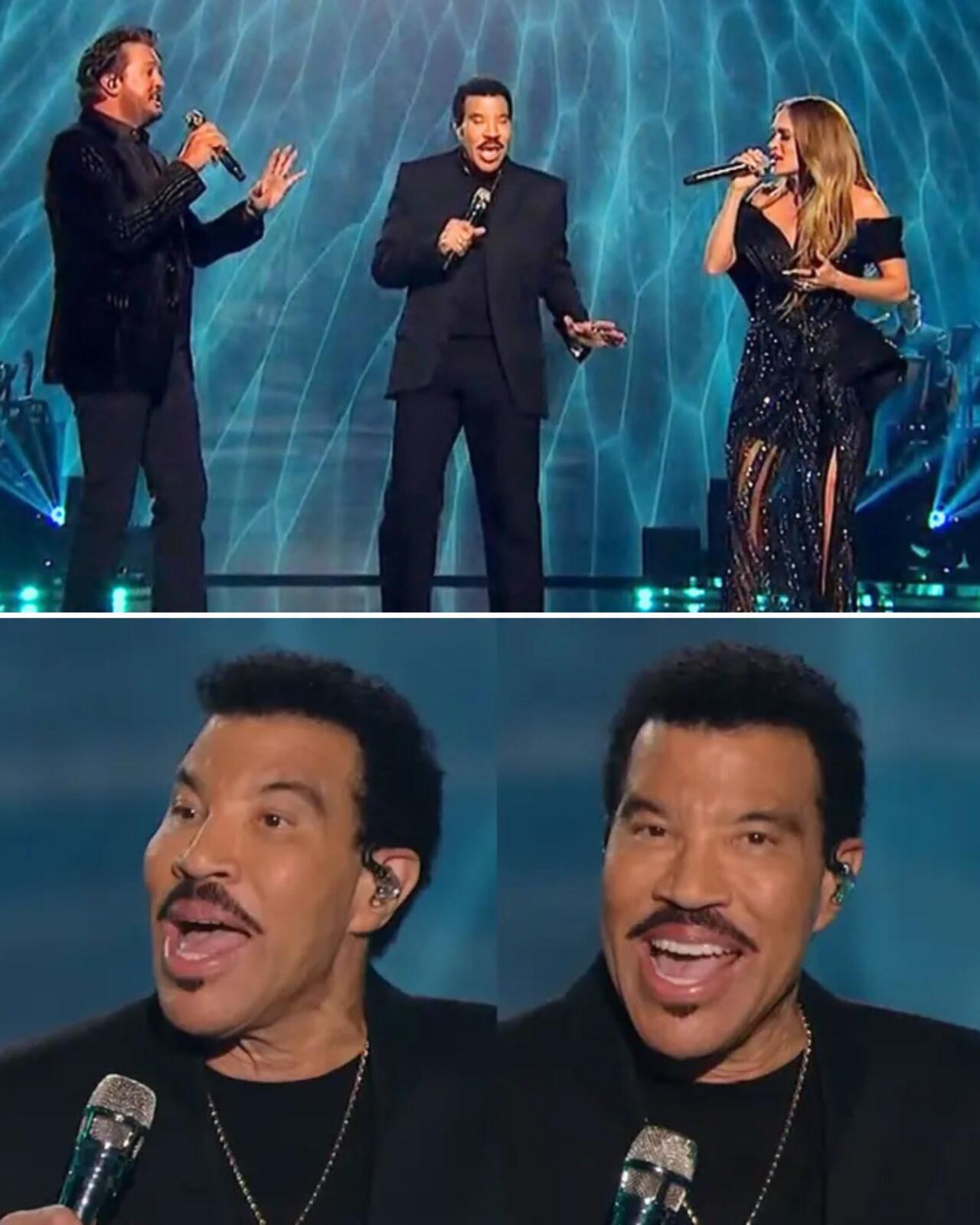
When Lionel Richie walked onto the American Idol stage during the Season 24 finale on May 11, 2026, alongside fellow judges Carrie Underwood and Luke Bryan, the performance carried four decades of music history behind it. Back in 1986, when Richie stood at the Country Music Association Awards singing “Deep River Woman” with the band Alabama, Underwood was just three years old and Bryan was a ten-year-old boy growing up in south Georgia. Forty years later, the two country superstars stood beside the Tuskegee, Alabama native—taking individual solo lines before blending into a three-part harmony for Richie’s sole musical appearance of the finale broadcast.
The moment quickly became one of the most replayed clips of the Season 24 closer, sparking warm nostalgia among longtime country and pop listeners while also igniting lively online debates across Reddit, X, and TikTok about vocal arrangements, genre crossover, and how the modern judging panel compares to past eras of the show.
From Tuskegee to the Top 10: Why Country Radio Embraced What Pop Ignored
To appreciate why the May 11 performance resonated so strongly, music observers point back to the unusual chart trajectory of “Deep River Woman” in 1986. Written solely by Richie—who was born and raised in Tuskegee, Alabama—the ballad was recorded for his blockbuster album Dancing on the Ceiling in collaboration with Alabama, the Fort Payne-bred supergroup that dominated country music throughout the 1980s.
Despite Richie’s massive pop stardom at the time, mainstream pop radio largely bypassed the track. On the Billboard Hot 100 pop chart, “Deep River Woman” stalled at No. 71, overshadowed by flashier synth-driven hits of the mid-1980s. Country radio, however, heard something entirely different. Driven by Richie’s Southern roots, unhurried storytelling, and Alabama’s signature vocal harmonies, country stations embraced the single and carried it all the way to No. 10 on the Billboard Hot Country Singles chart.
For music historians and longtime fans, that split reception underscored a key truth about Richie’s songwriting: beneath the glossy pop production of his 1980s catalog sat a deeply Southern sensibility shaped by country, gospel, and R&B traditions that coexisted naturally in Alabama.
Behind the Curtain of 1986: Richie’s Candid Admission About the Early CMA Days
While the 1986 CMA Awards performance with Alabama is remembered today as a landmark crossover moment, Richie later acknowledged that navigating the Nashville establishment in that era was anything but casual. Years after the broadcast, Richie admitted that during those early CMA appearances, he never sat in the audience and never stayed around afterward to mingle.
At the time, genuine collaborations between Black pop-R&B headliners and mainstream country acts were still relatively rare on major country awards telecasts. Stepping onto that stage meant entering an unfamiliar room where crossover artists often felt like visitors rather than insiders. Richie delivered the performance, honored the music he had written with his home-state band, and slipped back out without lingering in the room.
That history gave the May 11, 2026 American Idol finale its sharpest emotional contrast. Four decades after keeping his distance from the room at the CMAs, Richie did not have to look far for country partners—he simply turned to the two people sitting next to him at the judges’ desk every week.
Inside the May 11 Finale Arrangement: Three Judges, One Spotlight
Throughout the Season 24 finale on May 11, Richie kept a relatively low musical profile, making “Deep River Woman” his only performance of the night. Rather than turning the song into a high-volume vocal showcase or bringing in outside guest stars, the judges opted for a stripped-back, conversational arrangement built around shared vocal space.
Each of the three judges took a turn carrying solo lines—allowing Richie’s familiar, warm phrasing to set the foundation before Bryan’s relaxed Georgia drawl and Underwood’s clear, soaring upper register stepped forward. On the choruses and bridge, the trio locked into a three-part harmony that echoed the original vocal interplay between Richie and Alabama’s Randy Owen, Teddy Gentry, and Jeff Cook.
For viewers who had watched the trio trade jokes and critiques behind the American Idol desk all season, the performance served as a reminder that the panel’s chemistry rested on genuine musical compatibility rather than television banter alone.
Fan Reactions Across Reddit, X, and TikTok: Nostalgia Meets Critique
In the hours and days following the May 11 broadcast, social media platforms lit up with reactions ranging from tearful nostalgia to candid vocal critique.
On Reddit, threads in r/americanidol and r/CountryMusicStuff dissected both the song choice and the vocal blend. Many users praised the selection of “Deep River Woman” as a refreshing departure from predictable talent-show medleys, noting that younger viewers who only knew Richie from “All Night Long” or “Hello” were discovering a classic country-crossover gem for the first time. Several commenters highlighted the neat generational symmetry—pointing out that Underwood and Bryan literally grew up in the era when the song was playing on Southern car radios. At the same time, some Redditors debated the vocal balance of the performance, with a few arguing that Underwood naturally had to hold back her powerhouse range to blend smoothly with Richie and Bryan, while others countered that her restraint was precisely what made the three-part harmony work.
On X, clips of the finale performance circulated widely among country radio personalities and longtime Idol watchers. Posts comparing side-by-side footage of the 1986 CMA Awards with Alabama and the 2026 American Idol stage drew thousands of shares, with fans noting how seamlessly Richie bridged two completely different chapters of country music history.
On TikTok, short edits pairing the judges’ three-part chorus with archival photos of a young Carrie Underwood in Oklahoma and a ten-year-old Luke Bryan in Leesburg, Georgia, tapped directly into the platform’s appetite for full-circle celebrity timelines, sparking hundreds of comments from viewers sharing memories of listening to the 1986 track with their parents.
What the Moment Signals for American Idol and Country Crossover
Looking ahead, the reaction to the May 11 performance highlights why American Idol continues to lean heavily on the personal and musical history of its judging panel. In an era when singing competitions often struggle to generate watercooler moments beyond contestant eliminations, pairing Richie’s 1980s catalog with Underwood and Bryan’s country credibility delivered a rare broadcast moment that appealed simultaneously to legacy music fans and younger viewers.
More broadly, the forty-year arc of “Deep River Woman”—from a No. 71 pop oddity and No. 10 country hit in 1986 to a centerpiece harmony on prime-time television in 2026—demonstrates how durable a well-crafted song can be when given room to breathe. What began four decades ago as a cautious crossover appearance by an Alabama native who never stayed in the audience has evolved into an effortless shared moment among colleagues, proving that the right song does not just survive the passage of forty years—it grows richer when passed across generations.
Để lại một bình luận