🚨 THEY TURNED GRAND THEFT AUTO INTO A CHORE SIMULATOR?! 🚨
Millions of gamers logged into GTA 6 expecting pure chaos, high-speed heists, and zero rules… ONLY TO DISCOVER something that has X, TikTok, and Reddit completely at war right now.
Critics are calling it a “SIMP SLOP” over claims of mandatory relationship errands, buying flowers, painting walls, and untouchable NPCs—while progressive commentators are firing back with viral ratioed posts calling out “hate crime” complaints and sparking massive clapbacks in the replies.
Wait… is it ACTUALLY true that you can’t touch certain NPCs with a weapon, or is that part being blown out of proportion? And why are some players saying Jason does all the heavy lifting while Lucia doesn’t return the energy? 👀🔥
One viral post racked up over 2,200 replies in hours—and what people uncovered next in the comment threads will make you look at GTA 6 completely differently.
Read the full breakdown & see the receipts before you jump in 👇
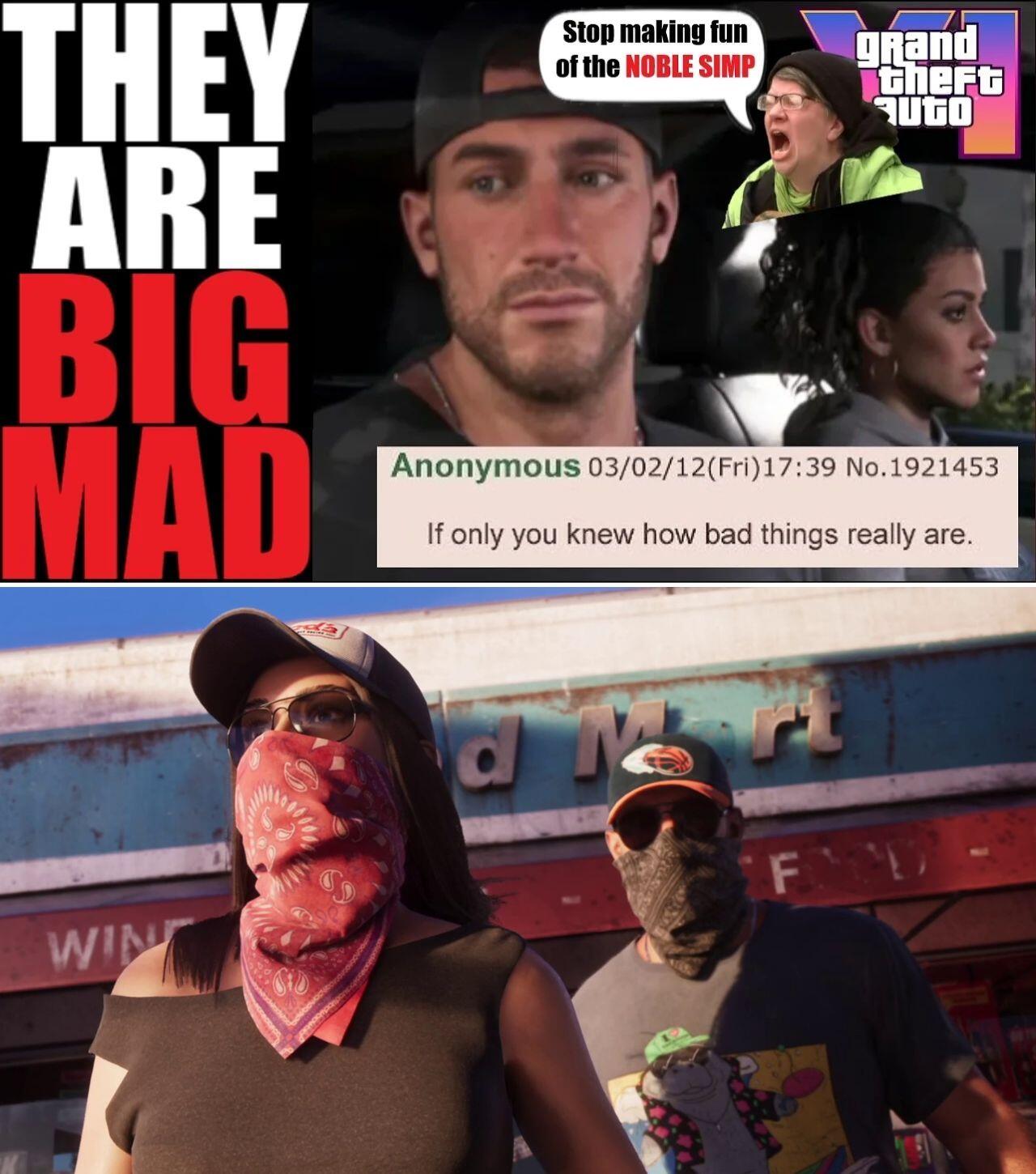
Grand Theft Auto VI was supposed to be the ultimate unifying blockbuster in video game history—a decade-in-the-making juggernaut arriving amid sky-high expectations across consoles and social feeds. Instead, within days of its launch window, the game has become the epicenter of a fierce online culture war pitting anti-woke gaming commentators against progressive defenders, creators, and franchise veterans.
At the center of the storm are viral social media posts mocking GTA 6 as a “simp simulator” or “simp slop,” driven by online chatter claiming players are pushed into domestic relationship chores for Lucia—such as buying flowers, picking up groceries, or painting—alongside claims that certain in-game protesters cannot be attacked or harmed like standard open-world pedestrians. On the opposite side, progressive users on X and across gaming spaces have pushed back hard against those complaints, accusing critics of overreacting to harmless romantic gestures or complaining that players cannot commit targeted violence against demonstrators.
The result is a noisy, high-decibel clash where screenshots, ratioed posts, streamer clips, and heated reply threads are driving engagement almost as fast as gameplay itself.
The Flashpoint: Viral Posts, Ratios, and “Simp Slop” Claims
The latest wave of controversy gained major traction through viral threads on X and commentary videos—including a widely shared breakdown by YouTuber Doctor Disaster, titled “Progressives FREAK OUT that gamer chuds are dunking on GTA 6 for being SIMP SLOP in viral posts,” which examined how critics and defenders are talking past one another across social media.
In those online exchanges, critics dubbed by commentators as “gamer chuds” have seized on two main grievances:
-
Domestic and Relationship Errands: Detractors argue that playing as Jason involves catering to Lucia through everyday or romantic tasks—such as bringing flowers, running errands, or doing house upkeep—rather than focusing exclusively on ruthless outlaw action. To critics who already viewed the franchise’s shift toward a co-lead romantic dynamic with skepticism, these mechanics felt closer to a life-sim chore list than a traditional Grand Theft Auto power fantasy.
-
Restricted NPC Targeting: Another major flashpoint involves claims circulating online that certain protesters in the game world cannot be attacked or affected by weapons, creating what critics describe as an “untouchable” class of NPCs in a series long defined by unrestricted sandbox mayhem.
When a viral X post mocked players upset over not being able to attack protesters—characterizing the complaint as frustration over not being able to commit “hate crimes or terrorism”—the post drew massive attention along with a lopsided reply count relative to likes, commonly referred to on X as a “ratio.” Rather than settling the debate, the ratio fueled hours of back-and-forth arguments over who actually understands the Grand Theft Auto series and who is speaking as an outsider.
Why This Hit a Nerve: Context Behind Grand Theft Auto and Modern Gaming Debates
To understand why a feature like buying flowers for a partner or whether a specific group of NPCs can be shot has become a major battleground, it helps to look at the history of the Grand Theft Auto franchise and the broader cultural climate surrounding big-budget games.
For more than two decades, Grand Theft Auto has operated on a specific tension: satirical, over-the-top crime fiction set inside sprawling, reactive sandboxes. From GTA III through San Andreas, GTA IV, and GTA V, players have long treated the open world as a chaotic playground where almost any pedestrian, cop, or bystander could trigger a wild chain reaction. At the same time, older entries also experimented with dating, girlfriends, stats, and mundane activities—sometimes praised for immersion, and sometimes criticized by players who just wanted to get straight to missions and shootouts.
What makes GTA 6 different in the eyes of online critics is scale, protagonism, and timing. Centering the story around Jason and Lucia—a Bonnie-and-Clyde-style pairing in a modern Leonida/Vice City setting—naturally puts relationship dynamics front and center. For players who love character chemistry and narrative texture, small gestures like bringing flowers or spending time together can read as storytelling depth or world-building. For players who want pure, unfiltered criminal escapism without feeling like they are doing virtual errands, those same moments become an easy punchline.
Meanwhile, modern AAA video game releases routinely arrive under intense cultural scrutiny. Over the past several years, online gaming discourse on X, Reddit, TikTok, Discord, and YouTube has become deeply polarized around perceived corporate caution, content guardrails, and ideological messaging. Whenever a high-profile game introduces any perceived restriction or domestic element, partisan camps quickly turn isolated clips or screenshots into proxy battles over the soul of the medium.
Inside the Community Reaction: Chuds, Progressivists, and “Tourists”
Across platforms like X, YouTube, Reddit, and TikTok, the reaction to the “simp slop” discourse is fractured along sharp lines—with both sides accusing the other of missing the point.
The Anti-“Simp Slop” Camp
Critics mocking the game as a “simp simulator” or “chore simulator” argue that escapism is the core reason people play Grand Theft Auto. In commentary like Doctor Disaster’s video and in replies across X, critics make several recurring points:
-
Escapism vs. Everyday Life: Many players say they already deal with responsibilities, chores, and relationship efforts in real life, and do not want menial tasks or subservient-feeling dynamics inside a crime sandbox.
-
Reciprocity Questions: Some commentators argue that if Jason is doing favors, buying flowers, or handling tasks for Lucia, the dynamic feels one-sided unless Lucia is equally doing heavy lifting or making sacrifices for him.
-
The “Untouchable NPC” Argument: On the protester question, critics contend that Grand Theft Auto has historically treated the sandbox as an amoral playground where chaos and dark comedy applied broadly (with long-standing unspoken boundaries such as avoiding child NPCs). Making specific protesters immune to player weapons, they argue, breaks the internal logic of a chaotic open world and signals developer hand-holding.
The Progressive and Pro-Defense Camp
On the flip side, progressive users and defenders of GTA 6 on X and in viral reply threads push back just as forcefully, framing the outrage as bad-faith culture warring or performative whining:
-
Mocking “Hate Crime” Complaints: Defenders argue it is bizarre or alarming for online commentators to complain that they cannot attack political or social protesters in a video game, framing that specific grievance as an absurd hill to die on.
-
“If You Don’t Like It, Don’t Play”: Many defenders tell critics to simply skip the game or move on if relationship mechanics or NPC rules bother them, pointing out that open-world games still offer plenty of action, driving, and crime.
-
Calling Out Hypocrisy: Some defenders note that players frequently praise realism and immersion in games like Red Dead Redemption 2, yet suddenly object when a character brings flowers or acts affectionately toward a partner.
Accusations of Being a “Tourist”
One of the most common insults flying in both directions is “tourist”—a term used online to label someone as an outsider who doesn’t truly understand the franchise or gaming culture. Critics call progressive defenders tourists for moralizing about a series built on theft and violence, or for shrugging off changes to classic sandbox freedom. Defenders call angry critics tourists or reactionaries for obsessing over culture-war talking points rather than actually playing and enjoying a massive game.
Fact-Checking the Hype: What Is Verified vs. What Is Viral Spin
Whenever a game as massive as GTA 6 explodes across TikTok clips, Discord servers, Reddit threads, and X posts, rumors and exaggeration travel fast. Even in commentary videos and viral threads, claims often mix real game details with hot takes, selective framing, or unverified assertions.
-
What is clear from the social media discourse: There is genuine, high-volume debate over how relationship/domestic tasks work in the game and whether certain protesters cannot be harmed by player attacks.
-
What requires caution: Social media clips frequently strip context out of cutscenes, missions, or optional/story interactions to make a point look more extreme—or more sympathetic—than it may appear in full playthroughs. Furthermore, viral posts on X often exaggerate engagement dynamics or treat a single clip as representative of the entire 80-to-100-hour experience.
In fast-moving internet controversies, narratives often harden within hours based on a 15-second clip or a ratioed tweet long before the broader community has tested every mechanic across the full map.
What Happens Next: The Future Outlook for GTA 6 and Gaming Discourse
Looking ahead, the “simp slop” and protester-NPC debate is unlikely to disappear overnight, though its trajectory will follow a familiar arc for blockbuster releases.
First, long-form playthroughs and community testing will separate myth from mechanic. As more players progress past early chapters, share unedited footage on YouTube and TikTok, and compare notes on Reddit and Discord, the community will get a clearer picture of how optional or mandatory relationship activities actually are, how NPC behaviors function across different districts, and how central Jason and Lucia’s dynamic is to the main campaign.
Second, commercial momentum will likely dwarf social media outrage. Historically, Grand Theft Auto titles have weathered intense media and cultural controversies—from moral panics in the early 2000s to debates over tone and monetization in GTA V—while still selling tens of millions of copies and dominating player counts. Culture-war posts on X can generate huge impression numbers and heated arguments, but mainstream players generally decide with their wallets and hours played.
Third, this clash sets the template for future big-budget launches. GTA 6 sits right at the intersection of mainstream pop culture and hyper-online fandom politics. Future trailers, DLC updates, online modes, and PC/console milestones will almost certainly trigger similar cycles—where every design choice, character moment, and NPC interaction is immediately scanned for cultural meaning.
For now, GTA 6 isn’t just being played in Vice City; it is being fought over across every timeline on the internet. Whether players view its relationship beats and NPC boundaries as smart character writing and guardrails or as tone-deaf “simp slop,” the game has already achieved one thing without question: nobody can stop talking about it.
Để lại một bình luận