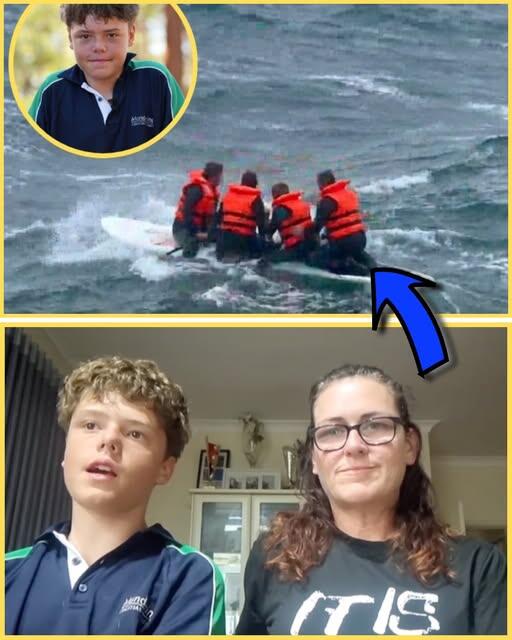
He had just swum nearly 4 kilometres through open water to save his stranded family. Exhausted. Alone. Barely able to breathe.
When police released the audio of Austin Appelbee’s Triple Zero call, listeners expected panic. Fear. Chaos.
Instead, what they heard stunned everyone.
And then — right at the end — the young boy said something so unexpected, so heartbreakingly calm, that even emergency operators later described it as “extraordinary.”
People can’t stop replaying the final seconds.
Because no one expected that to be the last thing he would say…
On February 11, 2026, Western Australia Police, with permission from Austin’s mother Joanne, released a portion of the 000 emergency call the 13-year-old made after his heroic ordeal. The recording, shared across major outlets like ABC News, 9News, CNN, and others, captures a moment of raw composure amid unimaginable pressure. Austin had just completed a grueling four-hour swim of approximately 4 km (about 2.5 miles) through rough swells in Geographe Bay, followed by a 2 km run along the beach to locate a phone — believed to be his mother’s — to make the call around 6 p.m. on January 30.
The family — Joanne (47), Austin (13), Beau (12), and Grace (8) — had set out for what was meant to be a relaxing paddle on inflatable stand-up paddleboards and a small kayak near Quindalup, roughly 200 km south of Perth. Strong winds and currents turned the outing deadly, sweeping them far offshore. Joanne made the gut-wrenching choice to send Austin alone for help while she stayed with the younger children, clinging to a paddleboard as they drifted up to 14 km out to sea.
In the audio, Austin’s voice is strikingly steady. He begins clearly: “Hello. My name is Austin… I’m outside on the beach.” He explains the situation without hesitation: the family got “lost out there” on a kayak and paddleboard trip, it happened “a very long time ago,” his mum told him to “go get help,” and he hasn’t seen them since. He reports that his siblings are Beau (12) and Grace (8), and stresses the urgency: “I think they’re kilometres out to sea. I think we need a helicopter to go find them.”
He then shifts to his own condition, matter-of-factly noting symptoms of hypothermia: “I’m sitting on the beach right now, and I have to also explain… I think I need an ambulance because I think I have hypothermia.” The operator keeps him on the line, gathering details while dispatching resources.
What leaves listeners — and reportedly the emergency operators — speechless comes toward the end. Amid the calm instructions and clear descriptions, Austin admits quietly: “I don’t know what their condition is right now, and I’m really scared.”
That simple, understated confession — delivered without hysteria, after hours of fighting for his life and his family’s — hits like a wave. Here was a boy who had just pushed his body beyond limits most adults couldn’t imagine: battling exhaustion, cold water, potential sharks, and the terror of leaving his mother and siblings behind. Yet when he finally reaches safety, his primary concern remains them. Not his own pain, not the hypothermia creeping in, not even the shock of survival. Just quiet fear for his family.
Emergency personnel who handled the call later described Austin’s demeanor as “extraordinary” and “level-headed,” a masterclass in crisis communication. He provided precise, actionable information — location context, family details, the need for aerial search — while acknowledging his own vulnerability. Dispatchers noted that his composure helped accelerate the response; the helicopter located Joanne, Beau, and Grace relatively quickly, pulling them from the water after up to 10 hours adrift.
The release of the audio sparked an emotional wave online and in media. Clips from ABC News, SBS, and international outlets like CNN and the BBC show people replaying the final moments, moved by the contrast: a teenager who could have screamed or broken down, instead spoke with heartbreaking clarity and calm. Comments flooded social media praising his maturity: “So calm, clear, and informative,” one wrote. “A masterclass in what dispatchers need,” another observed. Many called it proof of quiet strength under pressure.
Austin himself has consistently downplayed the attention. In post-rescue interviews, he repeated variations of “I just did what had to be done” or “I don’t think I am a hero.” But the audio tells a deeper story — one of a boy who, even at his most depleted, prioritized others. His final words on the call weren’t dramatic pleas or boasts. They were honest vulnerability wrapped in calm resolve: fear for his family, expressed plainly after doing the impossible to save them.
The incident has reignited discussions on ocean safety in Western Australia, the value of swimming education (Austin had recently struggled with a school 350m assessment yet performed far beyond it in crisis), and the resilience of young people in extreme situations. Fundraising and messages of support continue for the Appelbee family as they recover physically and emotionally.
In releasing the call, police aimed to highlight Austin’s courage while underscoring the effectiveness of clear emergency communication. But for millions who have heard it, the audio is more than that. It’s a reminder that true heroism often sounds quiet — a 13-year-old’s voice, steady through exhaustion, ending not with triumph, but with the simple, devastating truth: “I’m really scared.”
Because after everything he endured, what mattered most was getting them home.
Để lại một bình luận