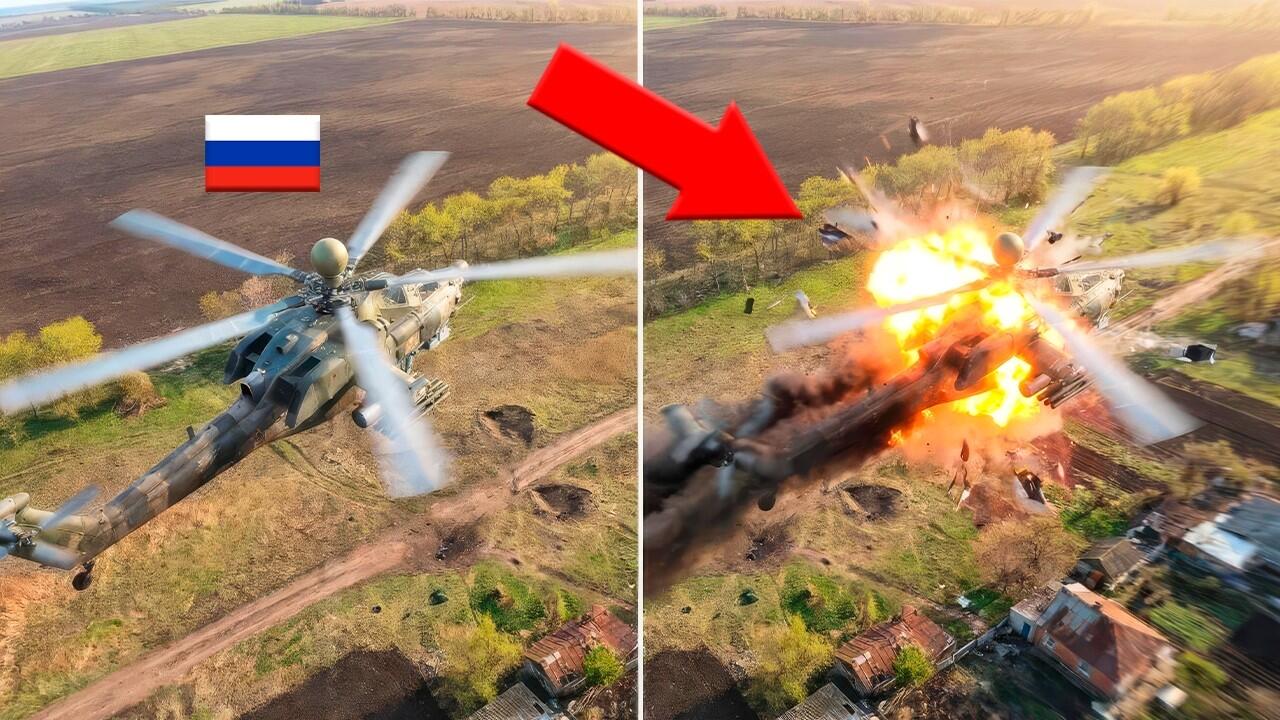
An $18M Russian attack helicopter lined up a shot from behind a tree line—and never saw the cheap Ukrainian drone waiting for its blind spot. 🚨
For weeks, Mi-28NM gunships popped up near the border, fired long-range missiles, and stayed out of reach. Until Ukrainian drone hunters noticed one fatal catch in how those missiles are guided.
To steer a missile all the way in, the crew has to keep its nose pointed toward the target—leaving its tail exposed for roughly a minute.
Then electronic warfare jammed the signal, a $300K+ Russian recon drone showed up in low clouds, a 30mm autocannon shredded the air, and a wounded evacuation vehicle was suddenly in the crosshairs with minutes left of daylight.
Wait until you see what happened during the 40-second handoff between two helicopters—and why the missile missed by nearly 100 meters when the strike finally landed.
Read the full breakdown before the next move hits the sky 👇🔥
Along the northern border between Belgorod Oblast and Kharkiv Oblast, air and drone warfare has turned into a high-stakes game of cat-and-mouse. Russian attack helicopters have repeatedly used standoff missiles from behind tree lines to strike Ukrainian positions without crossing the border, while Ukrainian air-defense and drone units have searched for ways to intercept aircraft operating in heavily contested airspace.
A dramatic account circulating across defense commentary and tactical storytelling channels highlights how a single Ukrainian air-defense drone unit—identified as “Prybul’tsi” (“Aliens”), part of the air-defense battalion of Ukraine’s 115th Mechanized Brigade, flying interceptor drones such as the BB-140 Blyskavka (“Lightning”)—tracked and challenged Russian Mi-28NM attack helicopters and reconnaissance drones during a tense day of border skirmishes.
While independent verification of individual combat claims in active war zones remains difficult—and official claims from each side often diverge on whether a struck aircraft was destroyed, damaged, or merely forced to abort—the episode illustrates a broader shift in modern warfare: how low-cost unmanned systems, electronic warfare, and tactical timing are reshaping duels between high-value manned helicopters and nimble interceptors.
Standoff Firepower vs. The One-Minute Guidance Constraint
For months along northern border sectors, Russian assault groups pushing toward Kharkiv’s frontier have relied on fire support to clear Ukrainian defenses. Attack helicopters such as the Mi-28NM are built for that role, pairing twin-engine survivability and heavy armor with long-range precision munitions—including missiles often referred to in battlefield accounts as LMUR (Product 305), credited with standoff ranges around 14 to 14.5 kilometers and thermal-imaging guidance on the nose of the missile.
Compared with short-range man-portable air-defense systems (MANPADS) like the Stinger, whose engagement envelope is far shorter, a standoff missile launched from behind cover on the Russian side of the border gives a helicopter crew a major range advantage.
Yet every weapon system carries trade-offs. According to the tactical breakdown, guiding a long-range missile to its target requires maintaining terminal guidance/line-of-sight geometry within the nose antenna’s cone—roughly 90 degrees to each side—over a flight time that can stretch to around a minute at roughly 250 meters per second. During that window, a helicopter holding its nose toward the target exposes its rear and sides to an incoming interceptor unless wingmen or air defenses cover the angle.
Jamming, Low Clouds, and a $300,000+ Recon Drone
Even when Ukrainian operators spot a target, getting an interceptor drone across the front line is rarely straightforward. Over sectors like Belgorod, Russian electronic warfare (EW) can flood the electromagnetic spectrum, breaking up video feeds or causing signal dropouts that force operators to fly low using terrain masking or shift launch positions closer to the line.
In the day’s unfolding sequence, a move to a forward tree line to launch a Blyskavka interceptor coincided with a radar detection of a slow-moving reconnaissance drone—identified as a Merlin-VR, widely described by Ukrainian forces as one of Russia’s costliest long-range reconnaissance UAVs (often cited above $300,000), capable of high-altitude flight and long-range optical zoom used to spot targets for loitering munitions such as Lancet drones.
With low clouds forcing the reconnaissance drone lower to observe the ground, a Ukrainian interceptor climbed in a spiral from behind to strike it—just minutes before a Lancet hit the abandoned launch spot the crew had just vacated. In high-intensity drone warfare, relocating on time can be the difference between surviving a strike and taking a direct hit.
When the Helicopter Fights Back: 30mm Autocannons and Wingman Escorts
Attack helicopters are not defenseless targets. Equipped with mast-mounted or nose-mounted sensors and a rapid-firing 30mm autocannon (such as the 2A42), an Mi-28 can engage low-flying drones at close-to-medium range with high-velocity shells. Earlier engagements have shown both the lethality of autocannon fire against incoming UAVs and the resilience of main rotor blades and cockpit armor against small-arms or light fragments.
When Ukrainian operators pressed a frontal approach, autocannon fire proved lethal to an incoming drone—prompting a shift toward rear and low-altitude approaches outside the primary firing arc.
Russia’s crews adapted, too. Rather than operating solo, Mi-28s frequently fly in pairs, with one aircraft firing while a wingman trails behind to watch the rear sector. That “bodyguard” positioning forced Ukrainian operators to skim low behind tree lines or change angles rather than fly straight into a wingman’s cannon line of sight.
The 40-Second Handoff and a High-Stakes Evacuation
By mid-afternoon, the stakes rose sharply when word came that a U.S.-supplied Bradley infantry fighting vehicle—carrying wounded personnel—was moving in the sector. A heavy armored vehicle evacuating casualties is a prime target for a precision anti-armor/surface missile.
When two Mi-28s rotated roles—one finishing its shots while the second moved up to line up a missile launch—a brief window opened before the wingman completed its transition into rear cover. Pushing a low-battery wing-borne interceptor in from behind during that window, an operator lined up a strike near the engine/rotor area just as Russian EW degraded the feed in the final meters.
The impact jolted the helicopter and caused its nose to swing away from the guidance cone mid-flight. Without terminal guidance updates on a moving target, the missile missed the advancing Bradley by roughly 100 meters, landing in an open field. Meanwhile, the hit helicopter—built with separated engines and explosion-mitigating fuel systems—staggered and headed back toward Russian territory trailing smoke, with Ukrainian unit reports claiming destruction and more conservative analysts noting damage/aborted sortie status.
A late-day attempt against another pair operating near maximum missile range saw a top/rotor-arc approach interrupted by signal/airflow instability and a subsequent turnback by the helicopters, leaving another missile unguided.
What Communities Are Saying: Reddit, X, Discord, and Defense Analysts
Across online communities and military-analysis spaces, reactions to footage and accounts of helicopter-versus-drone duels blend technical fascination with strict skepticism:
-
Reddit (
r/CombatFootage,r/ukraine,r/UkraineWarVideoReport,r/LessCredibleDefence): Viewers frequently break down video frames to debate whether a strike actually downed a helicopter or merely damaged it, pointing out that smoke or a jolt does not always equal a total loss—while praising innovative use of cheap interceptors against high-cost aircraft and recon drones. -
X (formerly Twitter) & Milblogger Circles: OSINT accounts and pro- and anti-war commentators scrutinize geolocation, launch distances, and EW effects. Russian sources often emphasize missile standoff ranges, rotor/armor durability, and EW resilience, while Ukrainian channels highlight interceptor kills and disrupted Russian sorties.
-
Discord & Tactical/Simulation Communities: Enthusiasts in military-simulation and defense Discord servers dissect the physics and tactics: loiter time of fixed-wing interceptors, battery limits, EW signal loss at low altitude, and the trade-off between keeping a sensor/guidance cone on target versus maneuvering to evade.
-
Defense Analysts & Industry Experts: Analysts note that even when an interceptor does not achieve a confirmed kill, forcing attack helicopters to fly higher-risk profiles, abort missile guidance mid-flight, or spend more time repositioning reduces their effective fire support for ground assaults. Conversely, experts caution that unverified battlefield tallies often inflate “destroyed” claims when an aircraft actually returns to base for repairs.
Strategic Takeaways and Future Outlook
Duels between manned attack helicopters and expendable interceptor drones underscore a central tension of modern conflict: a multi-million-dollar aircraft offers speed, payload, and multi-role flexibility that a small drone cannot match, yet a cheap, agile interceptor can force expensive evasive maneuvers and punish predictable flight patterns.
Looking ahead along the northern border and wider front lines, both sides are likely to keep iterating: Russia through longer standoff munitions, wingman screen tactics, and stronger electronic warfare, and Ukraine through faster interceptor drones, better EW-resilient links, and layered air defense. In a war where seconds of guidance and inches of altitude matter, neither manned aviation nor unmanned interceptors hold a permanent monopoly on the sky.
Để lại một bình luận