🚨 A FORENSIC PATHOLOGIST JUST RAISED THE ONE POSSIBILITY THAT COULD CHANGE THE ENTIRE NOLAN WELLS CASE.
Dr. Judy Melinek, who is NOT involved in the investigation, reviewed the publicly available evidence — and her analysis has raised questions about whether Nolan may have suffered a potentially fatal injury involving pressure to the neck. But there’s a problem: the very neck structures that could help answer that question were not available for the independent examination.
So what does the evidence actually show… and what could investigators discover when the state’s retained evidence and official autopsy findings are finally revealed? 👇🔥
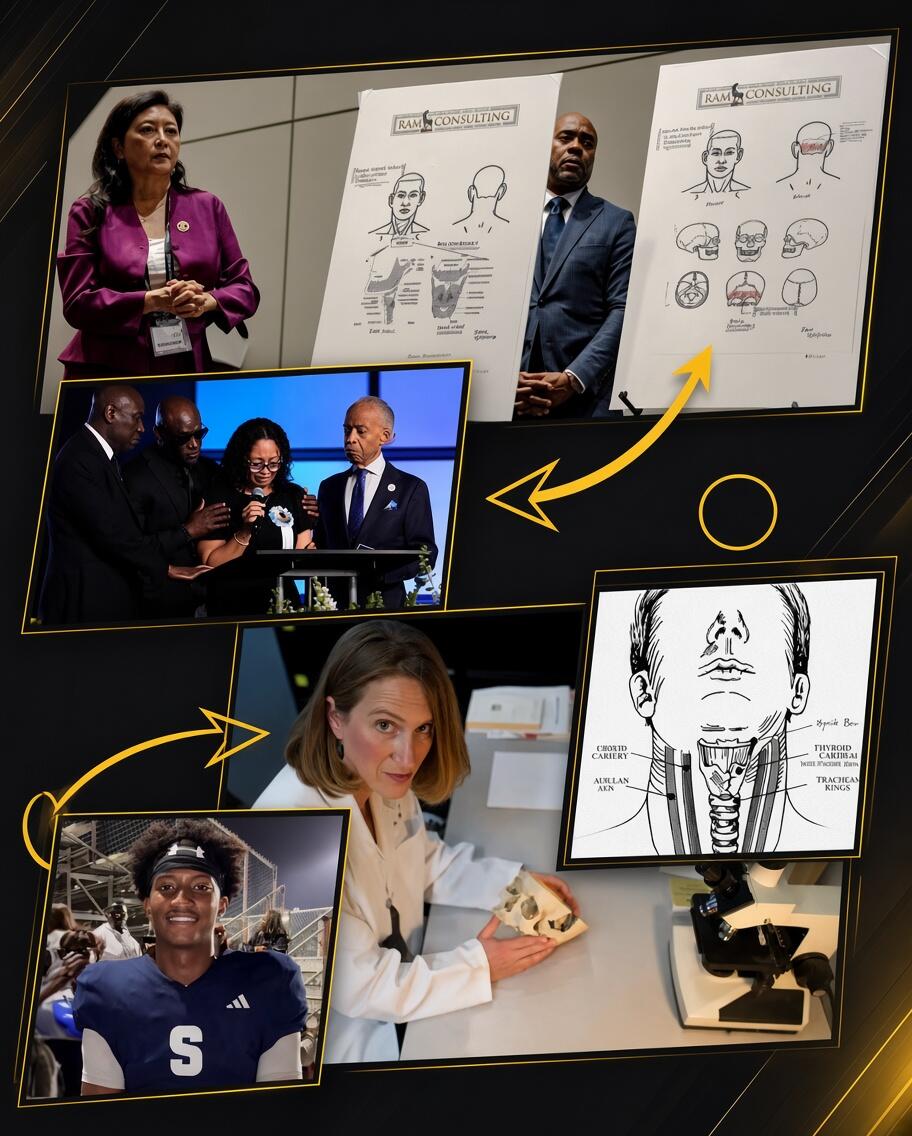
Nolan Wells Death Investigation: Forensic Pathologist Judy Melinek Raises Questions About Possible Strangulation
A new forensic discussion surrounding the death of Nolan Wells is giving the already controversial Mississippi investigation another twist.
Dr. Judy Melinek, a board-certified forensic pathologist who is not affiliated with the Wells investigation, has reviewed publicly available information surrounding the independent autopsy and offered her professional perspective on what the evidence may — and may not — establish.
Her analysis has fueled renewed online discussion about whether manual strangulation could be among the possibilities investigators need to consider.
But there is an important distinction between “could be consistent with” and “was the cause of death.”
Melinek has not examined Wells’ body, has not performed an autopsy in the case and has not issued an official cause-of-death determination.
The independent autopsy commissioned by Wells’ family reached no definitive conclusion, listing both the cause and manner of death as “undetermined pending investigation.” The official Mississippi autopsy has also not been publicly released.
Still, Melinek’s comments have focused attention on one of the most complicated aspects of the case: the condition and availability of Wells’ neck structures.
The question at the center of the forensic debate
Wells, an 18-year-old college football player from Ocean Springs, Mississippi, disappeared during a July 4 trip to Horn Island.
His body was recovered two days later.
Authorities initially indicated that they did not suspect foul play and that drowning appeared to be a possibility. But the circumstances surrounding Wells’ final hours quickly generated questions from his family, supporters and online investigators.
The independent autopsy commissioned by the family did not resolve those questions.
Forensic pathologist Dr. Roger Mitchell Jr. reported that decomposition and the condition of the remains limited what could be determined. He also noted that several important structures in the neck had been retained by the state medical examiner and were therefore unavailable for his independent examination.
Those structures include the hyoid bone and other portions of the larynx and airway.
That matters because the neck is one of the areas forensic pathologists examine when investigating possible mechanical asphyxia or strangulation.
But it is equally important to understand what the absence of those structures does not prove.
It does not establish that strangulation occurred.
It means an independent pathologist did not have all of the anatomical material necessary to independently evaluate that possibility.
What Dr. Melinek actually brings to the discussion
Melinek was interviewed by WXXV and other media outlets as an outside forensic expert.
She was not hired by the Wells family, is not working for law enforcement in the case and did not conduct either autopsy.
Her role is essentially that of an independent medical expert explaining how forensic pathologists interpret the evidence.
One of the points she emphasized was the difficulty of interpreting findings from a body recovered after a period of decomposition.
For example, the independent autopsy described a red discoloration in the tissue at the back of Wells’ head.
Online commentators quickly interpreted that finding as possible trauma.
Melinek offered a much more cautious interpretation.
She told WXXV that discoloration in a decomposed body can have multiple explanations and is not automatically evidence of an injury.
That distinction is important because the internet has repeatedly transformed uncertain forensic observations into definitive claims.
A discoloration is not automatically a bruise.
A missing anatomical structure is not automatically evidence of concealment.
And an undetermined autopsy is not automatically evidence of homicide.
The role of forensic pathology is to determine what the evidence can support — and equally importantly, what it cannot.
Why the hyoid bone matters
The hyoid is a small, U-shaped bone located in the upper portion of the neck.
It is one of several structures forensic pathologists may examine in cases involving possible strangulation or other forms of neck compression.
Experts discussing the Wells autopsy have explained that fractures, hemorrhage or other injuries involving the neck can sometimes provide evidence of mechanical compression.
On the Nancy Grace program, forensic death investigator Joe Scott Morgan discussed the importance of examining the hyoid and surrounding structures when evaluating possible strangulation. He noted that direct pressure to the neck can cause injuries that forensic pathologists may look for during an examination.
But even here, forensic medicine does not operate on a simple equation:
broken hyoid = strangulation.
And the reverse is also true.
No broken hyoid = no strangulation.
The interpretation depends on the complete medical picture, including the condition of the body, soft-tissue injuries, toxicology, scene evidence and investigative findings.
That is particularly relevant in Wells’ case because his body had been in the water for approximately two days before recovery.
Decomposition can substantially complicate the interpretation of soft tissue.
The missing neck structures have become a major talking point
The independent pathologist did not receive all of the structures necessary to perform a complete independent examination of Wells’ neck.
According to reporting on the autopsy, the state medical examiner retained portions of the throat and neck for further examination.
This is not necessarily unusual.
CBS News reported that the independent report itself acknowledged that retaining certain anatomical structures can be a common forensic pathology practice.
In other words, the fact that the state retained the structures does not establish that something improper happened.
It could mean that state forensic examiners were conducting additional testing.
The problem for the independent pathologist was different:
without those structures and the associated findings, he could not independently rule certain possibilities in or out.
That distinction has been somewhat lost in the social-media conversation.
TikTok and YouTube push the strangulation theory
Melinek’s involvement has nevertheless become a major talking point among online true-crime communities.
Searches across video platforms now show multiple titles framing her comments as a potential “manual strangulation” breakthrough.
One widely circulated video published July 31 was explicitly titled around the possibility that manual strangulation could have caused Wells’ death. Other videos similarly promoted the question of whether Wells may have been strangled.
Those videos have helped move the strangulation theory from a relatively technical forensic question into a major social-media narrative.
The problem is that some headlines make the theory sound much more conclusive than the underlying evidence.
There is a major difference between:
“A forensic pathologist says strangulation should be considered.”
and:
“A forensic pathologist says Nolan Wells was strangled.”
The first is consistent with the public evidence.
The second is not.
No official investigator has announced that Wells was strangled.
No public autopsy report has established strangulation as his cause of death.
And no person has been arrested or charged with killing Wells.
Reddit reacts: “Could this change everything?”
The new forensic discussion has landed in an online community that was already deeply divided over the case.
On Reddit, some users have argued that the independent autopsy raised legitimate questions about whether investigators initially dismissed foul play too quickly.
One major discussion thread emphasizes that the case remains unresolved and argues that the circumstances surrounding Wells’ friends, his phone and his final hours deserve additional scrutiny.
But other Reddit users have pushed back strongly against what they describe as premature conclusions.
Some point out that the evidence available to the public is incomplete and that an accidental drowning remains a plausible possibility.
One Reddit discussion specifically warned against treating the case as solved by either side, noting that the public simply does not yet know whether foul play occurred.
That disagreement is now being repeated in the forensic debate.
One side sees the missing neck structures and the possibility of strangulation as a potentially explosive clue.
The other sees an incomplete autopsy record being stretched beyond what the evidence can support.
The drowning question remains unresolved
The possibility of strangulation cannot be considered in isolation.
Drowning remains one of the major possibilities investigators must evaluate.
Wells’ body was recovered from water, and witnesses reportedly told authorities that he had consumed alcohol during the July 4 gathering.
But even that evidence requires caution.
Melinek has specifically warned that toxicology results from a decomposed body can be difficult to interpret.
Bacteria can produce alcohol after death, meaning that the presence of a small amount of alcohol in postmortem blood would not necessarily prove Wells was drinking immediately before his death.
That means toxicology could become another critical piece of the puzzle.
If alcohol is detected, investigators must determine whether it reflects actual consumption or postmortem production.
And if there is evidence of drowning, investigators still need to establish the circumstances under which Wells entered the water.
The independent autopsy was not a homicide ruling
Perhaps the most important fact to remember is the wording of Dr. Mitchell’s report.
It did not conclude that Wells was murdered.
It concluded that the cause and manner of death were undetermined pending further investigation.
Mitchell also said he could not rule out the possibility that non-accidental factors contributed to or caused the death.
That is an important forensic distinction.
“Cannot rule out” means the evidence does not allow the expert to exclude a possibility.
It does not mean that possibility has been proven.
Melinek’s outside analysis operates within the same framework.
She can identify what evidence might be relevant to a particular mechanism of death.
She cannot replace the official medical examination.
Why the official autopsy could become decisive
The biggest unanswered question may now be what the Mississippi State Medical Examiner found.
The official autopsy was still pending when the independent findings were released in July.
Since then, authorities have said the official examination has been completed, but its results have not been publicly released.
That report could potentially provide answers about:
- the condition of Wells’ neck structures;
- microscopic findings;
- toxicology;
- evidence relating to drowning;
- injuries that may not have been visible externally;
- and ultimately the official cause and manner of death.
Until those findings are released, the public is essentially looking at an incomplete forensic picture.
The wider investigation continues
The forensic debate is only one part of the investigation.
The Wells family has also pursued digital evidence, including information from social-media companies and location services.
Investigators have examined boats and GPS data.
The Sea Tow emergency call has been subjected to intense public scrutiny.
Witness accounts remain under examination.
And the FBI has reportedly become involved in aspects of the broader investigation.
Meanwhile, the online reaction has continued to grow.
The case has generated viral TikTok videos, Reddit megathreads, YouTube forensic analyses and heated debates about race, law enforcement and the credibility of witnesses.
That attention has also produced serious problems, including harassment and threats against people connected to the investigation. Three people have been federally charged in separate cases involving alleged threats against witnesses, officials or others associated with the case. Those charges are not homicide charges.
What would actually prove strangulation?
Forensic experts would likely look at multiple pieces of evidence rather than a single dramatic finding.
That could include examination of the retained neck structures, microscopic tissue analysis, toxicology, photographs from the original autopsy, external injuries, scene evidence and witness accounts.
If those pieces point in the same direction, investigators could potentially establish a much clearer cause and manner of death.
If they do not, the case could remain unresolved.
That is why Melinek’s comments are significant without being definitive.
Her analysis has identified a forensic possibility that deserves careful examination.
It has not solved the case.
The biggest question now
For months, the public debate surrounding Nolan Wells has largely centered on one question:
Was his death an accident — or was something more sinister involved?
The latest forensic discussion adds another layer:
Could an injury to the neck explain what happened before Wells entered the water?
At this stage, there is no public evidence establishing that it does.
But there is also no publicly released forensic conclusion definitively excluding every possibility of non-accidental death.
That is why the official autopsy findings, toxicology results and retained anatomical evidence could be so important.
For Wells’ family, the uncertainty remains agonizing.
For investigators, the task is more straightforward: reconstruct the final hours of an 18-year-old’s life using evidence that can withstand scrutiny.
And for the millions of people following the case online, the newest theory may be the most dramatic yet.
But until the forensic evidence says otherwise, manual strangulation remains a possibility being discussed — not an established cause of Nolan Wells’ death.
Để lại một bình luận