HOW IS RUSSIA STILL PAYING FOR THIS WAR?! The Secret Behind Putin’s Endless Cash Flow 🚨🔥
Back in 2022, Washington and Brussels thought they pulled the plug on Moscow for good—freezing $300 billion in central bank reserves and predicting the Russian economy would instantly collapse into dust.
Instead, four and a half years later, glittering neon avenues in Moscow are flooded with brand-new Chinese cars, steel mills in the Urals are roaring 24/7, and GDP numbers keep baffling Western economists. But behind those misleading growth stats lies a ticking time bomb: butter locked in plastic anti-theft boxes, skyrocketing 21% interest rates choking civilian businesses, and a severe shortage of nearly 2 million workers.
How did the Kremlin survive the greatest financial blitzkrieg in modern history? And more importantly… who is actually funding the machine behind the scenes?
The real economic numbers leaked from behind closed doors will shock you.
👉 Uncover the hidden financial truth before this report gets flagged:🔥
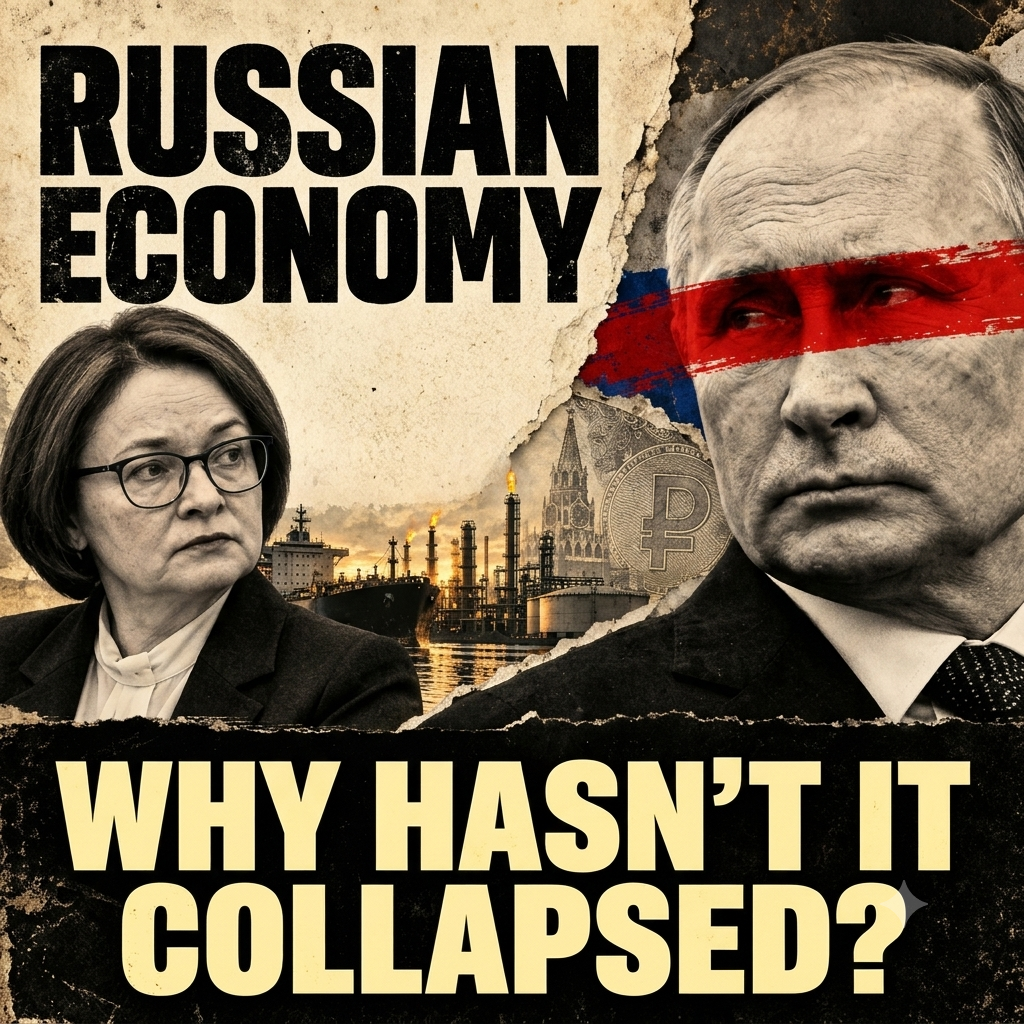
When Western powers descended upon Russia’s financial architecture in the bitter winter of 2022, freezing approximately $300 billion in central bank reserves and severing major lenders from the SWIFT system, the consensus in Washington and Brussels was absolute: a financial blitzkrieg would dismantle the Kremlin’s war chest within months.
Yet, more than four and a half years into the conflict, the reality on the ground defies simple orthodoxies. Strolling down the central avenues of Moscow or Saint Petersburg reveals a landscape adapted to relentless conflict—sleek new Chinese-branded automobiles replace departed Western models, while heavy industrial centers in the Urals burn bright across three shifts. While the International Monetary Fund (IMF) and other financial trackers have periodically registered resilient GDP numbers, a deeper, more fragile economic transformation has taken place beneath the surface.
Russia’s economy has not collapsed into rubble, but neither is it healthy. Instead, it has morphed into a peculiar, highly militarized organism running entirely on state-directed war spending—bearing hidden costs that threaten its long-term viability.
The Anatomy of the “Fortress Economy” and the 72-Hour Crisis
To understand how Moscow weathered the storm, one must look back at the defensive walls built during the preceding decade. Following the 2014 annexation of Crimea, technocrats like Central Bank Governor Elvira Nabiullina and Finance Minister Anton Siluanov meticulously fortified Russia’s fiscal foundations. They pushed public debt down to roughly 17% of GDP and accumulated over $630 billion in foreign reserves and gold.
When the hammer dropped in February and March of 2022, causing a frantic run on banks and a freefall of the ruble, Nabiullina executed a textbook emergency defense. By overnight hiking the base interest rate to 20%, enforcing strict capital controls, and forcing energy exporters to convert 80% of their foreign earnings into rubles, the central bank choked off panic.
Simultaneously, Vladimir Putin weaponized Europe’s energy dependency. By mandating that “unfriendly” nations pay for natural gas in rubles, Moscow forced European currency to flow directly through domestic Russian banks, engineering a stunning currency rebound and generating a record current account surplus of $227 billion in the first year alone.
The Shadow Fleet and the Pivot East
When Western allies realized that a total ban on Russian oil would trigger a catastrophic global energy shock, they introduced the G7 oil price cap at $60 per barrel in late 2022. Moscow’s countermove was historic: utilizing a war chest of capital, Russian energy firms acquired over 600 aging oil tankers to form a massive “shadow fleet.” Operating outside Western maritime insurance and routing cargoes through high-seas ship-to-ship transfers, this fleet bypassed the price cap and neutralized the western embargo.
The primary beneficiaries of this energy redirection were emerging economic giants. India rapidly transformed its import profile, scaling its purchase of Russian crude from under 2% to nearly 40%, with massive refineries processing the oil and legally exporting refined fuels back to global markets. Meanwhile, trade with China exploded past $240 billion annually, with over 90% settled in non-dollar currencies like the Chinese yuan and the ruble.
However, this pivot created a profound asymmetrical dependency. While Russia successfully decoupled from Western financial systems, it traded European integration for technological and industrial reliance on Beijing. Major Chinese banks, careful to avoid secondary U.S. sanctions, maintain strict compliance boundaries, and Beijing has continuously rebuffed Moscow’s requests to build massive new pipelines like “Power of Siberia 2” without deep, subsidized discounts.
“Militorism” and the Overheated Domestic Engine
As the war settled into a grinding war of attrition, the Kremlin structurally transitioned its entire fiscal apparatus into a “military-keynesianism” model. By 2024, direct spending on defense and national security climbed to over 7–8% of national GDP, consuming nearly 40% of the entire federal budget.
In a strategic masterstroke, Putin appointed former macroeconomic first deputy prime minister Andrei Belousov as Minister of Defense, tasking him with auditing military spending, eliminating corruption, and scaling up the production of munitions and unmanned aerial vehicles (UAVs). Across towns in the Urals and special industrial zones like Alabuga, defense manufacturing lines surged.
This massive injection of state capital trickled down into impoverished rural provinces and industrial towns through high military contract wages and one-time recruitment bonuses. For a working-class family in Siberia, a soldier’s pay or defense-plant salary—often triple local civilian wages—created a localized consumer boom. Families bought new apartments, cars, and appliances, explaining why everyday citizens in industrial towns felt a sense of financial buoyancy despite thousands of international sanctions.
The Breaking Points: Labor Shortages and Inflation
Yet, macroeconomic reality cannot be indefinitely bypassed by the printing press. Today, Russia’s economy suffers from severe structural overheating. Capacity utilization across factories has surpassed 81%, and the unemployment rate has plummeted to a historic low of 2–3%, signaling an acute labor shortage driven by hundreds of thousands mobilized soldiers and over 650,000 emigrated tech and professional workers.
As state defense plants fiercely compete with civilian businesses for labor, wages have outpaced productivity, fueling persistent inflation that keeps consumer prices high. To combat this, Governor Nabiullina pushed the central bank’s interest rate to a staggering 21%. While the military-industrial sector remains insulated by state subsidies, civilian sectors—ranging from real estate to small private enterprises—are suffocating under the weight of expensive commercial credit.
Furthermore, Ukraine’s asymmetrical tactics—such as long-range drone strikes targeting high-tech distillation towers at major Russian oil refineries—have systematically disrupted fuel exports and squeezed state revenues. Combined with the depletion of high-liquid assets in the National Wealth Fund and progressive tax hikes introduced to plug widening budget deficits, the long-term cost of sustaining the war is mounting quietly.
Conclusion: A Pyrrhic Survival
Russia will not experience a sudden, catastrophic economic collapse. As long as domestic agricultural and energy self-sufficiency holds, and major buyers in Asia continue purchasing its raw commodities, the Kremlin retains the basic financial stamina to sustain its military operations.
However, survival is not prosperity. By mortgaging its long-term civilian modernization, demographic stability, and technological independence to finance a perpetual war economy, Russia has locked itself into a historical trap. Whether the guns fall silent tomorrow or years from now, the inevitable post-war reckoning—reintegrating hundreds of thousands of combat veterans, deflating a militarized industrial bubble, and managing systemic technological arrears—will remain the ultimate test for the Russian state.
Để lại một bình luận