🚨 THREE BEERS. TWO HOURS. THEN A 0.16% BAC.
Stephen Schneider reportedly gave police a remarkably specific account: two Guinnesses and one Miller Lite before taking his grandchildren out on the boat. But the blood-alcohol figure revealed later has turned that simple drink count into one of the biggest questions in the case. 👀
Who can verify what was actually ordered? What did the people at the table see? And what could the restaurant records reveal about those final hours before the crash?
The beer tally may be only the beginning — because every minute of that dinner could now matter. 👇
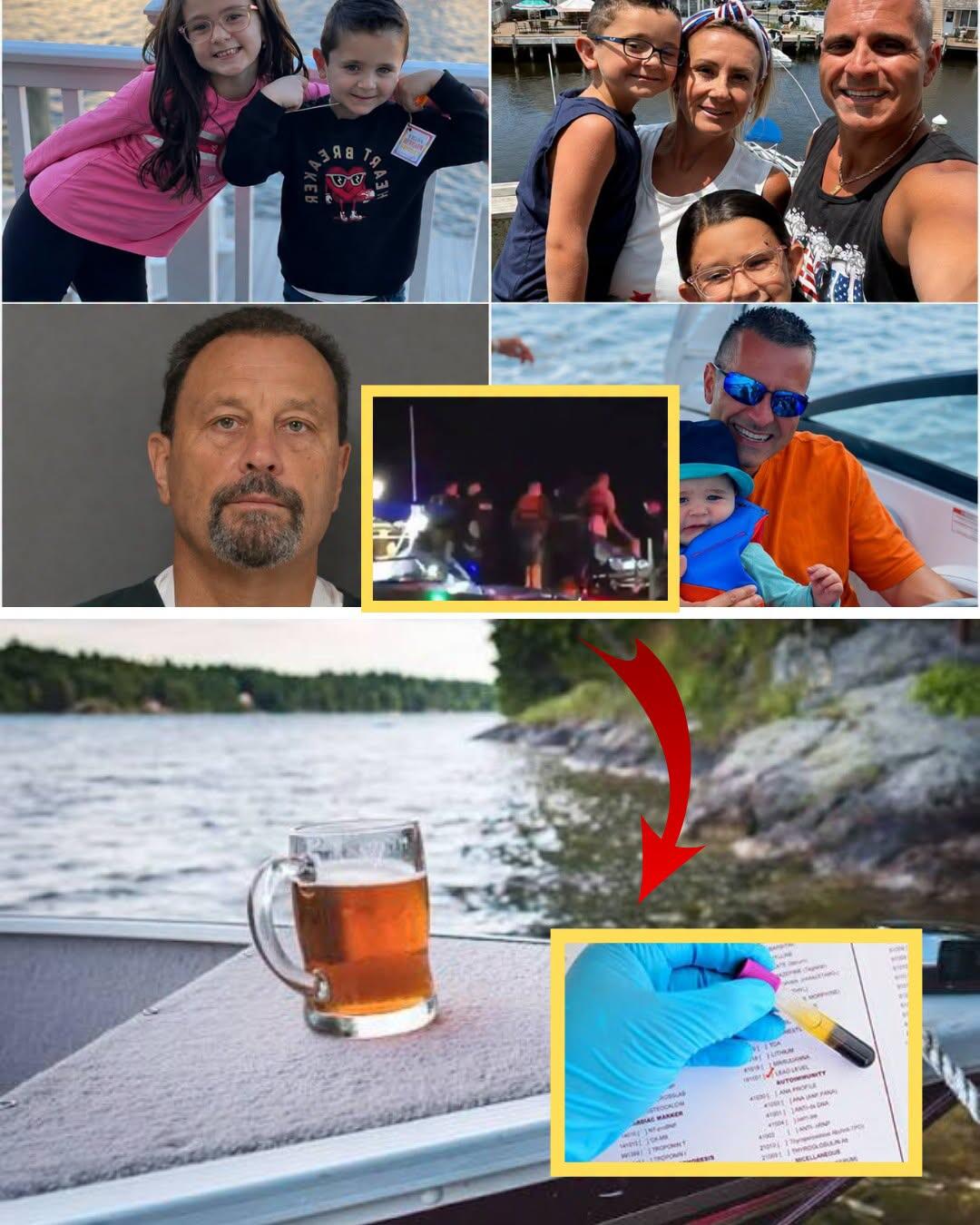
Three Beers, Two Hours and a 0.16% BAC: Why Stephen Schneider’s Drinking Timeline Is Under Scrutiny
Stephen Schneider’s account of what he drank before the fatal Barnegat Bay boat crash was unusually specific.
According to court documents cited by multiple news outlets, Schneider told investigators that he consumed three beers over approximately two hours at MJ’s Restaurant Bar & Grill in Bayville on July 19 — two Guinness beers and one Miller Lite.
That detail might have been little more than a routine part of an investigation into a boating crash.
Instead, it has become one of the most closely scrutinized pieces of the case after prosecutors said Schneider’s blood alcohol concentration was approximately 0.16% following the crash.
The figure was about twice New Jersey’s legal limit, according to prosecutors and subsequent reporting. Schneider, 64, now faces two counts of reckless vessel homicide, as well as charges related to operating a vessel under the influence and reckless operation.
The key issue is not simply how many drinks Schneider says he consumed.
It is whether his account can be independently reconstructed.
A Specific Statement, Not a Vague Admission
The distinction matters.
Schneider reportedly did not simply tell investigators that he had “a few drinks.”
The account described in the affidavit was specific: two Guinnesses and one Miller Lite over roughly two hours.
ABC7 New York reported that Schneider told police he had consumed three beers during the two-hour period before the crash. Court documents placed the family dinner at MJ’s Restaurant Bar & Grill, where Schneider was with his wife, daughter, son-in-law and two grandchildren.
The children — 9-year-old Mya Bella Golabek and 7-year-old Sigmund Paul Golabek — had arrived at the restaurant with their parents on a separate boat.
They ultimately left with their grandparents.
Around 9 p.m., Schneider’s Tidewater Custom 280 struck a channel marker in the Intracoastal Waterway.
The children were thrown from the vessel. Both were wearing life jackets, according to court-document reporting, but they were later pronounced dead at a hospital.
Schneider’s version of his alcohol consumption therefore sits directly inside the timeline investigators are trying to reconstruct.
Then Came the 0.16%
The reported BAC changed the significance of that statement.
At Schneider’s August court hearing, prosecutors said his BAC was approximately 0.16%.
NBC Philadelphia reported that prosecutors described the level as twice the legal limit. News 12 likewise reported that prosecutors cited a 0.16% BAC when arguing against his release.
The prosecution has also pointed to laboratory findings describing significant alcohol-related impairment, including effects on alertness, perception, judgment, response time and coordination. Those findings have become part of the government’s case that Schneider was not fit to operate the vessel.
Schneider has not been convicted of the charges.
His defense has challenged aspects of the prosecution’s case and indicated that an independent expert would examine the reported BAC, according to reporting from the August hearing. The defense has also raised questions about the channel marker and its visibility.
That means the 0.16% figure is highly important, but it is still evidence within an ongoing criminal case rather than a final judicial finding.
The Timeline Has a Four-Hour Problem
One detail has generated particular discussion online: the timing of the blood draw.
Reddit users examining the publicly reported timeline noted that the crash occurred around 9 p.m., while the blood sample was reportedly collected several hours later, around 12:45 a.m.
That timing is important because BAC is not static.
Alcohol is metabolized over time, meaning investigators and attorneys must consider when alcohol was consumed, when the crash occurred and when the blood sample was obtained.
That does not mean the Reddit calculations are correct, nor does it establish what Schneider’s BAC was at the exact moment of impact.
But it explains why the timeline matters so much.
The prosecution’s case is not simply about a number printed on a laboratory report. The significance of that number depends on the circumstances surrounding the test and the broader evidence.
That is precisely why Schneider’s reported drink count has attracted attention.
Could the Restaurant Records Matter?
Potentially — but there is an important distinction between what could exist and what has actually been made public.
A restaurant can generate several types of records that could theoretically help reconstruct a dinner.
There could be a receipt.
There could be a point-of-sale transaction showing when the bill was opened or closed.
There could be information about the beverages ordered.
There could be surveillance footage, depending on the restaurant’s camera system and retention period.
There could also be employees or other patrons who remember the group.
But there is currently no reliable public report establishing that investigators have released a detailed beverage receipt, individual beer-bottle inventory or surveillance footage showing Schneider’s drinking.
So claims that investigators can already “trace every beer bottle” should be treated cautiously.
What can be established is that Schneider’s own statement provides investigators with a specific account that can potentially be compared against independent evidence.
That is a much more defensible conclusion.
Six People at the Dinner Table
The restaurant was not an isolated setting.
Schneider was reportedly there with his wife, his daughter, his son-in-law and his two grandchildren.
That means several people were present during the period in which Schneider says he consumed the three beers.
Their observations could potentially become relevant if the case reaches trial.
For example, investigators could ask when Schneider arrived, when the drinks were ordered, how long the family remained at the restaurant and what he appeared like before leaving.
But even witness testimony has limitations.
Someone sitting at the same table does not necessarily know exactly how much another person consumed. A person can order a drink and consume it slowly, leave part of it unfinished, or consume alcohol outside the direct observation of another diner.
Likewise, a witness saying Schneider appeared normal would not automatically disprove the later toxicology evidence.
The value of such testimony would depend on how it fits with the complete evidentiary record.
What Online Communities Are Saying
The three-beer claim has become one of the most heavily debated details among people following the case online.
In a large Reddit discussion about the crash, commenters questioned how Schneider’s reported three beers could be reconciled with the reported BAC. Some users focused on the time between the crash and the blood draw, while others speculated about beer size, alcohol content and whether the restaurant’s records could establish what was actually purchased.
Some commenters went considerably further, suggesting that Schneider must have consumed more alcohol than he admitted.
Those claims remain speculation.
Other Reddit users raised a different issue: if restaurant receipts exist, investigators could potentially compare them with Schneider’s statement.
That is a reasonable investigative question, but it is not evidence that a receipt has already contradicted him.
The distinction is particularly important in a case involving criminal charges and two children’s deaths.
Online theories can identify questions worth asking.
They cannot answer them.
What the Prosecution Is Building
The prosecution appears to have several categories of evidence.
There is the crash itself.
There is Schneider’s account that he was traveling at approximately 20 mph and saw the channel marker only at the last moment.
There is evidence that the marker’s lighting was functioning properly, according to reporting based on the investigation.
There is the reported BAC of approximately 0.16%.
And there is Schneider’s own statement about consuming three beers over two hours.
Together, prosecutors can use those facts to argue that alcohol impairment played a significant role in the crash.
The defense, meanwhile, has reasons to scrutinize each component.
The BAC may be challenged through expert analysis.
The precise timeline of alcohol consumption can be examined.
The visibility of the channel marker can be disputed.
And the circumstances surrounding the collision can be analyzed independently of the toxicology evidence.
That is how the case is likely to develop: not around one isolated fact, but around how multiple pieces of evidence fit together.
The Human Element Behind the Timeline
The forensic questions can sometimes obscure what the original evening was supposed to be.
It was a family dinner.
The parents and children arrived by one boat, while the grandparents arrived separately.
After eating, the children were going to return with their grandparents.
Instead, the boat trip ended with a collision and a desperate rescue attempt.
A recently released 911 recording captured Schneider’s wife, Laurie, reporting the emergency and describing the frantic effort to locate and revive the children. The recording has added another documented layer to the timeline after the collision.
The tragedy is therefore not merely a dispute over a drink count.
The drinking evidence matters because prosecutors allege that Schneider’s impairment contributed to the deaths.
But the people involved were also a family spending what should have been an ordinary summer evening together.
Schneider Has Been Released While the Case Continues
A judge released Schneider from custody on August 19 while the criminal case proceeds.
News 12 reported that the decision took into account his lack of a criminal history and the fact that the children’s parents asked that he be released.
ABC7 reported that Schneider was ordered not to operate a boat or motor vehicle while completing a court-ordered assessment.
His next court proceedings will provide an opportunity for the prosecution and defense to further litigate the evidence.
That could include the toxicology findings, the circumstances of the crash and the events leading up to the boat trip.
What Happens to the Three-Beer Claim?
For now, the statement remains exactly that: Schneider’s reported account to investigators.
It has not been independently established by publicly released restaurant records.
And the reported 0.16% BAC does not, by itself, reveal exactly how many drinks Schneider consumed.
What it does establish is why investigators and attorneys have reason to scrutinize the entire timeline.
If restaurant records, witnesses or other evidence can independently establish what Schneider ordered and when, those details could become relevant.
If they cannot, prosecutors will have to rely on the toxicology evidence and the rest of the investigation to establish their case.
The most important unanswered questions are therefore remarkably simple.
How long was Schneider actually at the restaurant?
Exactly when were the drinks consumed?
Was the three-beer account consistent with the independent evidence?
And what was Schneider’s condition when he left the restaurant and took control of the boat?
Those questions are likely to remain central as the case moves toward court.
For now, the three beers are not a conclusion.
They are a starting point — a specific claim that investigators can compare against everything else that happened during those final hours before the boat left the restaurant.
Để lại một bình luận