WHY WOULD A LEADER DESTROY HIS OWN GOVERNMENT?! The Dark Secret Behind China’s Cultural Revolution 🚨🔥
In the summer of 1966, millions of red-scarved teenagers flooded Tiananmen Square, waving little red books and chanting commands to smash the very system their own party built. Within weeks, elite schools turned into torture chambers, state presidents were dragged from their homes in handcuffs, and an entire superpower plunged into a decade of absolute, bloody madness.
Most revolutions happen when the oppressed overthrow the rulers. But this time? The supreme leader himself ordered the destruction of his own machine.
Why did Mao Zedong turn 700 million citizens against each other? Was it an ideological crusade for absolute purity, or was it a ruthless, paranoid purge to crush political rivals after the catastrophic death toll of the Great Leap Forward?
The chilling truth behind the power struggle inside the Zhongnanhai red walls will leave you speechless.
👉 Uncover the forbidden history and the true body count before this post gets buried: 🔥
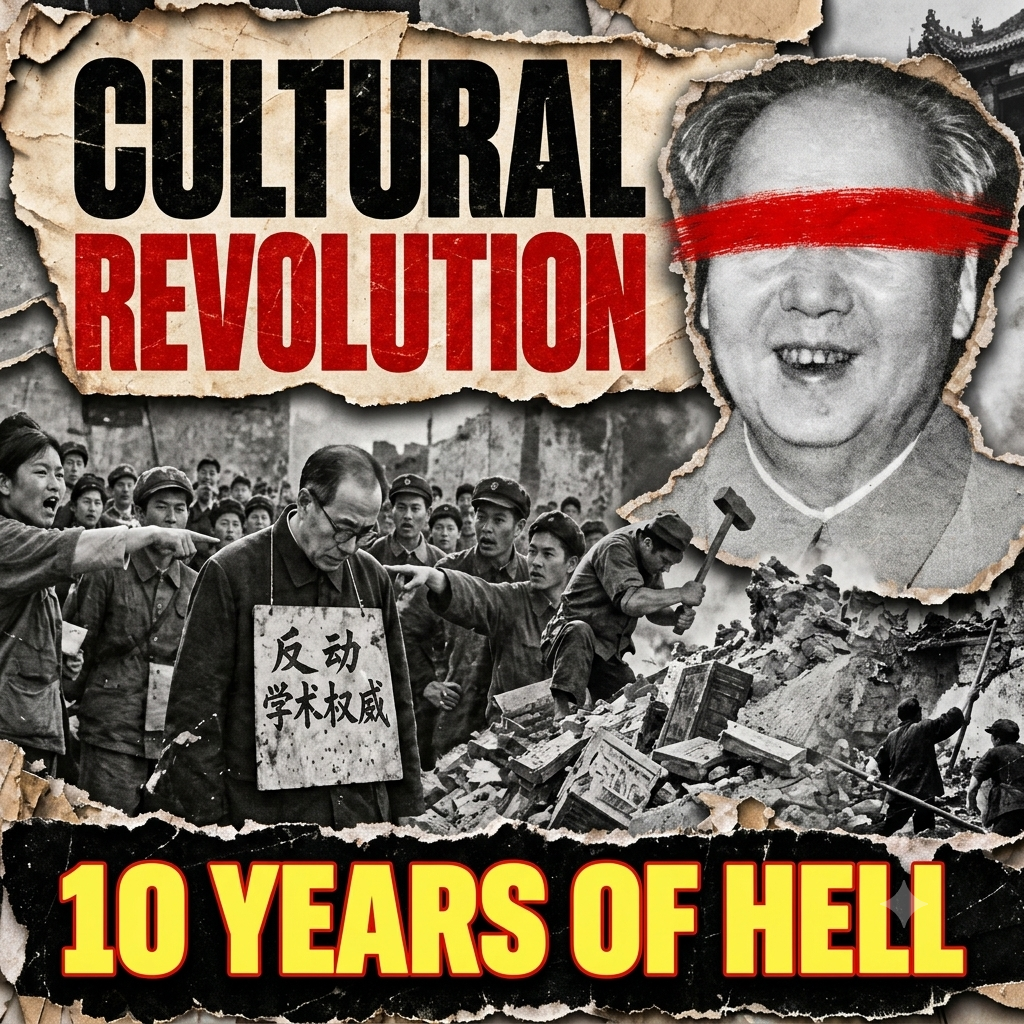
On a brisk morning in August 1966, Tiananmen Square was transformed into a sea of olive-green uniforms. Over a million teenage Red Guards waved identical red-bound books of Quotations from Chairman Mao, roaring with ideological fervor. On the rostrum above, a 72-year-old Mao Zedong looked down approvingly. What followed over the next ten years was one of the most bizarre and cataclysmic political paradoxes of the 20th century: a supreme leader deliberately weaponizing the masses to tear down his own government, purge his closest comrades, and plunge 700 million people into a decade of terror known as the Cultural Revolution.
While history books frequently frame the era through abstract ideological struggles, a deeper, more chilling reality emerges from the archives—one driven by political paranoia, economic catastrophe, and an unyielding battle for absolute survival at the apex of power.
The Ghost of the Great Leap Forward: The Roots of Paranoia
To understand why the Cultural Revolution exploded in 1966, one must look back to the spring of 1958 and the catastrophic fallout of the “Great Leap Forward.” Mao’s grandiose vision to surpass British industrial and agricultural output in a matter of years resulted in forced collectivization, absurd communal steel-making quotas, and artificial famines that starved tens of millions of peasants to death in provinces like Henan, Anhui, and Sichuan.
Inside the elite circles of the Chinese Communist Party (CCP), a suffocating silence reigned until the Lushan Plenum in July 1959. Defense Minister Peng Dehuai, a legendary military hero, took the immense risk of writing a private letter to Mao detailing the disastrous reality of the famine and criticizing the reckless economic policies.
Mao viewed Peng’s truth-telling as a direct existential threat to his authority. He retaliated fiercely, purging Peng and instilling a climate of sheer terror against anyone daring to speak truth to power.
By January 1962, at the “7,000 Cadres Conference” in Beijing, the fractures grew too wide to conceal. State Chairman Liu Shaoqi openly challenged Mao’s leadership, famously attributing the famine not merely to bad weather, but declaring it “three parts natural calamities, seven parts man-made disasters.” Stung by the rebuke and recognizing that practical pragmatists like Liu Shaoqi and Deng Xiaoping were quietly restoring private plots and reviving the economy through pragmatic reforms, Mao retreated to the “second line” of leadership—nursing a deep, vengeful resentment and a festering fear that his legacy would be undone.
The Soviet Nightmare and the Fear of Revisionism
Mao’s paranoia was supercharged by geopolitical developments in Moscow. In 1956, Nikita Khrushchev delivered his historic “Secret Speech” condemning Joseph Stalin’s cult of personality, followed by Khrushchev’s own sudden ouster in 1964.
For Mao, these events conjured twin nightmares: First, that while he was still alive, pragmatists like Liu and Deng might outvote and depose him; and second, that after his death, a “revisionist” leadership would dismantle his ideological framework and denounce his name, just as Khrushchev had done to Stalin.
When political disagreements boiled over into fierce debates in late 1964—culminating in Mao angrily asking colleagues if he was still considered a party member—the die was cast. Finding the official party apparatus in Beijing largely dominated by pragmatists loyal to Liu Shaoqi, Mao retreated to the south to forge a clandestine counter-offensive.
The Spark in Shanghai and the Mobilization of Youth
Mao’s offensive began not with a military coup, but through an intricate literary proxy war. Orchestrated by his fourth wife, Jiang Qing, alongside radical ideologues in Shanghai, a critique was launched against the historical play Hai瑞罢官 (Hai瑞 Dismissed from Office), written by Beijing Deputy Mayor Wu Han. The play told the story of an honest Ming Dynasty official who criticized the emperor—a thinly veiled allegory defending the purged Marshal Peng Dehuai.
When Beijing municipal authorities tried to shield Wu Han, Mao used the opportunity to declare that the Beijing municipal committee was an impenetrable “independent kingdom” infested with counter-revolutionaries. Backed by military support from Defense Minister Lin Biao—who distributed millions of copies of the “Little Red Book” throughout the People’s Liberation Army—Mao purged Beijing’s top leadership.
In May 1966, the Central Committee issued the “May 16 Notification,” formally declaring that bourgeois representatives had snuck into the party and were waiting to seize power. Within days, radical student posters at Peking University transformed ideological theory into physical action.
When Liu Shaoqi and Deng Xiaoping attempted to restore order by sending “work teams” to universities to manage the student protests, they walked directly into Mao’s political trap. Mao condemned the work teams as suppressors of the revolutionary masses, creating the pretext to label Liu and Deng as “capitalist-roaders” heading a bourgeois headquarters.
The Reign of the Red Guards and the Destruction of Culture
By the summer of 1966, the storm broke loose. Across China, millions of teenagers joined the Red Guards, granted total immunity from state laws. Encouraged by radical leaders, they launched the campaign to destroy the “Four Olds”—old customs, old culture, old habits, and old ideas.
Temples, ancient libraries, and historical monuments were systematically ransacked. In Qufu, the ancestral home of Confucius, priceless artifacts were burned, and graves were desecrated. In major cities, traditional street names were replaced with revolutionary slogans, and classical literature and Western instruments were thrown into bonfires.
Simultaneously, public struggle sessions became a horrific daily ritual. Intellectuals, teachers, and veteran party officials were forced into humiliating “airplane” postures, beaten, and subjected to vicious kangaroo courts. Elite scholars and writers, such as famed author Lao She, driven to the brink of despair by relentless public torture, chose suicide over further humiliation.
The Fall of the Titans and Military Chaos
The purge spared no one, consuming the very founders of the People’s Republic. Marshal Peng Dehuai was dragged back to Beijing to face brutal public degradation, ultimately dying in isolation in 1974. Deng Xiaoping was branded the “No. 2 Capitalist Roader” and sent to labor in a Jiangxi tractor repair factory, while his son was crippled after being persecuted by student radicals.
The ultimate target, State Chairman Liu Shaoqi, endured months of relentless physical and psychological abuse inside Zhongnanhai. Stripped of his clothes and medical care, a broken and feverish Liu was secretly flown to a damp underground cell in Henan province under a false name, where he died alone in November 1969.
As rival factions of Red Guards began fighting each other with stolen military weapons—transforming industrial cities like Wuhan and Chongqing into actual war zones with artillery and tanks—Mao realized the chaos threatened to tear the nation apart entirely. By late 1968, the military stepped in to restore order, and Mao initiated the “Up to the Mountains and Down to the Villages” movement, forcibly exiling over 16 million urban youths to remote rural frontiers to be “re-educated by peasants,” effectively neutralizing the radical student movement.
The Lin Biao Crisis and the Geopolitical Pivot
With the Red Guards sidelined, the military emerged as the dominant political force, centered around Vice Chairman Lin Biao, designated as Mao’s official successor. However, paranoia quickly poisoned this relationship as well.
Fearing that Lin Biao’s military faction was growing too powerful, Mao began chipping away at his base. Realizing they were facing imminent destruction, Lin Biao’s family allegedly drafted an abortive coup plot (Project 571). When the plot leaked in September 1971, Lin Biao, his wife, and son attempted to flee the country aboard a Trident airliner, which crashed mysteriously over Undur Khan in Mongolia, killing all on board.
The shocking death of Mao’s handpicked successor shattered the ideological faith of millions. Amidst deep domestic crisis and the looming threat of a nuclear clash with the Soviet Union, Mao and Premier Zhou Enlai made a stunning geopolitical pivot: opening secret channels with the United States. The historic visit of U.S. President Richard Nixon to Beijing in 1972 shattered China’s diplomatic isolation and redrew the global Cold War map.
The Final Act: 1976 and the Death of an Era
The final years of Mao’s life were characterized by a desperate tug-of-war between the radical faction known as the “Gang of Four”—led by Jiang Qing—and pragmatic leaders like Zhou Enlai and the newly rehabilitated Deng Xiaoping, who sought to restore economic stability and national modernization.
The year 1976 brought a cascade of unprecedented national grief and upheaval. Beloved Premier Zhou Enlai died in January, followed by Marshal Zhu De in July, and the catastrophic Tangshan earthquake in July, which claimed over 240,000 lives. When millions gathered at Tiananmen Square during the Qingming Festival in April to mourn Zhou Enlai while implicitly protesting the tyranny of the Gang of Four, the demonstrations were violently suppressed, and Deng Xiaoping was purged for a second time.
On September 9, 1976, Mao Zedong passed away at the age of 82. Less than a month later, on October 6, Hua Guofeng, Ye Jianying, and Wang Dongxing executed a swift, bloodless palace coup inside Huairen Hall, arresting the Gang of Four and abruptly ending the ten-year nightmare of the Cultural Revolution.
Conclusion: A Legacy Carved in Scars
By the time Deng Xiaoping returned to ultimate power in 1977 and the historic 1981 party resolution formally categorized the Cultural Revolution not as a social progress, but as “internal domestic turmoil caused by erroneous leadership,” the true cost had already been paid.
Between one and two million lives had been lost, over a hundred million citizens had suffered direct persecution, and an entire generation of education and cultural heritage had been devastated. The legacy of the era stands as a permanent, agonizing reminder of the dangers of unchecked absolute power, personality cults, and the erosion of the rule of law—ensuring that China’s subsequent path under reform and opening-up would permanently pivot toward economic pragmatism and institutional stability.
Để lại một bình luận