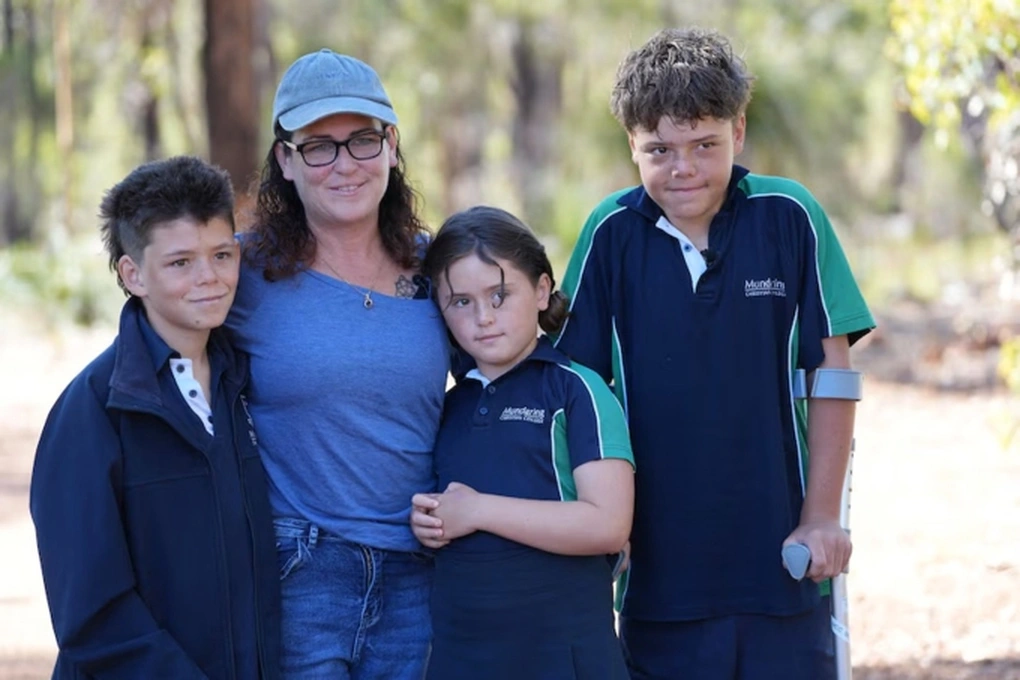
That was all Austin Appelbee said after saving his family — words so simple they stunned a nation.
Four hours in violent seas. One decision that changed everything.
What wasn’t known at first: the distance to shore may have been greater than initial estimates.
In late January 2026, the Appelbee family — mother Joanne, 47, and her three children: Austin, 13, Beau, 12, and Grace, 8 — were enjoying a holiday in Quindalup, Western Australia, about 200 kilometers south of Perth. They were paddleboarding and kayaking in the seemingly calm waters of Geographe Bay when strong winds suddenly turned the outing into a nightmare. The inflatable paddleboards and kayak were swept far offshore by powerful currents and rough swells.
What began as a fun family activity quickly became a fight for survival. The family found themselves drifting helplessly, clinging to two paddleboards as the shore disappeared from view. Joanne Appelbee faced an unimaginable choice: keep everyone together and risk all their lives as conditions worsened, or send someone for help. With darkness approaching and the children growing exhausted, she made the heart-wrenching decision to ask her eldest son, Austin, to try to reach land.
Austin initially attempted the journey in the kayak, but it quickly took on water and became unusable. Undeterred, he ditched the vessel and began swimming. He started wearing a life jacket but removed it midway because it restricted his movement and slowed him down in the choppy conditions. For four grueling hours, the 13-year-old battled massive waves, cold water, and exhaustion in shark-frequented waters. He later described repeating to himself, “Not today, not today, not today. I have to keep on going,” focusing on positive thoughts to push through the fear and fatigue.
Reports vary slightly on the exact distance Austin swam — some sources cite around 4 kilometers (about 2.5 miles), while others note the family’s eventual drift reached up to 14 kilometers (nearly 9 miles) offshore by the time rescuers arrived. Initial estimates of the distance to shore may have underestimated the relentless currents that carried the family farther out, making Austin’s swim even more daunting in hindsight. He used a combination of breaststroke, freestyle, and survival backstroke to conserve energy and stay afloat amid the violent seas.
When Austin finally reached the beach, he was far from finished. Exhausted and disoriented, he sprinted about 2 kilometers to access a phone — reportedly from his mother’s bag or a nearby point — and called emergency services around 6 p.m. local time. He urgently told authorities, “Police, I need helicopters, I need planes, I need boats… my family is out at sea.” His quick actions triggered a major rescue operation involving marine rescue teams, police, and emergency services.
Back in the water, Joanne and the younger children clung desperately to the paddleboards as night fell. Joanne later admitted she feared Austin might not have made it, telling media outlets like the BBC that she had “assumed Austin hadn’t made it.” The family drifted farther out, battling cold, fear, and the constant threat of the ocean. Yet, thanks to Austin’s alert, rescuers located them within about an hour of his call. The mother and siblings were brought safely to shore, having spent up to 10 hours in the water in some accounts.
Austin’s humility in the aftermath captured hearts worldwide. When interviewed by outlets including ABC News Australia, the BBC, and others, the teenager downplayed his role. “I don’t think I am a hero. I just did what I did,” he told the BBC. In other reports, he echoed the sentiment: “I just did what had to be done.” These understated words contrasted sharply with the praise he received. Rescuers described his effort as “superhuman,” and the story went viral, making international headlines and resonating as a tale of extraordinary courage in ordinary circumstances.
The incident highlighted several factors: the unpredictable dangers of coastal waters in Western Australia, even on seemingly mild days; the importance of family bonds in crisis; and the remarkable resilience of a young person under pressure. Austin had recently completed a school swimming program but had not passed a 350-meter continuous swim assessment — yet he managed far more in real peril. His mother credited her faith in his strength, saying it was one of the hardest decisions of her life to send him alone, but she knew he was the family’s best chance.
The rescue not only saved four lives but also sparked an outpouring of global support. Donations poured in, with reports of a fund reaching significant amounts (some social media mentions cited figures like £300,000) to support the family’s future and perhaps Austin’s education or opportunities. Messages flooded social media, with many calling the boy a symbol of hope and restored faith in humanity.
In an era often dominated by cynicism, Austin Appelbee’s story stands out for its simplicity and sincerity. He didn’t seek fame or accolades; he simply refused to give up. When asked about the ordeal, he focused on the relief of reuniting with his family rather than personal glory. His mother and siblings expressed profound gratitude, with Beau describing the terror of waiting in the water and Grace’s quiet resilience.
This miracle in Geographe Bay reminds us that heroism isn’t always loud or planned. Sometimes, it’s a quiet determination in the face of impossible odds — a teenager repeating “not today” to the sea, swimming through violence toward hope, and then saying nothing more profound than, “I just did what had to be done.”
Austin Appelbee’s actions saved his family, but his humility saved something else: our belief in the quiet power of ordinary people doing extraordinary things.
Để lại một bình luận