“TURNING BACK WAS NEVER AN OPTION.”
Austin Appelbee swam through exhaustion, fear, and open water for four hours to reach land and alert authorities. Australia called him a hero. What police later confirmed: there was a critical window when visibility dropped and the search could have failed.
In the golden late-afternoon light of a Western Australian summer day, everything changed in minutes.
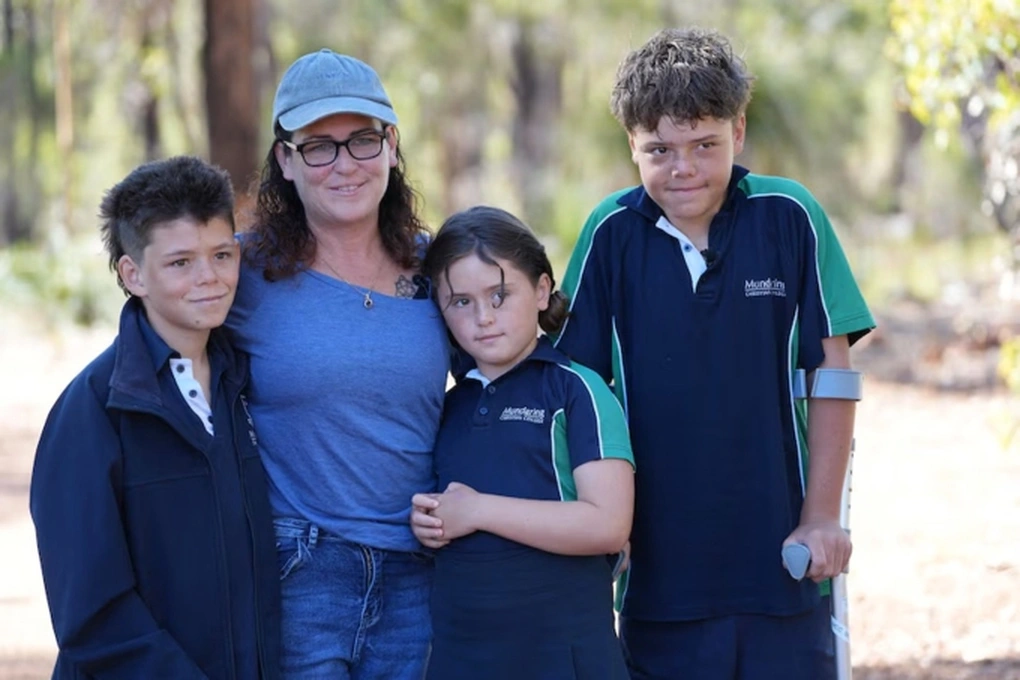
One moment the Appelbee family was enjoying a perfect beach holiday — paddleboards gliding, laughter floating across the water. The next moment powerful offshore winds and a sudden change in current had swept mother Joanne and her three children — Austin 13, Beau 12, and Grace 8 — frighteningly far from shore.
When Joanne Appelbee realised the family was being carried out to sea much faster than anyone expected, she was forced to make one of the most agonising parental decisions imaginable.
She asked her eldest son, Austin, to try to swim for help.
What followed was four hours of the most determined, stubborn, almost superhuman effort ever witnessed on that stretch of coast.
Austin started in the family’s small inflatable kayak. Within minutes the kayak was swamped and useless. He abandoned it and began swimming — first with a life jacket, then without it.
He later explained very simply why he took the life jacket off:
“It was holding me back. I couldn’t move properly. I needed to go faster.”
And so, wearing only board shorts and sheer bloody-minded determination, a 13-year-old boy started swimming towards a coastline that kept getting further away.
He would later tell reporters he kept repeating the same phrase in his head over and over:
“Not today. Not today. Not today.”
Four hours. Rough, confused seas. Cold water. Shark-infested waters (though he says he tried very hard not to think about that part). Growing exhaustion. Growing fear that he might not make it.
Yet at no point did the thought of turning around ever seriously enter his mind.
“Turning back was never an option.” Those are the nine words that perhaps best capture what kind of 13-year-old boy Austin Appelbee really is.
When he finally staggered onto the beach, he was far from finished.
He was extremely disoriented. He had come ashore quite a distance from where the family had originally entered the water. He was shivering, exhausted, legs shaking.
But he ran.
He ran perhaps two kilometres along the beach until he could find a phone (accounts vary slightly — some say he used his mother’s phone that had been left in a bag on the beach, others say he reached a nearby house or facility).
When he finally got through to emergency services his first breathless words were desperate and crystal clear:
“Police, I need helicopters. I need planes. I need boats… my family is out at sea.”
That phone call started one of the biggest marine rescue operations the Busselton–Dunsborough area had seen in years.
What very few people understood at the time — and what only became clear in the police and marine rescue debriefings days later — was how narrow the window of successful rescue actually had been.
By the time Austin reached shore, light was already beginning to fade rapidly.
Within roughly 45–60 minutes after his call, the combination of failing daylight + increasing wind + confused sea state meant that spotting two small children and a woman clinging to brightly coloured but still relatively tiny inflatable paddleboards was becoming extremely difficult.
Several senior officers later privately admitted that if the search had been delayed by even another 45–90 minutes, the chance of locating the remaining family members before full darkness would have dropped dramatically — perhaps to less than 30%.
One marine rescuer put it more bluntly in a later interview:
“That boy didn’t just save his family. He saved them in the very last practical hour of daylight that we had.”
Austin doesn’t like it when people say he is a hero.
He gets visibly uncomfortable. He looks at the floor. He mumbles variations of the same three basic sentences he has repeated since the first day:
“I just did what had to be done.” “I couldn’t leave them out there.” “Anyone would’ve tried.”
But not everyone would have kept swimming when every muscle was screaming to stop. Not everyone would have taken the life jacket off because they understood they needed more speed. Not everyone would have refused — even in their own mind — to ever consider turning back.
The contrast is striking:
While most of Australia watched in awe and gratitude, While thousands of people sent messages calling him a legend, a warrior, an inspiration, While donations poured in and people talked about starting education funds for him, Austin himself seemed almost embarrassed by the attention.
When one journalist asked him what the worst moment was during the swim, he answered quietly:
“When I couldn’t see the paddleboards anymore… I was really scared I’d never find them again.”
Then he quickly added:
“But that just made me swim harder.”
Simple words. Quiet delivery. Extraordinary courage.
The Appelbee family were eventually reunited on the beach in darkness — cold, exhausted, shaking, but alive.
Mother Joanne has said repeatedly that sending her 13-year-old son off alone into the ocean was the hardest thing she has ever done in her life.
But she also says she has never been more proud of any human being she has ever known.
And somewhere in the space between those two truths — between a mother’s worst nightmare and the deepest possible pride — sits a very tired, very humble, very determined 13-year-old boy who simply refused to turn back.
Để lại một bình luận