CRIMEA IS RUNNING OUT OF TIME—AND NOBODY SAW THIS NEXT MOVE COMING! 🚨
For days, the Crimean Bridge was hammered until the steel buckled, the road dropped, and the trains ground to a halt. Everyone thought the bridge strike was the main event…
They were dead wrong. 😱
While Moscow scrambles to explain why its “indestructible” lifeline looks like a war-torn wreck, something far more ruthless is unfolding behind the scenes. Disguised trucks going up in flames. Fuel lines stretching for miles in Sevastopol. Power flickering for hours at a time while residents wonder if tomorrow’s tank of gas—or grocery shelf—will even exist.
And the real twist? The bridge damage isn’t even the part keeping Russian commanders awake at night. It’s the second chokehold tightening around the peninsula right now—one that turns every detour, every tanker, and every supply run into a high-stakes trap.
What happens next could change the entire map of the Black Sea… and leave thousands stranded with almost no way out. 👀
Are they about to pull off the unthinkable before winter bites harder? Read the full breakdown before the story shifts again 👇🔥
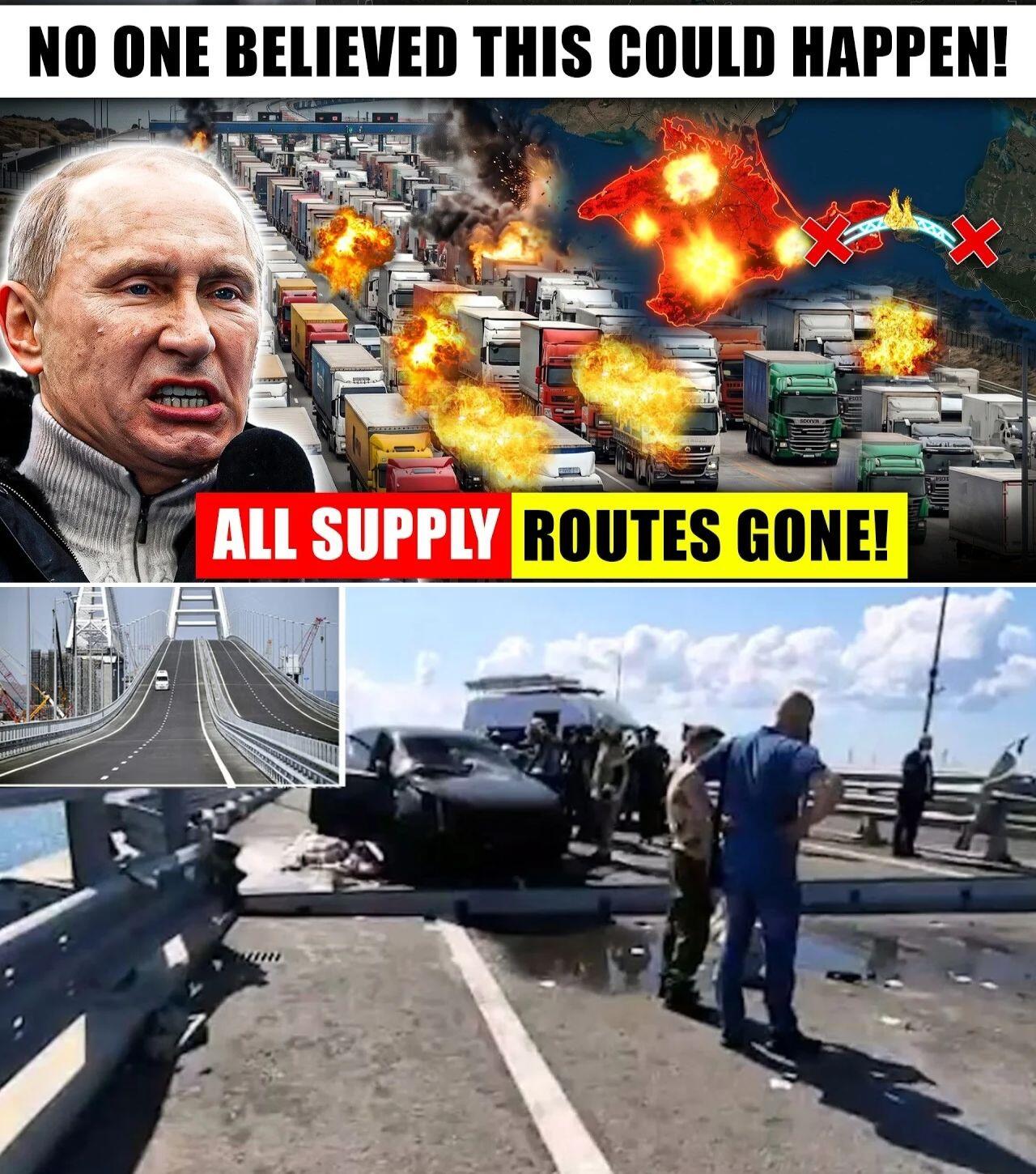
For more than a decade, the 19-kilometer Crimean Bridge has stood as the defining symbol of Moscow’s grip on the Black Sea peninsula it seized in 2014. Built to bind Crimea permanently to Russia’s Krasnodar region by road and rail, the structure carried everything from summer vacationers and everyday groceries to fuel, ammunition, and military hardware.
Now, after a series of coordinated strikes between November 16 and November 19, 2026, that vital artery has suffered severe damage—and the shockwaves are rippling far beyond battered steel and halted freight trains. According to reporting and analysis from Power Fault Lines, alongside dispatches cited from The New York Times, The Moscow Times, and Meduza, Ukrainian forces have paired multi-stage strikes against the bridge with a widening drone and logistics campaign targeting Russia’s remaining supply routes, including the R280 highway corridor.
Across Sevastopol and wider Crimea, residents are confronting a compounding squeeze on fuel, electricity, water pressure, and basic goods. Rationing rules have returned, panic buying has flared at local pumps, and officials have offered conflicting timelines on when the damaged bridge can be repaired. While Russian authorities insist essential supplies will continue moving, the combination of a crippled bridge and exposed overland routes has turned a high-stakes infrastructure battle into an everyday survival test for people on the ground.
A Multi-Stage Campaign Against a Signature Lifeline
The November assault on the Crimean Bridge did not happen overnight. According to statements from Ukrainian President Volodymyr Zelenskyy and Ukraine’s Security Service (SBU) referenced in the Power Fault Lines report, the operation unfolded over roughly a month as part of a broader, seven-stage plan. Rather than firing blindly at a heavily guarded target, Ukrainian forces first worked to degrade Russian air defenses, radar installations, and electronic warfare systems along the approach routes before focusing directly on the crossing itself.
When the strikes hit between November 16 and November 19, the damage escalated across consecutive nights:
-
November 16: An initial strike shifted a road arch and disrupted traffic flow, leaving vehicles moving intermittently while officials downplayed the severity of the hit.
-
Around midnight on November 17: A second strike brought down a road arch and the roadway beneath it, severing road traffic across that section and halting rail movement for a stretch.
-
Just after midnight on November 19: A follow-up strike targeted the rail bridge, prompting another suspension of train traffic while engineers assessed structural impacts.
Ukrainian officials pointed to a mix of strike systems used in the campaign, naming strike drones, Neptune missiles, and the FP5 Flamingo—a system described in reports alternately as a drone or a missile. By November 19, Russian President Vladimir Putin acknowledged serious damage, while satellite imagery indicated rail damage in at least three locations, including where an arch meets the track. Ukraine’s General Staff stated that the railway structure remained standing but with a damaged arch, while rail operations were restricted to a single track on November 20 and November 21, according to reporting cited from The Moscow Times and Wikipedia.
Repair projections have underscored just how difficult restoration could be. On November 19, Russian Deputy Prime Minister Marat Khusnullin suggested certain elements might reopen within one to two months, yet the very next day—November 20—he acknowledged there were no set repair timelines while designers calculated the damage. Engineers speaking to The New York Times estimated that replacing a collapsed steel arch under wartime conditions could take roughly two years. Even if partial traffic resumes sooner, the prospect of prolonged disruption has forced planners to treat the crossing as unreliable for the foreseeable future.
Widening Pressure on the R280 and Overland Corridors
If the bridge strikes grabbed immediate headlines, the secondary push along Russia’s overland supply network may prove just as consequential. With road and rail links across the Kerch Strait battered, the R280 highway—linking Russia with occupied southern Ukraine and Crimea—has taken on heightened importance as a primary conduit for moving military supplies and commercial cargo toward the peninsula.
Footage shared on X on November 22 showed a Ukrainian medium-range strike drone hitting a Russian fuel truck along the land corridor to Crimea. Notably, the vehicle appeared disguised as a civilian cargo truck—a detail that highlights both how Moscow has attempted to mask sensitive logistics and how closely Ukrainian operators are monitoring transport movement behind the front lines.
Medium-range strike drones offer a distinct tactical advantage in this kind of attrition fight. Unlike scarce, high-cost precision missiles reserved for heavily fortified or high-value fixed targets, strike drones allow operators to hunt moving vehicles—fuel tankers, supply trucks, and logistics assets—along highways and secondary arteries. Beyond the immediate blast, every destroyed tanker or stalled convoy forces Russian commanders to slow movements, reroute traffic, add security escorts, and stretch air-defense coverage across wider stretches of territory.
Other routes tying occupied southern Ukraine to Crimea are also under strain. Corridors and crossings near Chongar and Armyansk sit within the wider web of logistics routes that military planners rely on when primary arteries falter. Every bottleneck compounds the next: when rail capacity drops or highway lanes face drone threats, alternative paths carry heavier loads and become more tempting targets.
Everyday Life in Crimea: Fuel Lines, Blackouts, and Rising Prices
For ordinary residents living in Crimea and Sevastopol, geopolitical strategy quickly translates into practical friction. Fuel has been one of the clearest flashpoints since the mid-November strikes. Following the attacks, drivers in Sevastopol rushed service stations, with local Telegram channels reporting individuals purchasing anywhere from 200 to 500 liters at a time.
Authorities moved to curb those runs starting Thursday, November 19, allowing drivers to fill their tanks while capping extra container purchases at 20 liters at major networks such as ATN and TESCO. Those restrictions landed on top of earlier tightening seen during 2026—including a 20-liter-per-vehicle cap in July and windows in September when fuel was sold for only a few hours a day. For many residents, a traditional workaround had been bringing cheaper fuel across from Russia’s Krasnodar region, an option that becomes far less dependable when bridge and ferry crossings face delays and restrictions.
Fuel scarcity rarely stays confined to private motorists. Ambulances, municipal buses, delivery vans, farm equipment, and local businesses all depend on steady supplies. When fuel tightens, transport costs rise and everyday errands become harder to plan.
Power reliability adds another layer of strain. Following earlier Ukrainian strikes on regional energy infrastructure—which prompted Russian-installed authorities to declare a state of emergency across Crimea and Sevastopol in late June 2026, as reported by The Moscow Times—rolling blackouts and voltage instability have hit homes and businesses. Sevastopol’s Russian-appointed governor, Mikhail Razvozhayev, acknowledged that unstable electricity was hurting essential services and local enterprises, while emergency declarations allowed residents to seek compensation for damaged gear and let companies invoke force majeure clauses.
Because electric power drives water pumping stations, treatment facilities, and distribution networks, power fluctuations can spill directly into water pressure and municipal services. Meanwhile, residents trying to travel off the peninsula face fewer straightforward choices as road damage, rail limits, ferry crossings across the Kerch Strait, and bus adjustments complicate movement between Crimea and mainland Russia.
Food availability and prices represent another long-building concern. When supply routes face repeated strikes and fuel costs climb, deliveries slow down and shelf prices tend to rise. Earlier in 2026, Meduza reported that supermarket prices in occupied Crimea had jumped by roughly 30 percent, leaving some discount chains with half-empty shelves, while Ukrainian military intelligence reported nearly 400 food-service businesses closing in the first half of the year. Disruption feeds anxiety, anxiety fuels stockpiling, and stockpiling deepens shortages—a cycle that grows harder to break each time a major route is hit.
How the Community Is Reacting Online
Across social platforms and monitoring communities, the combination of bridge damage and drone footage has fueled intense debate, rapid verification efforts, and sharp partisan reactions.
-
X (formerly Twitter): Accounts tracking conflict footage and open-source intelligence circulated clips of the November 22 drone strike on the disguised fuel truck alongside satellite comparisons of the bridge’s rail and road sections. Users debated whether the strike proved Russian logistics were being forced into makeshift civilian covers or simply reflected routine wartime transport practices.
-
Telegram: Local Crimean and Russian channels became real-time barometers of daily life, tracking queue lengths at Sevastopol gas stations, sharing screenshots of fuel rationing rules, and trading tips on ferry schedules, bus connections, and spare parts. At the same time, channels aligned with pro-Russian commentary pushed back against claims of impending collapse, emphasizing ongoing repair assessments and alternative supply efforts.
-
Reddit: Communities focused on geopolitics, military logistics, and OSINT dissected repair estimates—weighing official Russian statements against engineering assessments cited in Western press—and argued over whether interdicting supply lines can meaningfully alter ground operations in southern Ukraine without a direct ground offensive against the peninsula.
-
YouTube, Discord, and TikTok: Video creators and defense-focused Discord servers broke down the multi-stage nature of the November strikes, examining how air-defense suppression sets up follow-on hits on bridges and highways, while shorter clips on TikTok and YouTube Shorts amplified dramatic explosion footage and scenes of frustrated drivers at the pump.
As is common during fast-moving conflicts, online spaces have also seen competing narratives: one side framing the campaign as a decisive chokehold that could make holding Crimea untenable, and the other contending that Moscow has weathered infrastructure hits before and will adapt through rerouting, sea transport, and air-defense reinforcement.
What Comes Next for Crimea and Southern Ukraine
Looking ahead, the central question is whether Ukrainian forces can sustain pressure on both the Crimean Bridge and overland corridors like the R280 long enough to meaningfully degrade Russian military logistics in southern Ukraine. Keeping a 19-kilometer bridge out of full service—or severely limiting its capacity—requires either lasting structural damage or repeated follow-up strikes, while suppressing air defenses and hunting moving vehicles along highways demands steady drone and missile availability.
For Moscow, keeping Crimea supplied and militarily capable will likely mean leaning harder on alternative land routes, maritime transport, convoys, and layered air defenses, even as repair crews assess what can realistically be fixed and on what timeline. Yet every detour carries friction, delays, and exposure.
For the people living in Crimea, the near-term outlook hinges on basic predictability: whether fuel stations stay stocked without strict caps, whether power grids hold steady through colder weather, whether grocery shelves stay full at affordable prices, and whether travel to and from the mainland remains possible. Until supply lines stabilize—or the wider conflict shifts—residents of the peninsula face the prospect of living on a tighter margin, caught between strategic strikes above and daily shortages below.
Để lại một bình luận