Moscow spent months building a massive Donbas push to break Ukraine’s fortress belt—and instead walked straight into a nightmare. 🚨
Over 800 square kilometers reclaimed. Entire Russian salients torn apart near Lyman. Troops forced back away from Dnipropetrovsk. And the strangest part isn’t even the map—it’s what Ukraine sent across the front line to do it.
Bomber drones dropping explosive-armed ground robots behind enemy lines. Ground machines handling up to 80% of frontline supply runs. Quiet infantry teams slipping past blinded positions while Russian commanders scrambled to plug holes across three different fronts at once.
Even Russian milbloggers had to admit what happened around Kamar—and now Kremlin planners are facing a brutal choice they never saw coming.
Wait until you see what independent OSINT maps actually show versus Kyiv’s numbers, why Putin’s Donbas precondition just hit a massive wall, and the one major catch analysts warn could flip the momentum right back.
Read the full breakdown before the next move hits the front line 👇🔥
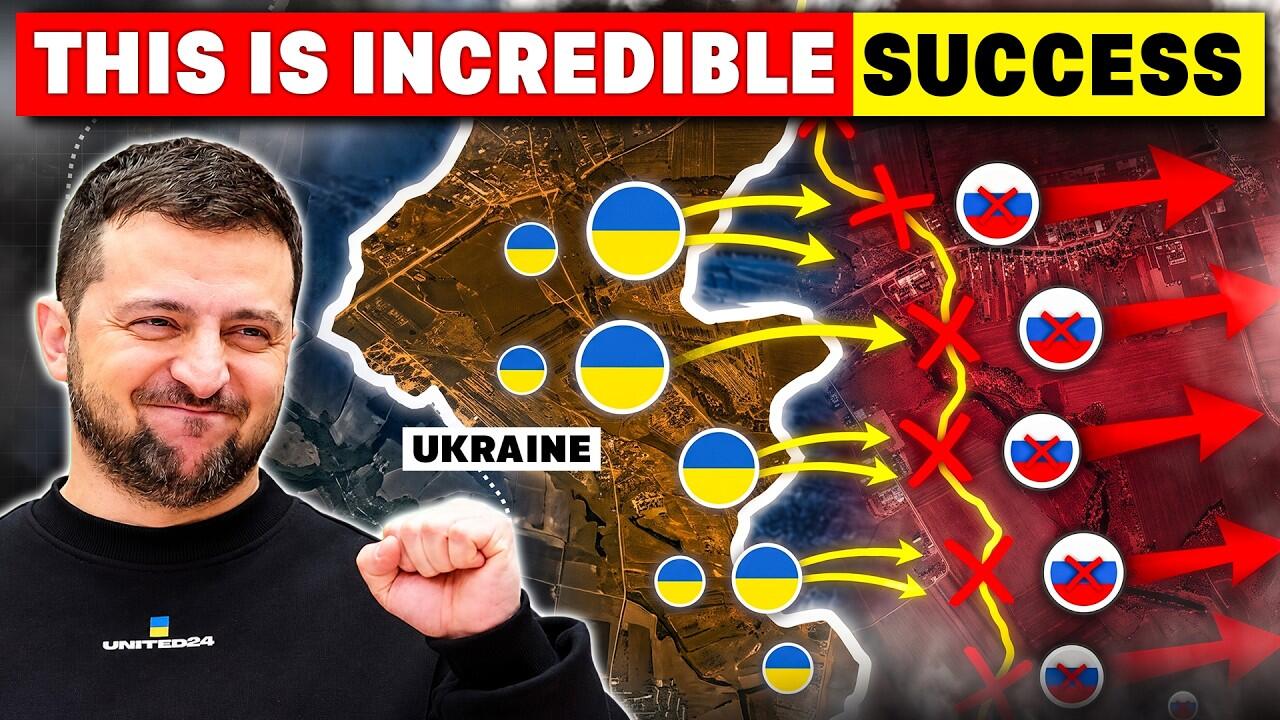
For months, the Kremlin’s battlefield narrative in eastern Ukraine rested on a familiar premise: relentless pressure across Donetsk Oblast would eventually crack Kyiv’s defenses, pry open the Sloviansk–Kramatorsk fortress belt, and hand Moscow control of the entire Donbas. Instead, a series of coordinated Ukrainian counteroffensives across 2026 has reversed ground in key sectors, reclaimed more than 800 square kilometers according to Ukrainian officials, and forced Russian commanders to scramble forces across multiple fronts.
While open-source intelligence (OSINT) trackers and independent analysts urge caution over exact square-kilometer tallies and casualty claims, military observers broadly agree on one point: the fighting in eastern and southern Ukraine is no longer moving exclusively in Moscow’s favor. By pairing electronic warfare, unmanned ground vehicles, strike drones, and reformed assault units, Ukrainian forces have turned once-promising Russian axes into liabilities—even as grinding Russian pressure continues elsewhere along the front.
A Multi-Front Push Backfires Across Donetsk and Dnipropetrovsk
Throughout 2025 and into 2026, Russian forces sought to advance toward Ukraine’s remaining Donbas strongholds while probing toward neighboring Dnipropetrovsk Oblast. In the north, Russian units pushed across the Zherebets River near Lyman, creating a salient designed to support a broader encirclement of Sloviansk. Further south and southwest, Moscow pressed along approaches linking Donetsk with Zaporizhzhia and Dnipropetrovsk, attempting to threaten key Ukrainian supply lines and industrial hubs.
Kyiv answered with localized, sustained counteroffensives rather than a single telegraphed push. On the Oleksandrivka axis—where the administrative borders of Dnipropetrovsk, Donetsk, and Zaporizhzhia meet—Ukrainian forces launched operations aimed at pushing Russian troops away from Dnipropetrovsk’s border and relieving pressure on the southeastern front. Following an August 12, 2026 announcement by President Volodymyr Zelenskyy citing 745 square kilometers retaken and 26 settlements liberated in that push, Ukrainian officials reported by early November that reclaimed ground in the direction had surpassed 800 square kilometers.
Farther north, Ukraine’s 3rd Army Corps, commanded by Brig. Gen. Andrii Biletskyi, executed Operation Vivaldi. Publicly confirmed on September 15 after months of preparation and operational secrecy, the operation targeted the Russian salient near the Zherebets River. By mid-October, the 3rd Army Corps reported clearing 277 square kilometers and liberating 16 settlements, disrupting the northern arm of Moscow’s planned thrust toward Sloviansk.
Additional pressure has surfaced along the Mokri Yaly River around Kamar and farther north toward Borova and Kupiansk. In mid-November, the Institute for the Study of War (ISW) reported that Ukrainian forces had cleared settlements including Peredbudova, Kamar, and Fedorivka, while continuing counterattacks against Russian infiltration routes—including operations targeting an underground pipeline near Kupiansk—under what commentators have linked to Operation Veles.
How the Battlefield Changed: Robots, “Robot Carriers,” and Stealth Infantry
What has drawn the closest scrutiny from defense analysts and military reporters is not just the reclaimed ground, but how Kyiv’s forces moved inside the modern “drone kill zone.” With reconnaissance and first-person-view (FPV) strike drones monitoring open terrain almost continuously, traditional massed armor columns face rapid detection and destruction.
According to battlefield accounts and reporting by outlets including Reuters, The New Voice of Ukraine, and Hromadske, Ukrainian commanders leaned into a layered mix of technology and deception:
-
Blinding and Disruption: Strike drones and precision fires targeted Russian reconnaissance systems, command posts, and rear logistics to degrade situational awareness before assault teams moved.
-
Feints and Deception: Rather than telegraphing a single main thrust, commanders staged coordinated assaults to draw Russian reinforcements toward secondary points before pressing breakthroughs elsewhere.
-
Small-Unit Infiltration: Instead of sending heavy armor straight into heavily observed kill zones, small infantry fire teams moved quietly on foot behind electronic-warfare jammers and Starlink/Starshield-backed communications.
-
Unmanned Ground Vehicles (UGVs): Tracked and wheeled ground robots—some armed with heavy machine guns, automatic grenade launchers, or explosives—were used to strike fortified positions and clear hazards. In one of the more striking tactics described by Ukrainian commanders, heavy bomber drones carried explosive-armed ground vehicles across the line and dropped them behind Russian positions to complete their runs.
Logistics has seen an equally sharp shift. In a November 13 interview with Hromadske, an officer in Ukraine’s 125th Separate Heavy Mechanized Brigade estimated that unmanned ground vehicles handle roughly 80% of the brigade’s frontline supply tasks—hauling ammunition, food, and evacuating wounded personnel. A 60th Mechanized Brigade officer cited by The New Voice of Ukraine offered a similar estimate of around 80% for ground-robot logistics in his unit.
At the same time, Ukrainian officers emphasize that machines do not replace soldiers. As the 125th Brigade officer noted, unmanned systems reduce exposure on dangerous routes, but trained infantry remain essential to clear trenches and hold ground once positions are breached.
Rebuilding Units—And the Limits of Manpower
Technology alone does not explain why specific sectors cracked. In the case of Operation Vivaldi, observers pointed to internal unit reform as a critical ingredient. A year earlier, the 60th Mechanized Brigade had struggled heavily on the Lyman sector amid personnel and discipline challenges, command friction, and drone shortages. After coming under the 3rd Army Corps, the brigade underwent leadership changes, personnel restructuring, tighter training, and closer integration between infantry assault teams and drone operators.
Still, military analysts caution against viewing localized counteroffensives as a cure-all for Ukraine’s structural challenges. Recruitment and rotation remain persistent strains for Kyiv, and building disciplined, well-equipped assault formations takes time. Nor has Russian offensive activity stopped: General Staff updates and ISW assessments in late November show Russian forces continuing attacks across multiple axes—including toward Sloviansk, Kostiantynivka, Pokrovsk, and Huliaipole—and registering net territorial gains in broader OSINT tallies over recent weeks.
Numbers Under the Microscope: Kyiv Claims vs. OSINT and Moscow
In a war saturated with competing figures, exact measurements remain contested. Ukrainian officials have cited 800-plus square kilometers reclaimed across major 2026 operations and reported steep Russian casualty figures—including claims of more than 8,000 Russian troops killed or wounded and hundreds captured in Vivaldi’s reported tally, alongside thousands more cited in the southern counteroffensive. None of those casualty numbers have been independently verified.
Independent mapping projects tell a more conservative, nuanced story. For the Oleksandrivka and northern Huliaipole directions combined, the ISW mapped roughly 627 square kilometers of Ukrainian gains by August, noting that its strict verification criteria likely undercount fluid or infiltrated positions. Meanwhile, broader territorial tracking based on DeepState OSINT data and reported by outlets such as Russia Matters and The Economist in late November shows that Russia still holds roughly 19% of Ukraine overall (including Crimea and pre-2022 Donbas areas) and recorded modest net gains over four-week and 30-day windows through late November—even as Ukrainian counterattacks periodically reversed Russian advances in specific pockets.
What the Community Is Saying: Reddit, X, Discord, and Defense Watchers
Across online communities and military-analysis channels, reactions to Ukraine’s counterattacks reflect sharp divides between euphoria over tactical reversals and skepticism toward headline-grabbing claims:
-
Reddit (
r/ukraine,r/worldnews,r/UkrainianConflict): Users tracking frontline maps celebrated the disruption of Russian salients and the use of unmanned ground vehicles to spare infantry, while more cautious commenters debated the gap between official liberation figures and conservative OSINT map updates, noting that Russia continues to grind forward in other sectors. -
X (formerly Twitter) & Milblogger Circles: Defense OSINT accounts and pro-Kremlin commentators have closely scrutinized footage and geolocations around Kamar, Lyman, and Kupiansk. Even some Russian military bloggers acknowledged Ukrainian pressure and local clearances—such as around Kamar—while arguing that Moscow’s broader artillery, glide-bomb, and manpower reserves remain active.
-
Discord & Gaming/Defense Communities: In tactical and military-simulation Discord servers, discussions have focused heavily on combined-arms adaptation: how jamming bubbles, drone-dropped ground robots, and small-team infiltration alter traditional assault doctrine in a transparent battlefield.
-
Industry & Policy Analysts: Think tanks and defense commentators emphasize two strategic takeaways: first, forcing Russia to shuttle reserves between Lyman, Borova, Kupiansk, and southern sectors strains Moscow’s operational tempo; second, Ukraine’s long-range strike campaign against Russian energy infrastructure and ongoing debates over air-defense interceptors and Western security guarantees shape the wider strategic picture just as much as tactical square kilometers.
Strategic Stakes and Future Outlook
For Vladimir Putin’s government, the Donbas remains central to Moscow’s stated war aims, with Russian officials continuing to demand control over Donbas as a precondition for ceasefire or peace talks, even as diplomatic negotiations and debates over U.S.-proposed security guarantees and Patriot interceptor deliveries remain tangled.
By breaking up the northern salient near Lyman, pushing Russian forces back from approaches toward Dnipropetrovsk, and contesting river lines and supply routes around Kamar and Kupiansk, Kyiv has demonstrated that Russian territorial gains are not irreversible and that Moscow cannot concentrate overwhelming force everywhere at once.
Looking ahead to winter and 2027, the trajectory of the front will likely hinge on a race of adaptation: whether Ukraine can sustain unit reforms, unmanned logistics, and air/drone defense despite manpower and interceptor constraints, and whether Russia can fix command bottlenecks and overcome localized counterblows to regain broader momentum across Donetsk.
Để lại một bình luận